Breaker Blocks
8 min readA Breaker Block is one of the most powerful — and misunderstood — concepts in Smart Money trading. It occurs when a previously bullish Order Block fails, gets swept through, and then flips its function. What was once support becomes resistance. What was once a demand zone becomes supply. This flip happens because the institutional orders that originally created the level have now been fully mitigated or taken out.
Think of it this way: when price initially moves away from an Order Block, institutions have open positions anchored to that level. As long as those positions are running, the OB acts as a support or resistance. But when price returns and breaks through it, those institutional orders have been filled or stopped out. The empty level now behaves in reverse — it attracts price as a magnet in the opposite direction.
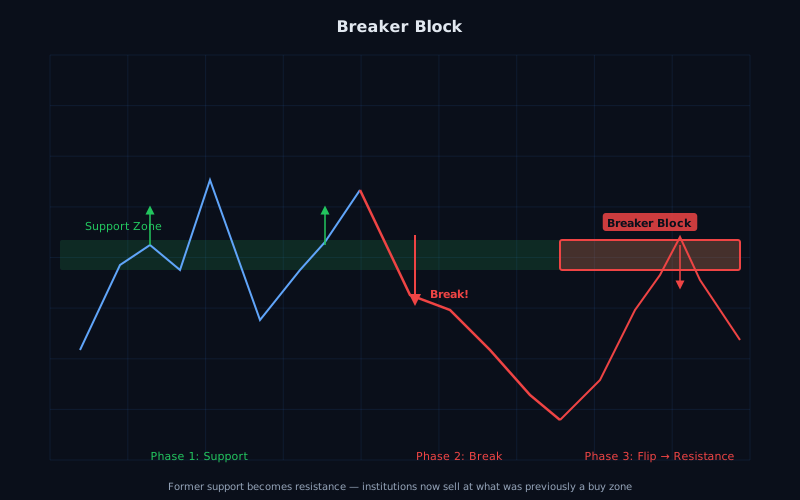
A bullish OB gets swept through, then acts as resistance on the next return — the Breaker Block.
How Breaker Blocks Form
The sequence is predictable once you know what to look for:
- Price is in an uptrend. A Bullish Order Block forms — the last bearish candle before an impulsive push higher.
- Price returns to that OB, appears to find support, but then breaks down through it with a displacement candle.
- That former bullish OB has now become a Bearish Breaker Block.
- Price rallies back up into the breaker zone and finds resistance there.
- Short entry opportunity from the Breaker Block zone.
Key Characteristics of a Valid Breaker Block
- Displacement: The break through the OB must be impulsive — not a slow grind. A proper displacement candle with large body confirms institutional involvement.
- Structure shift: After breaking through the OB, price must create a Break of Structure (BOS) or Change of Character (ChoCH) in the new direction. Without this, the flip is not confirmed.
- Clean return: Price should return to the Breaker zone cleanly, without multiple taps or extended time inside the zone before reacting.
- Timeframe alignment: Breaker Blocks on higher timeframes (4H, Daily) carry significantly more weight than those on lower timeframes.
Breaker Block vs Order Block — The Key Difference
Many traders confuse the two. The critical distinction:
- An Order Block is an untested zone that has not yet been returned to. It is a potential point of interest for price to react from on the first touch.
- A Breaker Block is a former Order Block that has been violated. It has changed polarity. A bullish OB that is broken becomes a bearish Breaker, and vice versa.
Breaker Blocks require a two-step confirmation: first, the original OB must be broken with displacement; second, there must be a structure shift in the new direction. Only then is the polarity flip confirmed and tradeable.
The concept of support becoming resistance is classical technical analysis — but ICT's Breaker Block framework gives it a mechanistic explanation: the change of polarity happens because the institutional orders that created the original zone have been exhausted, and now the opposing side of the market owns that price level.
- Breaker Block = failed Order Block that flips polarity
- Bullish OB broken → Bearish Breaker Block (now resistance)
- Bearish OB broken → Bullish Breaker Block (now support)
- Requires: impulsive break + structure shift to confirm
- Entry: return to Breaker zone after confirmation
- SL: beyond the high/low of the Breaker zone
Quick Quiz
1. What is a Breaker Block?
2. What happens to a bullish Order Block that gets broken with displacement?
3. What must accompany the break through an Order Block to confirm it as a Breaker?
Mitigation Blocks
7 min readA Mitigation Block is a concept built around the idea that institutional traders have unfilled or partially filled orders sitting at specific price levels. When price moves impulsively away from a zone, those institutions may still have open positions they need to close. Price is algorithmically designed to return to those levels to allow that mitigation — hence the name.
The key insight: every impulsive move creates an "open position" for the side that caused it. Smart money does not always get fully filled in one visit to a zone. They may get 80% filled on the initial visit, leave 20% open, and then allow price to return to complete the fill. That return visit is the Mitigation Block event.
How Mitigation Blocks Differ from Breaker Blocks
Both concepts involve price returning to a prior zone, but the mechanism differs:
- Breaker Block: The zone has been broken and flipped polarity. Old support is now resistance. The order type at the level has changed.
- Mitigation Block: The zone has not necessarily been broken. Instead, price is returning to close out open institutional positions. The overall trend direction may remain unchanged after the mitigation.
Trading Mitigation Setups
Mitigation setups are particularly useful in trending markets because they represent a pullback within the trend — price is returning to "clean up" before continuing. The trading approach:
- Identify a strong impulse move with a clear origin zone (the last candle or candles before the impulse).
- Mark the Mitigation Block — the body of the last opposing candle before the impulse, or the FVG left behind by the move.
- Wait for price to return to that zone.
- Look for confirmation: a lower timeframe structure shift, a reaction candle, or an entry FVG forming inside the mitigation zone.
- Enter in the direction of the original impulse — this is trend continuation.
- SL below/above the mitigation zone. TP at the previous swing high/low or the next liquidity target.
Mitigation Blocks are pullback entry tools in trending markets. Price returns to "close out" institutional open positions, then resumes the original trend. They are high-probability precisely because they represent the point where smart money is most active — re-entering to add to or complete positions.
Not every pullback is a Mitigation Block. Require: (1) a clear impulsive origin, (2) the zone is the actual body/origin of the impulse, not a random candle nearby, and (3) lower timeframe confirmation before entry. Entering without confirmation turns a mitigation trade into a guess.
- Mitigation = institutions returning to close remaining open positions
- Breaker = polarity flip | Mitigation = trend continuation pullback
- Mark the last opposing candle body before the impulse move
- Entry: LTF structure shift or FVG forming inside the zone
- Best used in clear trending markets (not consolidation)
Quick Quiz
1. What does a Mitigation Block represent?
2. In what market condition are Mitigation Blocks most effective?
3. What is the key difference between a Breaker Block and a Mitigation Block?
Rejection Blocks & Propulsion Blocks
6 min readBeyond Breakers and Mitigation Blocks, two additional advanced block types provide highly specific entry models: Rejection Blocks and Propulsion Blocks. Understanding these expands your toolkit for identifying institutional zones that the majority of retail traders completely miss.
Rejection Blocks
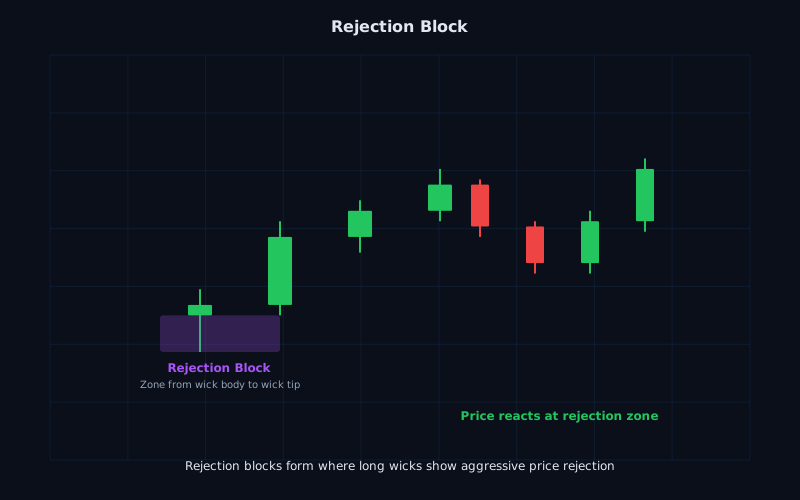
A Rejection Block forms when price creates a series of wicks at a specific level without a strong body close through it. The wicks represent institutional orders consistently rejecting price from that level — like a wall being built with every failed attempt.
The tradeable zone is defined by the bodies of the rejecting candles, not the wick extremes. The logic: institutions are placing orders at the body region, causing the wicks to form as price probes the area and gets pushed back. Entry is taken when price returns to the body zone of the rejection candles.
- Bearish Rejection Block: Multiple wicks probing above a key level, bodies remaining below. Indicates strong supply. Trade the return to the body zone for short entries.
- Bullish Rejection Block: Multiple wicks probing below a key level, bodies remaining above. Indicates strong demand. Trade the return to the body zone for long entries.
Propulsion Blocks
A Propulsion Block forms during a strong trending market. It is identified as the last consolidation or retracement candle(s) before a major continuation move. Price "propels" forward from this zone, and when it returns, the zone acts as a high-probability re-entry point to rejoin the trend.
The Propulsion Block differs from a standard Order Block in that it often appears in the middle of a trend (not at its origin) and signals that the dominant institutional participant is adding to their existing position, not opening a new one. This means the reaction from a Propulsion Block should be sharper and faster than from an initial OB.
Identifying Propulsion Blocks
- Identify a clear trend (sequence of BOS in one direction).
- Look for a brief pause, single-candle or small consolidation, within the trend structure.
- The next candle should be a strong impulse in the trend direction — this makes the prior candle the Propulsion Block.
- Mark the body of the propulsion candle (the pause candle) as the zone.
- Wait for price to return and react from that zone.
Rejection Blocks are defined by repeated wicks at a level — trade the body zone. Propulsion Blocks are mid-trend pause candles before a strong continuation — they represent institutions adding to winning positions. Both are highly specific and actionable when properly identified.
Many professional traders actually prefer Propulsion Blocks to initial Order Blocks in trending markets. The reasoning: Propulsion Blocks represent institutions doubling down on a high-conviction position, which means the subsequent move tends to be faster and more decisive.
Quick Quiz
1. What defines the tradeable zone of a Rejection Block?
2. When does a Propulsion Block form?
3. What does a Propulsion Block signal about institutional activity?
Balanced Price Range (BPR)
8 min readThe Balanced Price Range (BPR) is one of the highest-probability zones in the ICT framework. It forms when a bullish FVG and a bearish FVG overlap at the same price area. The two imbalances — one pointing up, one pointing down — effectively cancel each other out at the overlap, creating a zone of perfect equilibrium that price is algorithmically drawn back to.
The concept behind BPR: markets strive for balance. An unfilled bullish FVG represents unsatisfied buying. An unfilled bearish FVG represents unsatisfied selling. When both exist at the same price, the market has a very strong magnetic pull to that region because both sides have unfinished business there.
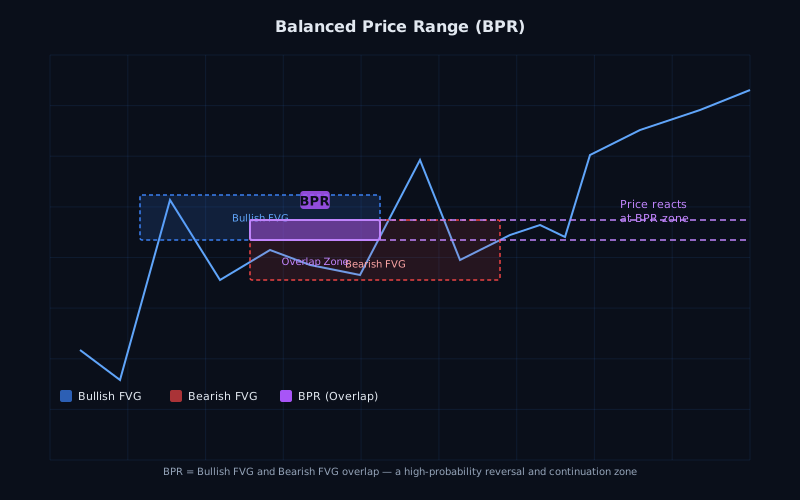
A BPR forms where a bullish FVG and bearish FVG overlap — the ultimate equilibrium zone.
Identifying a Balanced Price Range
- Mark all significant FVGs on your chosen timeframe (15M, 1H, or 4H for most setups).
- Look for a bullish FVG (created by three upward candles, gap between candle 1 high and candle 3 low).
- Look for a bearish FVG nearby (created by three downward candles, gap between candle 1 low and candle 3 high).
- If these two FVGs overlap — even partially — the overlap zone is the BPR.
- The BPR is most potent when it aligns with a key structural level (HTF OB, previous high/low, NWOG/NDOG).
Trading BPR Setups
The BPR acts as a gravitational centre. Trading approaches:
- As a target: When price has swept a liquidity pool and you expect a reversal, use the nearest BPR as your take profit zone — price is likely to stall or reverse there.
- As an entry: When price reaches a BPR that aligns with your bias (e.g., bullish BPR in a premium discount zone within a bullish structure), look for LTF confirmation to enter long.
- As an invalidation: A full close through a BPR (not just a wick) significantly weakens its relevance for future reactions.
A BPR is where two opposing FVGs overlap. It is the most balanced point in recent price action — both buy-side and sell-side imbalances exist there. Price is magnetically drawn to it, making BPRs excellent targets and high-probability entry zones when aligned with HTF structure.
- BPR = overlapping bullish FVG + bearish FVG
- The overlap zone is the highest-probability level within the BPR
- Use as: (1) target, (2) entry zone, (3) invalidation level
- Strongest when aligned with HTF OBs or NDOG/NWOG
- Full body close through BPR = invalidation
Quick Quiz
1. What creates a Balanced Price Range?
2. Why is a BPR considered a "gravitational" level?
3. When is a BPR invalidated?
Volume Imbalance & Opening Gaps
7 min readTwo additional imbalance types extend the FVG framework: Volume Imbalances and Opening Gaps. Both represent areas where price has moved without proper two-sided trading, creating zones the algorithm will return to for balance. ICT uses two specific gap types — NDOG and NWOG — as key reference points every single trading day and week.
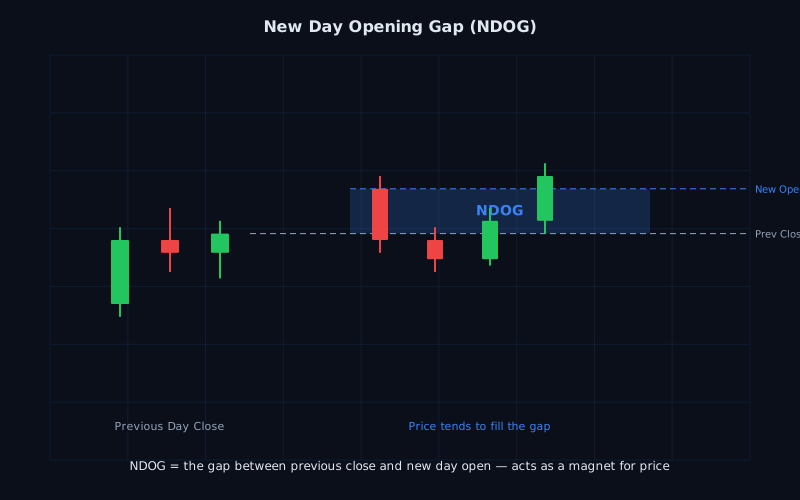
New Day Opening Gap (NDOG)
The NDOG is the gap between the closing price of the previous trading day and the opening price of the new trading day. In forex, where the market trades nearly continuously, the NDOG forms between the Friday close and Sunday open (the weekend gap). In US equities and indices, it forms at the 9:30 AM EST open every day.
Why it matters: the opening price is an extremely significant reference point in ICT's framework. It represents the last agreed-upon value from the prior session. If price opens significantly above or below the close, that gap is an imbalance — and gaps tend to fill. Trading setups:
- Price opens above the previous close → potential for a sell-off back into the NDOG range
- Price opens below the previous close → potential for a rally back into the NDOG range
- The midpoint of the NDOG (50% level) is particularly magnetic
New Week Opening Gap (NWOG)
The NWOG functions identically to the NDOG but on a weekly timeframe. It is the gap between the Friday close and the Sunday/Monday open. NWOGs are higher timeframe reference points and carry more weight than daily gaps. Institutional algorithms reference the opening price of the week throughout the entire trading week, often returning to the NWOG midpoint before making a major directional move.
Volume Imbalance
A Volume Imbalance forms when two consecutive candles have overlapping wicks but a gap between their bodies. Unlike a classic FVG (which requires three candles), a Volume Imbalance is a two-candle pattern. The gap between the close of candle 1 and the open of candle 2 (in a bullish move, candle 2 opens higher than candle 1 closes) represents an area of one-sided trading.
Volume Imbalances are generally weaker than FVGs because they represent a shorter duration of imbalance, but they still act as magnets for price. They are most useful when stacked with other confluence (FVG + Volume Imbalance at the same price = stronger zone).
Mark your NDOG and NWOG at the start of every trading session. These opening gaps are reference points the algorithm returns to with remarkable regularity. The midpoint (50%) of each gap is the most magnetic level. NWOG > NDOG in terms of timeframe weight.
Studies of major index futures (ES, NQ) show that the weekly opening gap (NWOG) is filled — or at minimum, price trades to the midpoint — in over 70% of trading weeks. This regularity is why ICT places such heavy emphasis on marking opening gaps as part of the daily trading routine.
Quick Quiz
1. What is an NDOG?
2. Which carries more weight — NDOG or NWOG?
3. How does a Volume Imbalance differ from a classic FVG?
Advanced Imbalance Trading
8 min readWith a solid foundation in FVGs, BPRs, and opening gaps, you can now combine these concepts into a more refined and nuanced approach to imbalance trading. Advanced imbalance techniques focus on specificity — not just "there is a FVG here," but "this specific part of the FVG, under these specific conditions, is the highest-probability entry point."
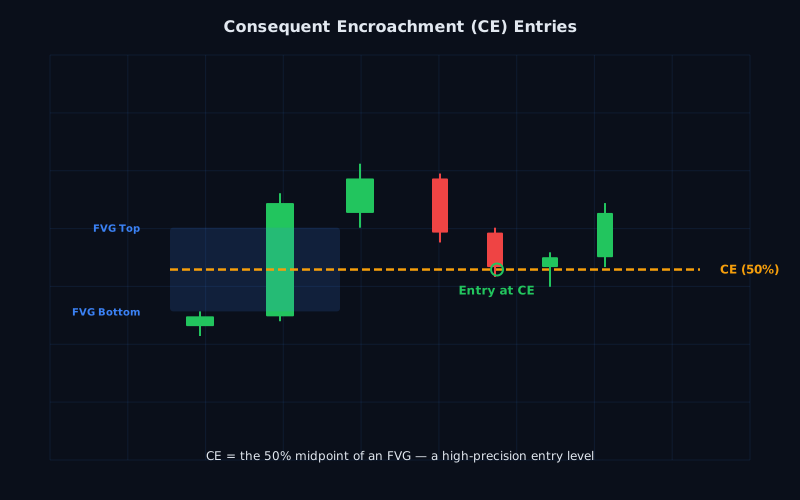
Consequent Encroachment (CE) Entries
The Consequent Encroachment level is the 50% midpoint of any FVG. Rather than entering at the bottom of a bullish FVG (which may never fully fill) or hoping for a full gap fill, the CE provides a precise, mechanical entry level with excellent risk-to-reward.
Why the 50%? It aligns with the broader principle of equilibrium — the exact midpoint of any imbalance represents the point of maximum balance between the two sides. Institutional algorithms are known to target CE levels before reversing. Trading approach:
- Identify a valid FVG with structural confluence
- Set a limit order or wait for price to reach the CE (50% of the FVG)
- Confirm with an LTF reaction at or near the CE
- Entry at CE, SL below/above the full FVG, TP at the structural target
The 1st Presented FVG
In any given move or swing, multiple FVGs will form. The 1st Presented FVG is the very first FVG that appears after a liquidity sweep and structure shift — the first opportunity for price to retrace and offer an entry. This FVG is prioritised above all subsequent FVGs because:
- It is closest to the liquidity event (the sweep), meaning institutional entry is most fresh there
- Subsequent FVGs are more likely to be "used up" or represent lower-quality entries
- If price bypasses the 1st FVG entirely and fills to a deeper FVG, re-evaluate the setup — the imbalance was stronger than expected
Stacked FVGs
When two or more FVGs exist at nearly the same price level, they form a Stacked FVG zone. This dramatically increases the strength of the imbalance because multiple rounds of one-sided institutional activity have occurred in the same region. Stacked FVGs are treated similarly to a BPR in terms of priority — they are high-probability zones for entries and reactions.
Filled vs Unfilled FVGs
Track whether your FVGs have been filled (price has traded back through them) or are still unfilled (price has not returned). Key rules:
- Unfilled FVG: Active magnet — price will likely return to it at some point. The longer it remains unfilled, the more relevant it becomes.
- Partially filled FVG: Still relevant up to the CE (50%). Once CE is filled, the remaining gap is weaker.
- Fully filled FVG: Remove from your chart. It no longer provides trading value — the imbalance has been resolved.
Advanced imbalance trading is about precision: use the CE (50%) as your entry level, prioritise the 1st presented FVG after a sweep, watch for stacked FVGs as ultra-high-probability zones, and clean up your chart by removing fully filled gaps. This keeps your analysis clean and actionable.
- CE = 50% midpoint of an FVG — highest probability entry within the gap
- 1st Presented FVG = the first FVG after a sweep + structure shift = priority entry
- Stacked FVGs = multiple FVGs at same level = treat like a BPR
- Remove fully filled FVGs from your chart to stay clean
- FVGs filled to CE = partially valid; fully filled = invalid
Quick Quiz
1. What is the Consequent Encroachment (CE) level of an FVG?
2. Why is the "1st Presented FVG" after a sweep prioritised over later FVGs?
3. When should you remove an FVG from your chart?
The 2022 ICT Model
10 min readThe 2022 ICT Model is the most complete and systematic trading framework taught by ICT (Inner Circle Trader). It is a rules-based, step-by-step model that integrates liquidity sweeps, market structure shifts, and Fair Value Gap entries into a single cohesive process. When you follow each step without skipping, the model provides clear entry, stop, and target criteria on virtually any liquid pair or instrument.
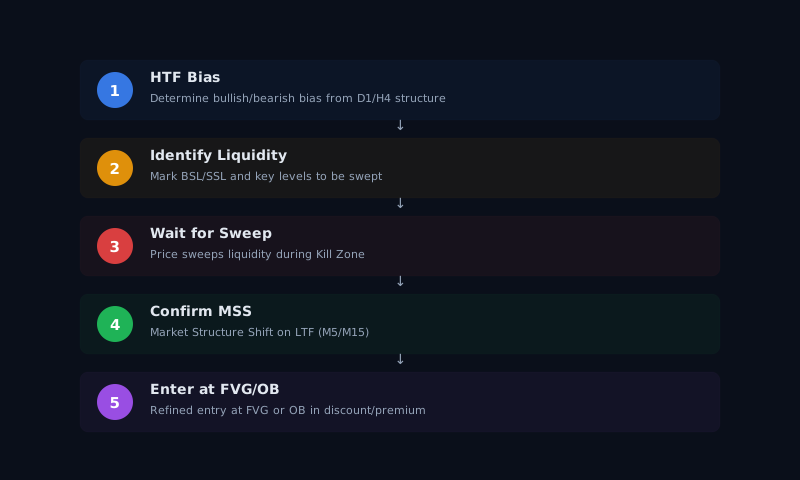
The Full 2022 ICT Model — Step by Step
Begin on the 4H or Daily chart. Identify the higher timeframe trend using Break of Structure (BOS). Determine whether you are in a bullish or bearish structure. Your trades should align with HTF bias — don't fight the higher timeframe.
Locate the nearest significant liquidity pool in the direction of your bias. For a bullish bias: find Buy Side Liquidity (BSL) above — equal highs, previous swing highs. For bearish: find Sell Side Liquidity (SSL) below — equal lows, previous swing lows. This is your trade target.
Before price moves toward your target, it will first sweep the opposite liquidity. Bullish bias: price sweeps SSL (lows) before running to BSL (highs). This sweep is the manipulation phase — smart money hunts retail stop losses to fuel the real move.
After the sweep, wait for a Market Structure Shift or Change of Character on a lower timeframe (15M or 5M). A candle must break and close above (bullish) or below (bearish) a recent swing — confirming the reversal has begun. Do not enter without this confirmation.
The MSS displacement candle typically creates a Fair Value Gap. This is the 1st Presented FVG — your primary entry zone. Wait for price to retrace into this FVG (ideally to the CE at 50%). This is the premium entry point.
Enter at the FVG (CE preferred, or at the FVG boundary for tighter entries). Place stop loss below the swept low (bullish) or above the swept high (bearish) — beyond the actual liquidity sweep point. This gives the trade room to breathe while keeping risk defined.
Your take profit is the liquidity pool identified in Step 2 — the BSL (equal highs) for bullish trades, the SSL (equal lows) for bearish trades. This gives you a built-in 1:3 to 1:5+ risk-to-reward ratio when the setup is clean.
When to Use This Model
The 2022 ICT Model works best during the high-liquidity kill zones: London Open (2:00–5:00 AM EST) and New York AM (7:00–10:00 AM EST). It is most effective on liquid pairs: GBP/USD, EUR/USD, NAS100, US30, XAU/USD. Avoid using it during low-liquidity Asian consolidation or the New York PM session.
The 2022 Model is: HTF bias → identify liquidity target → wait for opposing sweep → confirm MSS → enter on 1st FVG → SL beyond sweep → TP at liquidity pool. Every step is mechanical. Skipping any step reduces the setup quality from A-grade to speculative.
The most common mistake is entering at Step 3 (the sweep) instead of waiting for Step 4 (the MSS). A sweep alone is not a trade signal. Price can sweep a level and continue in the same direction. Always require the structure shift confirmation before committing capital.
Quick Quiz
1. In the 2022 ICT Model, what must happen AFTER the liquidity sweep before you enter?
2. Where is the stop loss placed in the 2022 ICT Model?
3. What is the take profit target in the 2022 ICT Model?
ICT Silver Bullet
9 min readThe ICT Silver Bullet is one of ICT's most widely used time-specific trading models. It is built on the premise that institutional algorithms deliver price in predictable patterns during three specific 60-minute windows each trading day. During these windows, a high-probability setup — liquidity sweep followed by FVG entry — occurs with remarkable consistency.
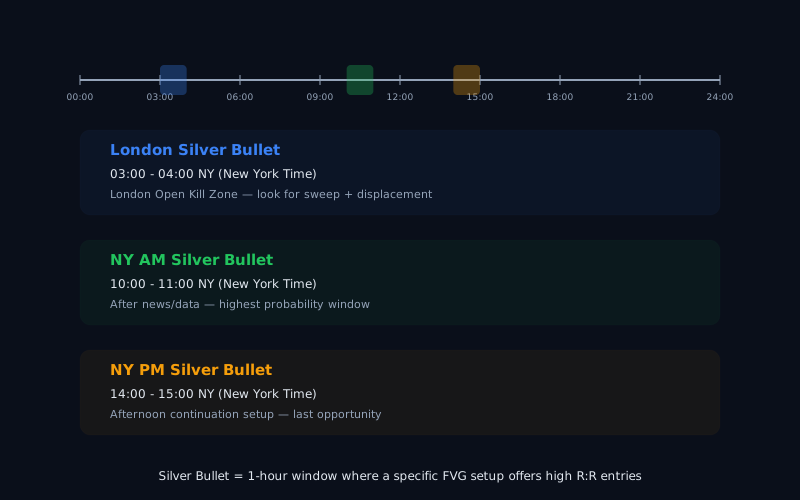
The Three Silver Bullet Windows
All times are New York time (EST):
| Window | Time (NY/EST) | Session | Characteristics |
|---|---|---|---|
| Silver Bullet 1 | 3:00 AM – 4:00 AM | Early London | Less popular; targets overnight Asia lows/highs; lower volatility |
| Silver Bullet 2 | 10:00 AM – 11:00 AM | NY AM | Most popular and reliable; post-London-open continuation or reversal |
| Silver Bullet 3 | 2:00 PM – 3:00 PM | NY PM / London Close | End-of-day move; often reverses or extends NY morning trend |
How to Trade the Silver Bullet
The model is deliberately simple. During any Silver Bullet window:
- Mark your bias: Determine whether you are bullish or bearish using HTF structure (4H/Daily).
- Wait for a liquidity sweep: Within the window, price should take out a recent high (if bearish) or low (if bullish) — sweeping the stop-loss orders of traders positioned the wrong way.
- Identify the FVG: The candle that creates the reversal after the sweep will leave an FVG. This is your entry zone.
- Enter at the FVG: Place your entry at the FVG (CE preferred). Set stop loss beyond the sweep. Target a clean structural level — equal highs/lows, previous session high/low, or HTF liquidity pool.
- Time exits: The Silver Bullet setup must be entered and managed within the window. Positions not triggered within the window are cancelled.
Silver Bullet Rules and Invalidation
- Only one trade per window: If you miss the first FVG, do not chase the second or third opportunity in the same window. One A-grade entry per window.
- Bias alignment is mandatory: Do not take a bullish Silver Bullet if the 4H structure is bearish. The model must align with HTF direction.
- Window expiry: If price does not sweep a clear liquidity level during the window, there is no Silver Bullet setup. Skip and wait for the next window.
- The 10:00–11:00 AM window (SB2) is the highest probability because it coincides with the post-London consolidation and the beginning of the NY institutional program.
The Silver Bullet is elegant in its simplicity: HTF bias + time window + liquidity sweep + FVG entry. Mastering just one Silver Bullet window (most traders choose the 10:00–11:00 AM NY window) can be sufficient for a full trading strategy. Volume over complexity is never the goal.
ICT has stated in multiple mentorships that the Silver Bullet was designed as a "beginner's entry" into time-based trading — yet it is used by many experienced traders as their primary model because of its mechanical clarity. Simple does not mean weak; it means repeatable.
Quick Quiz
1. How many Silver Bullet windows are there per trading day?
2. Which Silver Bullet window is considered the most reliable?
3. If no clear liquidity sweep occurs during a Silver Bullet window, what should you do?
ICT Venom Model
7 min readThe ICT Venom Model is a variation of the classic "Turtle Soup" setup, adapted within the ICT framework. It targets short-term liquidity grabs at recent swing highs and lows — specifically the kind of stop-hunt that catches breakout traders and trend-followers off guard. The "venom" metaphor refers to the quick, decisive nature of the reversal that follows the trap.
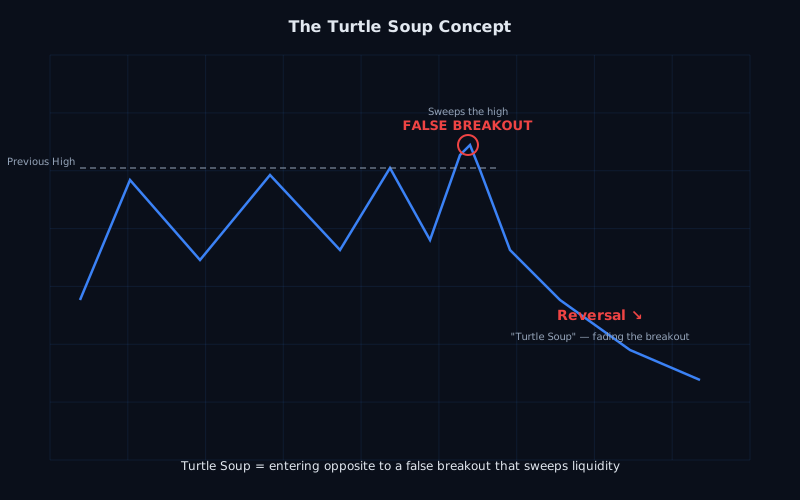
The Turtle Soup Concept
The original Turtle Soup (from Linda Raschke and Larry Connors) was a counter-trend setup: when price briefly breaks a 20-day high or low and immediately reverses. ICT refined this idea using his structural framework:
- Retail breakout traders buy new highs / sell new lows — providing liquidity
- Smart money uses those orders to exit their existing positions or enter in the opposite direction
- The "false breakout" is not random — it is engineered to fill institutional orders
Venom Model Mechanics
- Identify a recent swing high or low that has been clearly defined — one that retail traders will be watching as a breakout level.
- Wait for a brief break above/below that level — this is the liquidity grab. The key word is "brief": price sweeps the level but does not sustain movement beyond it.
- Look for a strong reversal candle: A large-bodied bearish candle (for a false upside break) or bullish candle (for a false downside break) closing back within the prior range.
- Confirm with FVG or MSS: The reversal candle should leave an FVG or create a structure shift on the 1M–5M chart.
- Enter the reversal: Short entry below the reversal candle's open (bearish Venom) or long above the reversal candle's open (bullish Venom). SL above/below the sweep extreme. TP at the opposing swing low/high or liquidity pool.
Entry/Exit Criteria Summary
- Entry trigger: Reversal candle close back within range after sweep, confirmed by FVG or MSS on LTF
- Stop loss: 3–5 pips/ticks beyond the sweep extreme (the false break point)
- Take profit: The opposing swing point that was established before the false break occurred
- Risk-to-reward: Typically 1:3 or better because the SL is very tight (just beyond the sweep) and the TP is the full opposing swing
- Best timeframes to execute: 1M–5M for entry; 15M–1H for structure identification
The Venom Model exploits the engineered false breakout. Breakout traders get caught; their stops provide the liquidity for smart money's reversal trade. Very tight stop placement (just beyond the sweep extreme) gives excellent RR ratios. The reversal candle and LTF confirmation are non-negotiable entry requirements.
Not every swing break is a Venom setup. Require: (1) a clean, widely-observed swing level, (2) a brief false break — not a sustained move, (3) an immediate reversal candle with body close back inside range, (4) LTF confirmation. Without all four elements, the setup is speculative.
Quick Quiz
1. What is the core concept behind the ICT Venom Model?
2. Where is the stop loss placed in a Venom setup?
3. Which component of the Venom Model is NON-NEGOTIABLE for entry?
Choosing Your Model
7 min readYou now have three complete ICT trading models in your toolkit: the 2022 Model, the Silver Bullet, and the Venom Model. A critical mistake made by developing traders is treating all three as equally valid choices to deploy on any given day. In reality, model selection is a skill in itself — and mastering one model deeply will produce better results than dabbling in all three.
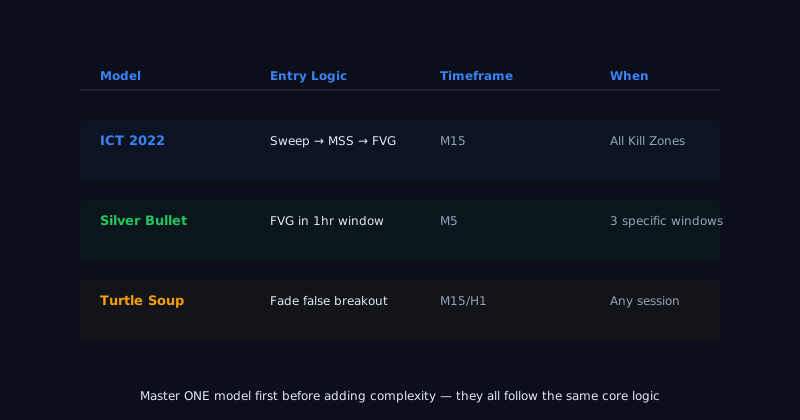
Model Comparison
| Model | Best For | Time Required | Complexity |
|---|---|---|---|
| 2022 ICT Model | Full session traders; those who can watch markets for 1–2 hours | 1–2 hrs per session | High — many steps |
| Silver Bullet | Part-time traders; specific window focus; beginners to advanced | 1 hr per window | Low — simple, mechanical |
| Venom Model | Experienced traders; counter-trend specialists | Variable | Medium — requires experience to identify |
How to Pick the Right Model for Your Lifestyle
- 9–5 job, can check charts on lunch break? → Silver Bullet (10:00–11:00 AM window). One focused hour produces one clean trade.
- Full-time trader, can sit through a full session? → 2022 ICT Model during London or NY AM kill zones.
- Experienced, comfortable with counter-trend? → Incorporate Venom setups alongside your primary model.
- Complete beginner to live markets? → Start with Silver Bullet only. One model, one window, paper trade for 3 months minimum.
One Model Mastered Beats Five Learned Poorly
This cannot be overstated. A trader who knows every ICT concept but has no defined model will always underperform a trader who knows only the Silver Bullet but can execute it flawlessly. Model mastery comes from:
- Commitment: Choose one model and commit to it for a minimum of 3 months. No switching.
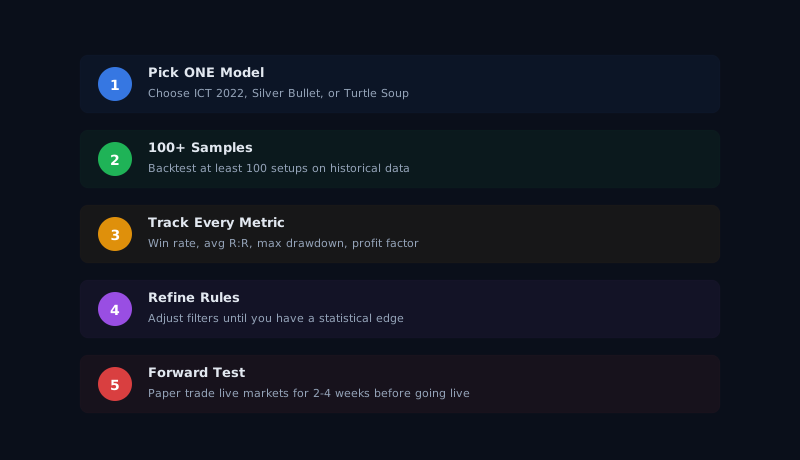
- Backtesting: Review 100+ historical examples of your chosen model across multiple pairs.
- Forward testing: Paper trade the model in real time for 60+ sessions before going live.
- Journaling: Record every triggered setup — whether you took it or not. Learn from the misses as much as the hits.
- Refinement: After 3 months, identify your model's edge cases — when it works best, which session, which pairs.
Choose your model based on your lifestyle, screen time, and personality. Then commit to it for at least 3 months. Mastery is built through repetition, not variety. The trader who trades one model 500 times will dramatically outperform the trader who tries 10 models 50 times each.
Quick Quiz
1. Which ICT model is best suited for a trader who can only watch markets for 1 hour during the trading day?
2. How long should you commit to one model before switching?
3. For a complete beginner going live for the first time, which approach is recommended?
What is SMT Divergence?
8 min readSmart Money Technique (SMT) Divergence is one of the most powerful confirmation tools in the ICT framework. It occurs when two positively correlated instruments (assets that usually move together) diverge at a key price level — one makes a new high/low while the other fails to confirm. This non-confirmation is a powerful signal that the apparent breakout is false and a reversal is imminent.
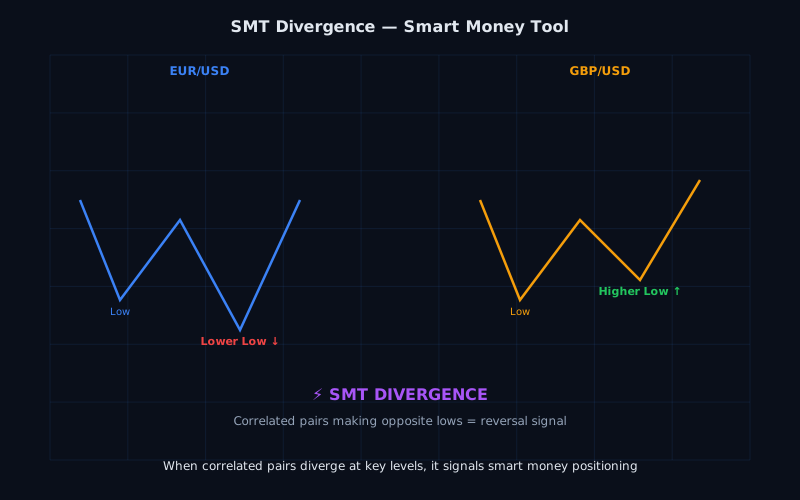
The underlying logic: if two instruments are tightly correlated and always move together, then a point where they diverge represents an anomaly. That anomaly is typically caused by institutional manipulation — one instrument is being used to create a false impression of strength or weakness while the other reveals the true order flow.
Classic SMT Pairs and Correlations
| Instrument A | Instrument B | Correlation Type |
|---|---|---|
| EUR/USD | GBP/USD | Positive — both are USD base pairs, move together most of the time |
| NAS100 (NQ) | SPX500 (ES) | Positive — both US equity indices |
| NAS100 | US30 (Dow Jones) | Positive — all three major US indices |
| EUR/USD | DXY (USD Index) | Negative — DXY rises when EUR/USD falls |
| XAU/USD | DXY | Negative — Gold often moves inversely to the dollar |
Identifying SMT Divergence
SMT Divergence at swing highs (bearish signal):
- EUR/USD makes a new swing high (creating a higher high).
- GBP/USD simultaneously fails to make a new swing high — it makes a lower high.
- This divergence suggests the EUR/USD high is a fake-out — it will likely reverse.
- Combine with: a bearish FVG at the EUR/USD high, a liquidity sweep of the high, LTF structure shift.
SMT Divergence at swing lows (bullish signal): the reverse — one instrument makes a new low while the correlated pair makes a higher low.
DXY and USD Pairs
The US Dollar Index (DXY) is the master reference for all USD-denominated pairs. Understanding DXY provides a top-down perspective that cannot be obtained from a single pair alone. Key rules:
- DXY making new highs while EUR/USD makes new lows = alignment (no divergence)
- DXY making new highs while EUR/USD also makes highs (or fails to make new lows) = SMT divergence = potential dollar reversal
- Always check DXY structure when trading major USD pairs
SMT Divergence is a non-confirmation signal. When two correlated instruments diverge at a key level, the breakout in one is likely a manipulation — a false move engineered to trap breakout traders. The divergence confirms a reversal trade setup when combined with a liquidity sweep and structural confirmation.
Quick Quiz
1. What is SMT Divergence?
2. EUR/USD makes a new swing high but GBP/USD makes a lower high. What does this suggest?
3. What type of correlation exists between DXY and EUR/USD?
Using SMT for Confirmation
7 min readSMT Divergence on its own is an observation — not a trade signal. Its power is unlocked when used as a confirmation layer on top of an existing setup. When your primary setup (liquidity sweep + FVG + structure shift) aligns with an SMT divergence signal on a correlated instrument, the trade conviction increases dramatically.
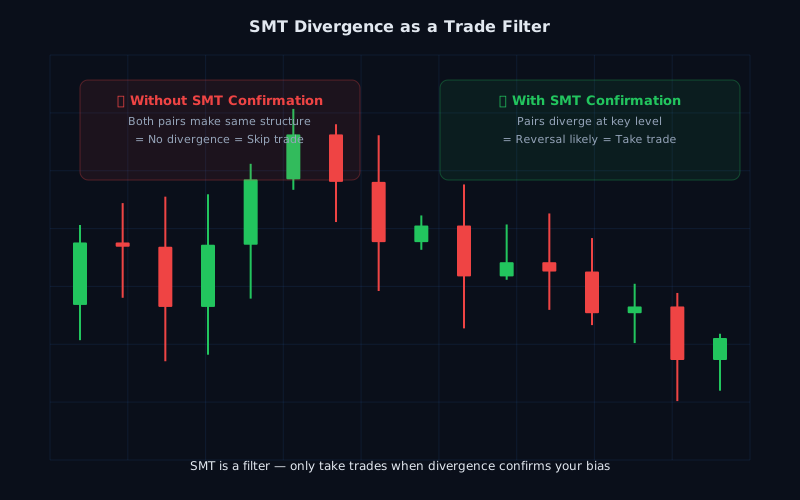
SMT as a Filter
Use SMT to filter out setups where price action alone is ambiguous. Scenario: price sweeps a swing low and creates an FVG — but is this a real reversal or will it continue lower? Check the correlated instrument. If the correlated pair has NOT made a new swing low (or has made a higher low), the divergence confirms the sweep is a manipulation and the reversal has higher probability.
Setting Up Correlation Charts
Practical setup for SMT analysis:
- Open split-screen charts: Display your primary pair alongside its correlated instrument at the same timeframe and same chart window.
- Align the time axis: Ensure both charts show identical time periods — you need to compare swing points at the exact same moment in time.
- Mark swing highs and lows on both: Use horizontal lines or markup tools to compare where each instrument made its swing points.
- Look for non-confirmation: At a key potential reversal level, does the correlated instrument confirm the swing? If not, SMT divergence is present.
Which Pairs to Compare
- Trading EUR/USD? → Compare with GBP/USD. Both are euro-zone and UK pairs strongly influenced by USD flows.
- Trading NAS100? → Compare with SPX500 or US30. All three US indices should move in tandem at swing points.
- Trading GBP/USD or EUR/USD? → Also check DXY for macro confirmation.
- Trading XAU/USD? → Compare DXY direction. A DXY failing to make new highs while USD pairs make new highs = potential gold reversal setup.
SMT is a confirmation tool, not a standalone entry signal. A primary setup (sweep + FVG + MSS) with SMT confirmation = highest-probability trade. A primary setup without SMT confirmation = still tradeable but lower conviction. SMT confirmation alone without a primary setup = no trade.
Quick Quiz
1. How should SMT Divergence be used in trading?
2. If you are trading EUR/USD, which instrument provides the best SMT comparison?
Multi-Asset Analysis
8 min readProfessional traders don't look at a single chart in isolation. They maintain a multi-asset view of the market — monitoring how different instruments relate to each other to build a comprehensive picture of institutional order flow. This section covers the key inter-market relationships and how to build a practical multi-screen setup.

DXY and USD-Denominated Pairs
The US Dollar Index (DXY) measures the dollar's value against a basket of currencies (EUR, JPY, GBP, CAD, SEK, CHF). Since most actively traded pairs are USD-denominated, DXY movements ripple through the entire forex market:
- DXY bullish (rising): Expect USD pairs to follow — EUR/USD down, GBP/USD down, AUD/USD down. Also watch for Gold (XAU/USD) weakness.
- DXY bearish (falling): Expect USD pairs to strengthen against the dollar — EUR/USD up, GBP/USD up. Gold often rallies.
- DXY at a key level: If DXY is at an HTF OB or FVG, expect significant reactions across all USD pairs simultaneously.
Equity Index Correlations
The three major US equity indices — NAS100 (Nasdaq), SPX500 (S&P 500), and US30 (Dow Jones) — are highly correlated in normal market conditions. Advanced traders use this to spot SMT divergences and also to gauge overall "risk sentiment":
- All three making new highs together = confirmed bullish momentum; avoid counter-trend shorts
- One diverging while two confirm = SMT signal; the diverging index is weakening or was manipulated
- All three selling off = genuine risk-off event; USD typically strengthens (safe haven flows)
Gold as a Hedge Indicator
Gold (XAU/USD) has a well-established role as a safe-haven and inflation hedge. Key relationships for traders:
- Gold typically rises when: USD weakens, equity markets sell off sharply (fear-driven), inflation expectations rise
- Gold is often used for SMT analysis against DXY — if DXY makes new highs but Gold holds its level (doesn't make new lows), expect a DXY reversal
- Gold's liquidity and volatility make it ideal for Silver Bullet and 2022 Model setups — it moves cleanly and respects ICT concepts reliably
Building a Multi-Screen Setup
Recommended professional setup:
- Screen 1: Your primary trading pair (1M–15M for entries)
- Screen 2: Correlated pair for SMT (same timeframe)
- Screen 3: DXY on 4H or Daily for macro context
- Screen 4: HTF view of primary pair (4H or Daily) for structural context
Even with a single monitor, you can achieve this with split-screen or tabbed chart layouts. The key is having macro context visible before making micro-timeframe entry decisions.
- Always check DXY before trading major USD pairs
- NAS100, SPX500, US30 should all move in sync — divergence = SMT signal
- Gold diverging from DXY = potential dollar reversal incoming
- Multi-screen setup: primary pair | correlated pair | DXY | HTF view
- Risk-on = equities up, USD mixed, Gold neutral | Risk-off = equities down, USD up, Gold up
Quick Quiz
1. When DXY is rising, what generally happens to EUR/USD?
2. What does it signal when all three US equity indices (NAS, SPX, DJI) are all selling off simultaneously?
Displacement & Dealing Ranges
8 min readDisplacement is the engine that drives high-probability setups in the ICT framework. A displacement is a rapid, impulsive price move — characterised by large-bodied candles, minimal wicks, and a clear directional intent — that leaves behind imbalances (FVGs) and represents genuine institutional order flow entering the market.
Not every big candle is a displacement. The key characteristics:
- Large body relative to recent candles: The displacement candle should be noticeably larger than the surrounding price action.
- Small or absent wicks: A true displacement has conviction — little to no retracement within the candle itself.
- FVG left behind: Almost every genuine displacement creates a Fair Value Gap between the previous candle's wick and the new candle's body.
- Sequence change: Displacement should break a recent swing point (BOS or MSS), confirming that the move is structural — not just noise.
Dealing Ranges
A Dealing Range is the range defined by the highest high and lowest low of a clearly identifiable consolidation or swing phase. It is the "dealing" area where price oscillates before making a directional move. Every swing — whether in a trend or consolidation — creates a dealing range.
The dealing range concept provides a framework for understanding where price is likely to go within the current structure:
- Premium zone (above 50%): Institutions sell in the premium — price is expensive relative to the range. Look for short setups here.
- Equilibrium (50%): The midpoint of the range. Price passing through this level confirms directional intent.
- Discount zone (below 50%): Institutions buy in the discount — price is cheap relative to the range. Look for long setups here.
Trading Within Dealing Ranges
- Identify the dealing range: the most recent clear swing high and swing low.
- Calculate the 50% midpoint (equilibrium).
- If you are bullish: look for long setups only in the discount zone (below 50%).
- If you are bearish: look for short setups only in the premium zone (above 50%).
- Target the opposite extreme of the dealing range as your TP.
Displacement confirms institutional participation — it is the evidence that smart money has entered. Dealing ranges define the context: buy in discount, sell in premium, target the opposite extreme. Together they answer two critical questions: "Is this move real?" and "Am I entering at a logical price?"
Quick Quiz
1. Which of the following is NOT a characteristic of genuine displacement?
2. In a dealing range, where should you look for long (buy) setups?
IRL & ERL
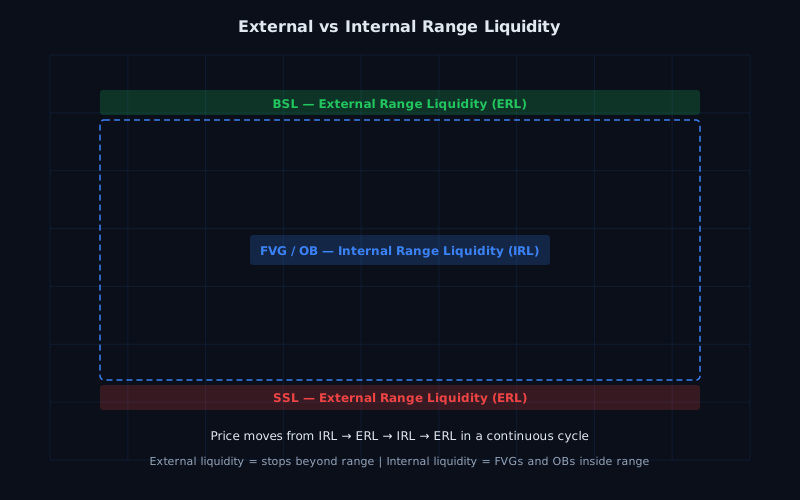
7 min readInternal Range Liquidity (IRL) and External Range Liquidity (ERL) are two complementary concepts that describe where price is likely to go next based on the current dealing range. Understanding IRL and ERL answers one of the most important questions a trader faces: "Where is price going?"
Internal Range Liquidity (IRL)
IRL refers to liquidity that exists within the current dealing range. These are levels that price will typically target before making a full move to the range extremes. Examples of IRL:
- Open FVGs within the range (price will often fill them on the way to the extreme)
- The 50% equilibrium level of the range
- Minor swing highs and lows within the current dealing range
- NDOG/NWOG gaps within the range
IRL acts as "speed bumps" — partial targets that price pauses at or passes through before reaching the final ERL target. When trading, you can use IRL as partial take profit levels or as decision points to move stop loss to break-even.
External Range Liquidity (ERL)
ERL refers to liquidity that exists outside the current dealing range — beyond the swing highs and swing lows that define it. This is the ultimate target of any directional move. Examples of ERL:
- Previous swing highs (Buy Side Liquidity — BSL) above the range
- Previous swing lows (Sell Side Liquidity — SSL) below the range
- Equal highs or equal lows beyond the current structure
- HTF liquidity pools (the daily or weekly swing points)
How Price Oscillates Between IRL and ERL
The model predicts this cycle: price sweeps ERL (external liquidity) → reverses → targets IRL (internal liquidity) → reverses → targets the opposing ERL. This oscillation is how markets deliver price at every timeframe, from the 1-minute chart to the monthly chart.
Practical application:
- After sweeping an ERL (swing high/low), expect IRL to be the next stop — partial TP here.
- After filling IRL (an FVG, the 50% level), expect ERL to be the next target — final TP here.
- Your entry should always be positioned to benefit from the IRL-to-ERL or ERL-to-IRL move.
IRL = targets within the range (FVGs, 50%, internal swing points). ERL = targets beyond the range (swing highs/lows, equal highs/lows). Price oscillates between them. Know whether you are targeting IRL or ERL and size your position and target accordingly. ERL targets give larger RR; IRL targets give higher probability.
Quick Quiz
1. What is External Range Liquidity (ERL)?
2. After sweeping ERL (an external swing high), where does price typically move next?
Hidden & Suspension Blocks
7 min readTwo advanced block types that most traders never identify: Hidden Order Blocks and Suspension Blocks. These concepts operate in the gaps between the more widely-known OBs and FVGs, providing additional precision entries and exits for traders who have mastered the foundation.
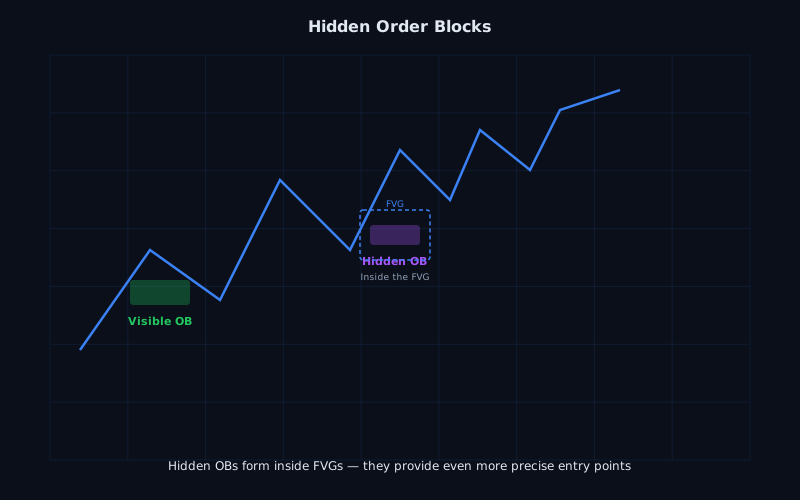
Hidden Order Blocks
A Hidden Order Block forms from overlapping wicks at a price level rather than candle bodies. The logic is identical to a standard OB — institutions are placing orders at this level — but the evidence is embedded in the wick structures rather than in the obvious last opposing candle before an impulse.
Identification process:
- Look for a cluster of candles where multiple wicks probe the same level repeatedly without a body close at that level.
- The zone of wick overlap — where multiple candles' high or low wicks cluster — is the Hidden OB.
- This zone acts as a support (bullish hidden OB) or resistance (bearish hidden OB) on returns.
- Confirmation: a strong reaction from this zone that creates displacement in the opposite direction.
Suspension Blocks
A Suspension Block appears in strongly trending markets. It is identified as a candle or series of candles that "suspend" — pause momentarily — within a trend, without creating a significant retracement. These brief pauses represent institutions adding to positions as price trends, and they act as support/resistance on any future return.
The key distinction from a Propulsion Block: a Suspension Block is characterised by smaller, tighter-range candles within the trend — almost like a micro-consolidation at pace — whereas a Propulsion Block is a single pause candle before a clear acceleration. Both are valid entries on return; Suspension Blocks tend to cluster over a slightly wider price range.
RDRB — Redelivered Rebalanced Price Range
The RDRB (Redelivered Rebalanced Price Range) occurs when price fills an FVG on its way to a target, then returns again to the same zone as support or resistance for a second reaction. The zone has been "redelivered" — price has now visited it twice, and institutional activity at the level is confirmed. RDRB zones are strong because they have proven institutional interest on multiple visits.
Many of the most precise ICT entries in recorded trade reviews involve Hidden OBs or Suspension Blocks. Retail traders see only "random noise" in these areas — professionals see institutional order placement. The ability to identify these structures separates the amateur from the professional analyst.
- Hidden OB = cluster of wicks at a level (not candle bodies) — still acts as S/R
- Suspension Block = micro-consolidation within a trend — institutions adding to positions
- RDRB = FVG that has been visited twice — confirmed institutional interest
- All three: require confluence with structure (not used in isolation)
Quick Quiz
1. What is a Hidden Order Block formed from?
2. What does RDRB stand for?
Algorithmic Price Delivery
9 min readPerhaps the most paradigm-shifting concept in all of ICT's teaching: price is not random. Markets are not driven by the random chaos of millions of individual decisions. Instead, price is delivered by algorithms — computer programs running at institutional trading desks, market makers, and central banks — that follow predictable, time-based delivery patterns.
Understanding algorithmic price delivery means understanding when price will move, where it will go, and why. This is the culmination of everything you have learned in this course.
The Concept: Price as an Algorithm
ICT's core thesis is that institutional algorithms:
- Deliver price to liquidity targets (the stops and pending orders of retail participants)
- Do so within predictable time windows (kill zones, Silver Bullet windows, macro times)
- Leave behind evidence in the form of FVGs, OBs, and structural shifts
- Reference key price points: opening prices, previous session highs/lows, round numbers
Time-Based Price Delivery
The algorithm respects time above all else. The most important time-based reference points:
| Time (NY) | Event | Significance |
|---|---|---|
| 12:00 AM | New Day Open | Marks start of NDOG; opening price is key reference all day |
| 2:00–5:00 AM | London Open Kill Zone | London institutions enter; manipulation of Asia range begins |
| 7:00–10:00 AM | NY AM Kill Zone | NY institutions enter; highest probability for trend day setups |
| 9:50–10:10 AM | ICT Macro Window | Algorithm delivers reversal or continuation; Silver Bullet 2 overlap |
| 10:50–11:10 AM | ICT Macro Window | Mid-morning delivery; often confirms or reverses morning trend |
| 1:10–1:40 PM | ICT Macro Window | Lunch consolidation break; NY afternoon setup forming |
| 2:00–3:00 PM | Silver Bullet 3 | London close; NY PM directional move begins |
Opening Prices as Reference Points
Every institutional algorithm references opening prices as key anchors:
- Yearly Open: The price at Jan 1 open — used as a macro bias indicator for the entire year
- Monthly Open: Key bias indicator — price above monthly open = bullish bias; below = bearish
- Weekly Open (NWOG): Critical reference; algorithms often return to this level during the week
- Daily Open (NDOG): The most actively referenced level on intraday charts
- Session Opens (London, NY): Each session's opening price is a bias reference for that session
Price is not random — it is algorithmically delivered to predictable targets during predictable time windows. Mark your opening prices daily (yearly, monthly, weekly, daily). Trade within the kill zones. Use ICT macro windows for high-probability reversals. Time + levels = the full edge.
The evidence for algorithmic price delivery is statistical: ICT macro windows (e.g., 9:50–10:10 AM) show a measurably higher frequency of swing highs and lows than random 20-minute windows throughout the day. This statistical regularity is the fingerprint of algorithmic order delivery.
Quick Quiz
1. According to the algorithmic price delivery concept, why does price move to specific levels?
2. Which opening price is considered the most important intraday reference level?
Backtesting Your Strategy
8 min readBacktesting is the process of reviewing historical price data to find and assess your trading setups after the fact. It is the most important step between learning a concept and trading it live. Without backtesting, you are gambling — you have no statistical evidence that your strategy has an edge. With proper backtesting, you have data-driven confidence.
How to Backtest Properly
- Choose your instrument and timeframe: Start with one pair and one model. For example: GBP/USD, Silver Bullet 10:00–11:00 AM window on the 5M chart.
- Go back 3–6 months minimum: You need a statistically significant sample. 100 setups is the minimum; 200+ is ideal.
- Use a replay tool or manual chart scrolling: TradingView has a bar replay function. Scroll to a date, hide the right side of the chart, and scroll forward candle by candle. Do not look ahead.
- Record every triggered setup: Whether you would have entered or not, record: date, time, entry price, stop loss price, take profit price, outcome (W/L), pips gained/lost.
- Be ruthlessly honest: If you only record the winning setups, your backtest is useless. Record every instance where your rules were met.
Key Metrics That Matter
| Metric | Formula | Target |
|---|---|---|
| Win Rate | Wins ÷ Total Trades × 100 | >50% preferred; 40%+ with 1:3 RR is profitable |
| Average RR | Avg Win ÷ Avg Loss | Minimum 1:2; target 1:3+ |
| Profit Factor | Total Won ÷ Total Lost | >1.5 is good; >2.0 is excellent |
| Max Drawdown | Largest peak-to-trough loss sequence | <10% of account |
| Expectancy | (Win% × Avg Win) − (Loss% × Avg Loss) | Positive number required |
100 backtested trades is the minimum before claiming you understand your strategy. Track win rate, average RR, and profit factor. A strategy with 45% win rate and 1:3 RR is highly profitable. Statistics don't lie — your feelings do. Let the data tell you whether your setup has edge.
Backtesting bias is the #1 enemy of accurate results. Hindsight makes every setup look obvious. To prevent this: always define your rules before scrolling forward. If you cannot articulate exactly what triggered your entry, it doesn't count as a valid setup in your backtest.
Quick Quiz
1. What is the minimum number of backtested trades before you can claim statistical validity?
2. A strategy has 40% win rate and an average RR of 1:3. Is it profitable?
3. What is the Profit Factor?
Creating Your Playbook
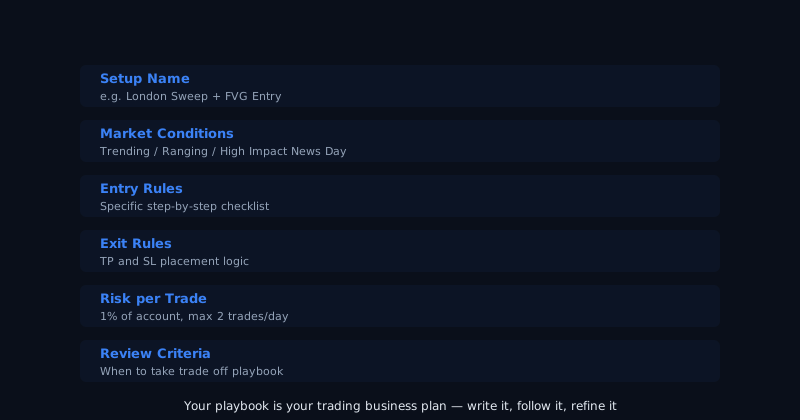
7 min readA Trading Playbook is your personal reference guide — a documented collection of your best setups, complete with screenshots, annotations, entry rules, and the conditions that make each setup A-grade. Every professional trading firm maintains a playbook. It enforces consistency and prevents you from taking B and C-grade setups out of boredom or FOMO.
How to Build Your Playbook
- Screenshot and annotate: For every A-grade setup you identify in backtesting or live trading, take a full screenshot of the chart at the moment of entry. Annotate: entry zone, stop loss, take profit, the specific concepts at play (FVG, sweep, MSS, etc.).
- Write the rules: For each screenshot, write 3–5 bullet points describing exactly what made this an A-grade setup. If you cannot write the rules, you do not understand the setup well enough to trade it.
- Grade your setups (A/B/C): Not all setups are equal. Define what makes an A-grade, B-grade, and C-grade version of your model. Commit to trading A-grades only.
- Categorise by session and pair: Note which session (London/NY) and which pair the setup was on. Identify your statistical edge by session and instrument.
- Review monthly: Your playbook should evolve as you learn. Remove setups that no longer work. Add new ones as you discover edge cases.
A-Grade vs B-Grade vs C-Grade
| Grade | Characteristics | Action |
|---|---|---|
| A-Grade | All rules met: sweep, MSS confirmed, FVG present, HTF aligned, correct session | Take the trade — full size |
| B-Grade | Most rules met but 1 element missing or ambiguous | Reduce size by 50% or skip |
| C-Grade | Setup "looks similar" but 2+ conditions not met; based on gut feeling | Do not trade — no exceptions |
Your playbook is your constitution. Write it when you are rational and calm. Follow it when you are emotional and excited. The setups that feel like C-grades during market hours are almost always losing trades in hindsight. Respect the grading system.
Quick Quiz
1. What should you do with a C-grade setup?
2. What is the primary purpose of annotating playbook screenshots?
The Trading Journal
7 min readA Trading Journal is your most valuable tool after your playbook. Where the playbook defines what to trade, the journal records what you actually traded — and more importantly, why and how you felt while trading it. The journal is where pattern recognition meets psychological self-awareness.

What to Record in Every Entry
- Date and time of entry/exit
- Instrument and timeframe
- Entry reason: Exactly which rules triggered your entry (sweep location, FVG details, MSS confirmation)
- Exit reason: Did you exit at planned TP? Did you exit early? Close due to SL? Record the reason honestly.
- Emotions: Were you confident? Anxious? Did you second-guess the entry? Did you move the SL? Record this without judgment.
- Setup grade (A/B/C): What grade was this setup at entry? (Not in hindsight — at the actual moment of entry)
- Result: Win/Loss, pips gained/lost, % of account gained/lost
- Lesson: One sentence. What did this trade teach you?
Weekly Review Process
Every week, dedicate 30–60 minutes to reviewing your journal. Ask:
- Did I follow my rules on every trade this week?
- Which trades were my best executions? What made them clean?
- Which trades were mistakes? What triggered the rule-break?
- Was my emotional state correlated with my performance?
- What is the one thing I will improve next week?
Monthly Performance Analysis
At the end of each month, calculate your key metrics: win rate, average RR, profit factor, total P&L. Compare to your backtest expectations. If your live results are significantly worse than your backtest, the gap is almost always psychological — not strategic. The journal data will tell you exactly where the breakdown occurred.
- Date | Pair | Session | Grade | Entry price | SL | TP | Result
- Entry reason (1–2 sentences — be specific)
- Exit reason (planned or unplanned)
- Emotion score (1=calm and focused, 5=anxious/FOMO/revenge)
- Lesson learned (1 sentence)
Quick Quiz
1. Why is recording emotions in your trading journal important?
2. If your live trading performance is significantly worse than your backtest results, what is the most likely cause?
From Demo to Live
8 min readThe transition from demo to live trading is one of the most underestimated steps in a trader's journey. Many traders who perform consistently in demo fall apart when real money is at stake. This is not because their strategy has changed — it is because psychology changes everything when real capital is on the line.
When You Are Ready to Go Live
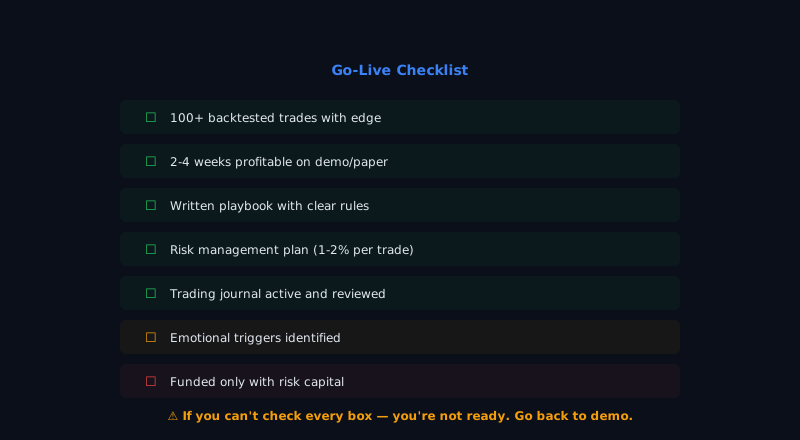
You are ready to go live when you can tick all of the following boxes:
- 3+ consecutive profitable months in demo (not just profitable overall — 3 consecutive months)
- Win rate and RR in line with backtest expectations (within ±5%)
- No rule-breaks in the last 30 trading days
- Risk plan is written, printed, and followed
- Playbook contains at minimum 10 annotated A-grade setups
- Journal has been maintained for the full demo period
Two weeks of great demo trades does NOT mean you are ready to go live. The market rewards patience and preparation. Traders who rush to live after 2–4 weeks almost universally lose their initial deposit. 3 months minimum. No exceptions.
Starting Small
When you do go live, start with the smallest viable account size — not your target account size. The goal of your first 30 live trading days is NOT to make money. It is to prove to yourself that you can execute your strategy under real market conditions with real money. Recommended approach:
- Month 1 live: Risk 0.25–0.5% per trade (half your planned risk). Focus entirely on execution quality.
- Month 2 live: If month 1 results match demo expectations within ±10%, increase to 0.5–1% risk.
- Month 3+ live: If consistent, graduate to full planned risk (1–2% per trade).
- Scaling: Only increase account size or risk % after 3 consecutive profitable months at the current level.
The Psychology Shift
Common psychological challenges that appear only in live trading — and how to address them:
- Moving the stop loss wider: The cure is commitment. Write your SL in your journal before you enter. Treat moving the SL as a serious rule violation.
- Exiting winners too early: Set your TP as a limit order immediately upon entry. Do not watch the trade in real time if it causes premature exits.
- Revenge trading after losses: The daily loss limit is your shield. Once it is hit, close the platform. No negotiation.
- FOMO on missed setups: Your playbook has hundreds of setups. Missing one A-grade does not hurt you. Taking a C-grade to compensate does.
Going live is not the finish line — it is the start of a new phase of learning. Start small, execute the process, let statistics play out. The traders who survive long enough to let their edge compound are the ones who treat live trading with the same measured process as demo. Protect the account. The profits follow.
- 3+ consecutive profitable demo months ✓
- Live results match backtest within ±5% ✓
- Zero rule-breaks in past 30 trading days ✓
- Written risk plan + printed and displayed ✓
- Playbook with 10+ annotated A-grade setups ✓
- Trading journal maintained throughout demo ✓
- Start at 0.25–0.5% risk for first 30 days ✓
Quick Quiz
1. What is the minimum demo trading period before going live?
2. What should your risk per trade be in your first month of live trading?
3. What is the primary goal of your first 30 live trading days?
Advanced Risk Management
Mathematical frameworks for optimal position sizing, Monte Carlo drawdown analysis, and equity curve trading — the tools used by professional traders to gain an edge in expectancy management.
Kelly Criterion & Fractional Kelly
⏱ 12 min readThe Kelly Criterion is a mathematical formula that calculates the optimal fraction of your capital to risk on each trade to maximize long-term capital growth. It was developed by John L. Kelly Jr. at Bell Labs in 1956 and has since been adopted by professional gamblers, investors, and traders who seek to optimize capital allocation mathematically.
The Formula
f* = (b × p − q) / b
Where:
f* = optimal fraction of capital to risk per trade
p = probability of winning (your historical win rate)
q = probability of losing (q = 1 − p)
b = the odds ratio (average win / average loss; e.g. if average win is $2 for every $1 risked, b = 2)
Worked Trading Example
A trader backtests their strategy over 200 trades and finds a 50% win rate with an average win of 1.5R (winning trades average 1.5× the risk) and average loss of 1R. Calculate the Full Kelly:
Kelly Calculation — 50% Win Rate, 1.5:1 R:R
Full Kelly says risk 16.7% of your account per trade. That sounds reasonable until you hit a 5-trade losing streak — you'd be down over 60% of your account. This is why Full Kelly is never used in practice by professional traders.
Another Example: Blackjack Card Counter
Kelly for a Card Counter — 52% Win Rate, Even Odds
Fractional Kelly: The Professional Approach
Because markets have fat tails, regime changes, and estimation errors in win rate and R:R, professional traders use a fraction of the full Kelly value. The most widely recommended fractions are:
| Fraction | Risk Per Trade (on 16.7% Full Kelly) | Growth Retained | Drawdown Risk |
|---|---|---|---|
| Full Kelly (f*) | 16.7% | 100% | Very high — 50%+ drawdowns common |
| Half Kelly (f*/2) | 8.35% | ~75% | Moderate — retains 75% growth with far less variance |
| Quarter Kelly (f*/4) | 4.175% | ~51% | Low — 80% drawdown probability drops from 1-in-5 to 1-in-213 |
Most professional traders use 25%–50% of Full Kelly as their practical upper bound. For a system with 16.7% Full Kelly, that means risking 4.2–8.3% per trade — still very aggressive by prop firm standards. For funded trading, 1–2% per trade is optimal regardless of what Kelly suggests.
Kelly's Practical Limits in Trading
- Kelly requires known probabilities and known payoffs — rarely true in live markets
- Markets have fat tails and regime changes that Kelly's formula doesn't account for
- Estimation errors in win rate and R:R cause Kelly to overestimate the optimal bet
- Betting even one penny above Full Kelly increases variance AND reduces long-term expected growth
- Use Kelly as an upper ceiling, not as a target bet size
The Kelly Criterion formula is f* = (b × p − q) / b. Full Kelly maximizes long-term growth but produces extreme drawdowns. Use Half Kelly (50% of f*) as a practical maximum — it retains 75% of optimal growth with substantially less variance. For prop firm challenges, trade at 1–2% risk regardless of what Kelly calculates.
Quick Quiz
1. A trader has a 55% win rate and a 2:1 reward-to-risk ratio. What are the variables in the Kelly formula?
2. Why do professional traders use Fractional Kelly rather than Full Kelly?
3. Half Kelly on a system with a Full Kelly of 20% means risking what per trade?
ATR-Based Position Sizing
⏱ 10 min readStandard position sizing (risk a fixed dollar amount per trade) doesn't account for market volatility. A stock moving $5/day and a stock moving $0.50/day require completely different stop-loss placements — and therefore completely different position sizes to risk the same dollar amount. ATR-based position sizing solves this automatically.
What Is ATR?
The Average True Range (ATR) measures market volatility by averaging the True Range over N periods (default: 14). True Range is the maximum of:
- Today's High − Today's Low
- |Today's High − Yesterday's Close|
- |Today's Low − Yesterday's Close|
High ATR = high volatility. Low ATR = low volatility. ATR does NOT indicate direction — only volatility magnitude.
The ATR Position Sizing Formula
Position Size = Account Risk Amount ÷ (ATR × Multiplier)
Where Account Risk Amount = Account Size × Risk % per trade
Worked Example: Stocks
ATR Position Sizing — $100,000 Account, 1% Risk
Worked Example: Forex
ATR Position Sizing — Forex (EURUSD)
Choosing Your ATR Multiplier
The multiplier determines how much room you give each trade before the stop is hit:
- 1× ATR stop: Very tight; more stop-outs but excellent R:R when winners run
- 1.5× ATR stop: Standard retail approach; balances stop-outs vs R:R
- 2× ATR stop: Wide; fewer stop-outs on normal fluctuation; lower R:R
- 3× ATR stop: Very wide; rare stop-outs; used by swing traders on daily charts
Why ATR Sizing Outperforms Fixed-Lot Sizing
- Maintains consistent dollar risk across different volatility regimes
- Automatically reduces size in volatile markets (reducing overexposure)
- Automatically increases size in quiet markets (capturing more opportunity)
- Removes emotion from position sizing — size is a mathematical output, not a feeling
ATR-based sizing = Account Risk $ ÷ (ATR × Multiplier). On a $100K account risking 1% with a $2 ATR stock and 2× multiplier: 250 shares. This formula automatically adjusts for volatility — trade smaller when markets are choppy, larger when they're quiet. Recalculate before every trade.
Quick Quiz
1. Your $50,000 account risks 2% per trade. The stock's ATR is $3.50 and you use a 2× multiplier. What is your position size?
2. A higher ATR multiplier means:
3. What happens to your ATR-based position size when market volatility doubles (ATR doubles)?
Monte Carlo Simulation & Maximum Adverse Excursion (MAE)
⏱ 11 min readPart A: Monte Carlo Simulation
Monte Carlo simulation is a computational technique that runs thousands of random simulations of your trade sequence to estimate the probability distribution of outcomes — particularly maximum drawdown and ruin probability. Where a simple backtest tells you one possible history, Monte Carlo tells you the range of histories you might actually face.
How Monte Carlo Works in Trading
- Gather a sample of historical trades (win/loss amounts from your backtest or live trading journal)
- Randomly reshuffle the sequence of trades (not the amounts, just the order)
- Run 1,000–10,000 iterations of the reshuffled sequence
- For each iteration, calculate the equity curve and maximum drawdown
- Analyze the distribution: what drawdown occurs 95% of the time? 50%? 10%?
Monte Carlo Output — Interpreting the Results
Practical Rule: If your historical backtest shows a 20% maximum drawdown, multiply by 1.5 to estimate the realistic live trading worst case: 30%. Monte Carlo will typically confirm this range. If your account cannot survive a 40% drawdown, reduce position size until the 10th-percentile drawdown is survivable.
Part B: Maximum Adverse Excursion (MAE)
Developed by John Sweeney, MAE quantifies the maximum unrealized loss a trade experiences from entry to its lowest point before the trade closes or reverses.
For Long Positions: MAE = Entry Price − Lowest Price Reached (while trade was open)
For Short Positions: MAE = Highest Price Reached − Entry Price
Maximum Favorable Excursion (MFE): The peak unrealized profit during the trade's life (maximum gain before the trade closed)
How to Use MAE to Optimize Stop Losses
- Record the maximum adverse move of your last 20–30 trades of the same setup type
- Calculate the average MAE (e.g., 15 pips)
- Never set a stop smaller than 1.2–1.5× your average MAE — otherwise you're being stopped out on normal market noise, not actual invalidation
- For dynamic stops, combine MAE with ATR: Stop = MAE + (ATR × 0.5)
MAE Stop Optimization Example
The MAE Scatter Plot
Plot MAE vs MFE for all your trades. This creates a chart that shows:
- Winners cluster at low MAE / high MFE — the trade never went far against you before becoming profitable
- Losers cluster at high MAE / low MFE — the trade went against you immediately and never recovered
- The boundary between these clusters shows your optimal stop placement — just beyond the MAE of your winning trades
Monte Carlo simulation takes your historical trades, reshuffles them 1,000+ times, and shows the range of possible drawdowns — revealing the 10th-percentile worst case (the catastrophic scenario you must survive). MAE analysis shows the average maximum adverse move of your winning trades, allowing you to set stops that absorb normal noise without being too tight. Optimal stop = at least 1.2× average MAE.
Quick Quiz
1. What does Monte Carlo simulation do that a simple backtest does not?
2. If your backtest shows a 20% maximum drawdown, what is the realistic live-trading worst case per the practical rule?
3. Your average MAE across 25 trades is 18 pips and your ATR is 12 pips. What is the optimal stop using the MAE+ATR formula?
Equity Curve Trading
⏱ 8 min readEquity curve trading is a systematic risk management technique that adjusts your trading activity based on whether your strategy's equity curve is above or below its own moving average. It adds a meta-layer of risk control on top of your existing strategy.
The Core Rule
Equity above its 20-trade moving average → Green light. Trade normally at full size. The strategy is performing as expected.
Equity below its 20-trade moving average → Red light. Stop trading or reduce position size to 50%. The strategy may be in an unfavorable regime.
Why It Works
All strategies go through periods of underperformance due to changing market conditions (ranging vs trending, high vs low volatility, correlated vs uncorrelated moves). The equity curve moving average acts as a detector: when performance consistently lags, the MA signals you to step back — before you've given back a significant portion of your gains.
Three Variants
- Moving Average Method (most common): Plot a 20-trade MA of equity. Trade full size above it; stop or half-size below it.
- Consecutive Loss Rule: After N consecutive losses (e.g., 3–5 losses in a row), take a mandatory break of 24–48 hours before resuming.
- Drawdown Percentage Rule: When drawdown from equity peak exceeds X% (e.g., 5%), reduce size by 50% until equity recovers to within 2% of peak.
Benefits and Drawbacks
| Benefits | Drawbacks |
|---|---|
| Reduces drawdowns by stopping during losing streaks | May cause you to sit out recovery periods near the low |
| Improves Sharpe ratio and max drawdown metrics | Moving average lag means some equity loss before signal fires |
| Systematic, emotion-free risk reduction | Reduces total profit if you stop near the absolute low |
Equity curve trading treats your strategy's performance as a tradeable signal. When equity is above its 20-trade MA, trade normally. When below, reduce size or stop until performance recovers. This systematic approach removes emotion from the "should I keep trading?" question and objectively manages strategy drawdowns.
Quick Quiz
1. Under equity curve trading (20-trade MA method), when should you stop or reduce position size?
2. What is the primary benefit of equity curve trading?
Trading Psychology Masterclass
The mental edge separates consistently profitable traders from the majority who fail. Master the frameworks used by the greatest trading psychologists: Kahneman, Mark Douglas, Van Tharp, and the science of cognitive bias.
Daniel Kahneman: System 1 vs System 2 Thinking in Trading
⏱ 10 min readDaniel Kahneman, Nobel Prize winner in Economics, introduced the concept of two cognitive systems in his book Thinking, Fast and Slow (2011). These two systems explain why intelligent, analytical people make systematically irrational trading decisions — and what to do about it.
System 1: Fast Thinking
- Automatic, quick, unconscious
- Operates without deliberate effort
- Pattern recognition, intuition, emotional reactions
- Handles approximately 90–95% of all daily decisions
- Evolutionarily ancient — designed for rapid threat and opportunity response
- In trading: Impulsive entries on "looks" rather than confirmed setups; emotional reactions to losses; knee-jerk exits; FOMO; revenge trading
System 2: Slow Thinking
- Deliberate, analytical, conscious
- Requires focused attention and effort
- Complex computations, rule-following, discipline
- "Lazy" — the brain resists activating it unnecessarily
- In trading: Following a pre-written trading plan; calculating position sizes using a formula; waiting for all confirmation criteria; reviewing trades objectively in a journal
WYSIATI: "What You See Is All There Is"
Kahneman's most important trading insight: System 1 builds confident judgments from the information currently available, while systematically ignoring absent information. In trading, this means:
- Focusing on the recent uptrend while ignoring the higher-timeframe bearish structure
- Ignoring risks that aren't immediately visible on the chart
- Overconfidence based on a recent winning streak, not long-term statistical evidence
The Key Insight for Traders
All cognitive biases — confirmation bias, anchoring, loss aversion, FOMO — are System 1 shortcuts. Awareness alone doesn't fix them because System 1 keeps running even when you know about it. The solution is structural:
Pre-plan your trading rules using System 2 outside of market hours, when System 1 pressure is low. Then execute the plan mechanically during the session without modification. This lets disciplined, pre-written rules override impulsive System 1 reactions. "Big decisions need a cooling-off period. System 1 delivers its verdict immediately — delay committing that verdict."
Three Core System 1 Biases in Trading
- Confirmation bias: System 1 only looks for information that confirms your existing position. After entering a long, you selectively notice bullish signals and dismiss bearish ones.
- Loss aversion: System 1 makes losses feel approximately 2× more painful than equivalent gains feel pleasurable. This is why traders hold losers too long and cut winners too short.
- Anchoring: System 1 over-weights the first piece of information received (e.g., your entry price), making it disproportionately hard to abandon the position even when evidence changes.
System 1 is fast, emotional, and automatic — it causes every impulsive trading mistake. System 2 is slow, deliberate, and rule-based — it produces disciplined trading. You cannot turn off System 1 during trading, but you can pre-program System 2 rules that override it. Write your plan when calm; execute it mechanically when markets are live.
Quick Quiz
1. Which Kahneman system is responsible for impulsive FOMO entries and revenge trading?
2. What does Kahneman mean by "WYSIATI"?
3. What is the most effective countermeasure against System 1 biases in trading?
Mark Douglas: Trading in the Zone
⏱ 12 min readMark Douglas's Trading in the Zone is widely considered the most important book on trading psychology ever written. Douglas's core thesis: consistent trading results come from a trader's mindset, not their analysis or strategies. Two traders can use identical systems with completely different results — the difference is psychological.
The 5 Fundamental Truths of Trading
Douglas identifies five truths that consistently profitable traders have internalized at a deep level. Most losing traders intellectually understand these but do not truly believe them:
- "Anything can happen." The market is full of surprises. No analysis eliminates uncertainty. Always prepare for the unexpected.
- "You don't need to know what is going to happen next to make money." Focus on managing risks and capitalizing on probabilities as they arise. You need an edge, not perfect prediction.
- "There is a random distribution between wins and losses for any given set of variables that define an edge." Even a 60% win rate strategy will not win exactly 60% of the next 10 trades. Wins and losses are randomly distributed across the sample. Do NOT judge system validity from 5–10 trades.
- "An edge is nothing more than an indication of a higher probability of one thing happening over another." An edge doesn't guarantee success — it tilts the odds. Trust the probabilities over the long run.
- "Every moment in the market is unique." No two setups are identical. Past wins and losses do not affect future outcomes. Avoid anchoring on what happened in the last trade.
The 7 Principles of Trading Consistency
Douglas provides seven principles that traders must adopt as genuine beliefs to trade consistently. These are not affirmations — they are behavioral commitments:
- I objectively identify my edges.
- I predefine the risk of every trade.
- I completely accept the risk or I am willing to let go of the trade.
- I act on my edges without reservation or hesitation.
- I pay myself as the market makes money available to me.
- I continually monitor my susceptibility for making errors.
- I understand the absolute necessity of these principles of consistent success, and therefore I never violate them.
"The Zone"
Douglas describes "The Zone" as a mental state where traders operate at peak performance — free from fear, ego, and the need to be right. In The Zone, traders:
- Accept uncertainty fully without needing to know the outcome in advance
- Act on edges consistently without hesitation or second-guessing
- Experience losses as normal statistical events, not personal failures
- Have no emotional interference in decision-making
The Consistent Loser Pattern
Douglas identifies a self-defeating pattern in losing traders: oversizing winning positions (confidence builds after wins, leading to larger trades) and undersizing or skipping trades during losing streaks (fear of further losses). This pattern guarantees inconsistent results because position size variance creates variance in outcomes that has nothing to do with the actual strategy edge.
Mark Douglas's central message: "Consistency is a function of a trader's mindset, not their analysis." The 5 Truths remind you that anything can happen, that you need probability over time not perfection in individual trades, and that every moment is unique. The 7 Principles are the behavioral commitments that produce consistent execution. Internalize these — they cannot just be intellectually understood.
Quick Quiz
1. Which of Mark Douglas's 5 Fundamental Truths explains why you should NOT judge your strategy after just 5–10 trades?
2. According to Douglas's 7 Principles, what must you do BEFORE entering every trade?
3. What does Douglas call the mental state of peak trading performance?
Van Tharp's R-Multiple System & Position Sizing Models
⏱ 9 min readDr. Van Tharp is one of the few trading coaches to systematically apply position sizing science to trading performance. His core argument: "Position sizing is the key to meeting your trading objectives. A mediocre system with excellent position sizing can outperform a great system with poor position sizing."
The R-Multiple Framework
R stands for the initial risk on a trade. If you risk $500 on a trade, that trade has a risk of 1R. Every outcome is then measured as a multiple of this initial risk:
- Win of $500 (equals the initial risk) = 1R win
- Win of $1,500 (3× the initial risk) = 3R win
- Loss of $500 (equals the initial risk, stopped out) = −1R loss
- Loss of $250 (exit early at half stop) = −0.5R loss
R-Multiple System Evaluation — 10 Trades
The mean R (expectancy per trade) tells you: for every $1 risked, you expect to gain $0.20. Over 100 trades risking $500 each, that's 100 × $100 = $10,000 expected profit. This is how you evaluate a strategy scientifically.
Van Tharp's Four Position Sizing Models
1. Fixed Fractional (Percentage Risk) Model
Risk a fixed percentage of current equity per trade (e.g., 1–2%). Risk adjusts with equity: account grows → absolute risk grows; account shrinks → absolute risk shrinks. This is the most common professional approach and the one recommended for prop firm challenges.
2. Fixed Ratio Model (Ryan Jones)
Increase position size only after accumulating a fixed dollar amount of profit per contract. More conservative early; accelerates as profits accumulate. Designed for futures and leveraged trading.
3. Optimal f (Ralph Vince)
Mathematically optimal position size based on historical trades (similar to Kelly). Maximizes long-term growth but creates 50%+ drawdowns. Academic — rarely used in practice.
4. Volatility-Adjusted (Tharp's Preferred)
- Low volatility = larger position: When volatility is low, take larger positions (same dollar risk = more shares/contracts)
- High volatility = smaller position: Reduce size in volatile markets to maintain consistent dollar risk
- Scaling up rules: Only increase position size after 3+ consecutive months of consistent results; scale in gradual steps, not jumps
The R-Multiple framework standardizes all trade outcomes as multiples of initial risk. Calculate mean R across all trades to get true strategy expectancy (e.g., +0.2R means earn $0.20 per $1 risked). Van Tharp's preferred approach is volatility-adjusted fixed fractional: risk a consistent % of equity, trade smaller in volatile conditions, larger in quiet ones, and only scale up after 3+ months of consistency.
Quick Quiz
1. In Van Tharp's R-Multiple system, if you risk $600 on a trade and win $1,800, what is the R-Multiple of this trade?
2. Over 8 trades your R-multiples are: +3R, −1R, −1R, +2R, −1R, +1R, −1R, +2R. What is your mean R (expectancy per trade)?
7 Cognitive Biases Every Trader Must Know
⏱ 14 min readCognitive biases are systematic errors in thinking that affect the decisions and judgments of all people — including experienced traders. Unlike random errors, biases are predictable and directional. Understanding each one with specific trading examples and countermeasures is the first step toward neutralizing them.
Bias 1: Anchoring Bias
Definition: Over-weighting the first piece of information received (the "anchor") when making subsequent decisions, even when that anchor is irrelevant.
In Trading:
- Anchoring to your entry price and refusing to cut a losing trade because "it'll come back to my price"
- Anchoring to a stock's 52-week high and dismissing further downside because "it's already down 30%"
- Stubbornly maintaining a price target set before new contradictory information emerged
Countermeasure: Evaluate each position fresh using current evidence only. Ask: "If I had no position right now, would I enter at this price with this setup?" If no → exit regardless of your entry price.
Bias 2: Recency Bias (Availability Bias)
Definition: Giving more weight to recent events and information over older historical data when making decisions.
In Trading:
- After 5 consecutive winning trades, assuming the strategy is infallible — sizing up aggressively
- After 3 losing trades, abandoning a strategy with a 200-trade proven edge
- Treating recent volatility as a permanent regime change rather than a temporary condition
Countermeasure: Always evaluate performance over statistically significant samples (minimum 100 trades). Never change your strategy based on 3–5 outcomes. Keep a long-run statistics sheet visible at your workstation.
Bias 3: Gambler's Fallacy
Definition: The incorrect belief that future probabilities are altered by past independent events.
In Trading:
- "I've had 5 losing trades in a row — the next one must be a winner" (No. Each trade is independent.)
- Doubling position size after a losing streak, assuming the "streak must end"
- Sizing down aggressively after a winning streak, believing a loss is "due"
Key Truth: If your system has a 55% win rate, the next trade has exactly a 55% chance of winning — regardless of whether you've won the last 10 or lost the last 10. Trade outcomes are independent events.
Countermeasure: Track win rates over 100+ trade samples to see true edge expression. Never change size based on streaks — use a fixed percentage risk rule that ignores streak information entirely.
Bias 4: Sunk Cost Fallacy
Definition: Persisting with a failing course of action because of prior investment (money, time, emotional energy), rather than evaluating it on current merits.
In Trading:
- Holding a losing trade past your stop because "I've already lost $800, I can't take another $200 loss"
- Refusing to exit a multi-week position because "I've been in this trade for 3 weeks"
- Continuing to take a broken setup because "I've already paid for this signals service"
Countermeasure: The sunk cost is gone regardless of what you do next. Evaluate every open position as if you just opened it at the current price. "If I had no position right now, would I enter here?" If no → exit.
Bias 5: Confirmation Bias
Definition: Seeking and over-weighting information that confirms existing beliefs while discounting contradictory evidence.
In Trading:
- After entering a long, only scanning for bullish indicators; dismissing bearish signals as noise
- Cherry-picking timeframes that confirm your anticipated direction
- Only following analysts who share your market view
Countermeasure: Before any entry, actively seek evidence against the trade thesis. Ask: "What would have to happen for me to be completely wrong?" If you can't articulate the bear case for a long trade, you haven't done sufficient analysis.
Bias 6: FOMO (Fear of Missing Out)
Definition: Impulsive decision-making driven by the fear of missing a profitable move already in progress.
In Trading:
- Chasing price after it has already moved 50 pips in your direction without you
- Entering late into a trend with a poor risk-to-reward because "it looks strong"
- Taking suboptimal setups just to "participate" in a trending day
- In prop firm context: leads to overtrading and daily loss limit breaches
Countermeasure: Accept that you will miss moves — every professional trader does. There are always more setups. Define specific entry criteria and a maximum entry price. If price has passed your entry level, the setup is void. Mark the missed trade in your journal to build the mental habit of letting them go.
Bias 7: Disposition Effect (Loss Aversion)
Definition: The tendency to sell winning positions too soon and hold losing positions too long. Root cause: Kahneman's Prospect Theory shows that losses feel approximately 2× more painful than equivalent gains feel pleasurable.
In Trading:
- Taking profit at 1R when your plan called for a 3R target because "it feels like enough"
- Refusing to cut a losing trade at 1R because "it'll come back" — letting the loss grow to 3R
- Result over time: average win < average loss = negative expectancy despite high win rate
Countermeasure: Predefine profit targets AND stop-losses before entry. Use set-and-forget orders. Make exit decisions systematic rather than discretionary. If your R:R plan says 3:1, the target order must be placed before you open the trade.
The 7 biases — anchoring, recency, gambler's fallacy, sunk cost, confirmation, FOMO, and disposition effect — all create systematic, predictable errors. The universal countermeasure is systematization: pre-planned entry criteria, fixed risk rules, predetermined exits. The more you systematize, the less bias can operate.
Quick Quiz
1. A trader refuses to cut a losing position that hit their stop because "I've already lost $900, I can't take another $100 loss." Which bias is this?
2. A trader with a 60% win rate system doubles their position size after losing 6 trades in a row, believing a win is "due." Which bias is this?
3. The disposition effect causes traders to do what to their winning positions?
The Dunning-Kruger Curve & Flow State in Trading
⏱ 10 min readPart A: The Dunning-Kruger Effect in Trading
The Dunning-Kruger effect is a cognitive bias where people with limited knowledge or skill in a domain overestimate their own competence, while true experts often underestimate theirs. The core insight: the skills needed to perform a task well are often the same skills needed to accurately assess one's own performance.
The Four Stages of Trader Development
The Dunning-Kruger Curve Applied to Trading
How Dunning-Kruger Manifests in Trading
- Overleveraging after an early winning streak ("Mount Stupid" behavior)
- Failing to prepare for worst-case drawdowns because "I've mastered this"
- Skipping risk management on "obvious" setups
- Ignoring different market conditions after only experiencing bull markets
Countermeasure: Systematic performance tracking, backtesting all assumptions, journaling every trade, and seeking feedback from more experienced traders. The antidote is evidence — replacing confidence with data.
Part B: Flow State in Trading
Psychologist Mihaly Csikszentmihalyi defined flow as a state of optimal experience characterized by complete immersion in an activity, where self-consciousness disappears and time distorts. Mark Douglas calls this same state "The Zone." It is the highest-performance mental state a trader can achieve.
Characteristics of Flow in Trading
- Complete focus on current price action and setups — nothing else exists
- No second-guessing; decisions feel clear, obvious, and automatic
- No emotional interference — no fear, greed, or hesitation
- Actions are consistent with the trading plan without effort
- After the session: often cannot recall specific micro-decisions but outcomes are positive
Conditions Required for Flow
- Clear, well-defined rules: Ambiguity breaks flow. If you're not sure what constitutes a valid setup, your mind wanders.
- Skill level matched to challenge: Too easy = boredom; too hard = anxiety. Neither produces flow.
- Immediate feedback: Live market data provides this naturally.
- Full acceptance of uncertainty and risk: Fighting uncertainty creates anxiety; accepting it enables flow.
- Focus on process, not outcome: Watching P&L destroys flow. Executing the setup creates it.
How to Access Flow State Before Trading
- Follow a strict pre-market routine (same time, same sequence, every day) — rituals signal readiness to your nervous system
- Meditate or practice deliberate breathing for 5–10 minutes before the session
- Remove all distractions (no social media, phone, background conversation during trading hours)
- Trade only when psychologically ready — never when emotionally disturbed, tired, or distracted
- Focus entirely on executing the next setup correctly, not on what the P&L will be
The Dunning-Kruger curve maps directly to trader development: overconfidence at the start ("Mount Stupid"), a valley of despair as reality hits, then gradual growth toward sustainable competence. Most traders quit in the Valley. Countermeasure: trade data over feelings. Flow state ("The Zone") is achieved when rules are clear, skill matches challenge, and focus is purely on process. Create flow conditions deliberately through pre-market routine.
Quick Quiz
1. At which stage of the Dunning-Kruger curve does the trader's largest percentage drawdown most often occur?
2. Which of the following is NOT a condition required for achieving flow state in trading?
Volume Analysis
Volume is the footprint of institutional activity. Learn to read Volume Spread Analysis (VSA) signals and Volume Profile levels to confirm high-probability setups and identify where smart money is truly active.
Volume Spread Analysis (VSA): Key Signals
⏱ 11 min readVolume Spread Analysis (VSA) was developed by Tom Williams based on the work of Richard Wyckoff. It analyzes the relationship between price spread (the range of a candle's high to low), closing position (where price closes within the spread), and volume to determine whether the move is likely to continue or reverse.
The core premise: volume reveals the activity of professional "smart money." When volume and price spread tell contradictory stories, the market is about to turn.
The Four Core VSA Signals
Signal 1: No Demand
No Demand Bar Characteristics
Signal 2: No Supply
No Supply Bar Characteristics
Signal 3: Stopping Volume
Stopping Volume Characteristics
Signal 4: Climactic Action (Buying or Selling Climax)
Climactic Action Characteristics
Using VSA for Trade Confirmation
VSA signals are most powerful when they appear at your existing areas of interest — ICT order blocks, Fair Value Gaps, or key support/resistance levels. A No Supply bar appearing exactly at a bullish order block is a high-confidence long setup. A Climactic Action bar at a resistance level is a strong shorting signal. Volume provides the institutional fingerprint that price action alone cannot.
The four VSA signals: No Demand (narrow up bar, low volume = weak rally), No Supply (narrow down bar, low volume = weak pullback), Stopping Volume (ultra-high volume down bar closing high = professional buying), and Climactic Action (extreme volume wide bar = trend exhaustion). Use these to confirm your ICT/SMC entries rather than as standalone signals.
Quick Quiz
1. What is a "No Demand" bar in VSA?
2. Stopping Volume appears after a sustained downtrend and closes in the upper half of a wide-spread down bar with very high volume. What does this signal?
3. A Buying Climax is identified by what characteristics?
Volume Profile: Point of Control, Value Area & Volume Nodes
⏱ 12 min readVolume Profile is a charting tool that plots the total volume traded at each price level over a specified period, displayed as a horizontal histogram. Unlike standard volume (which shows volume per candle/time period), Volume Profile shows volume per price level — revealing where the market has spent the most time and traded the most contracts.
The Five Core Volume Profile Concepts
1. Point of Control (POC)
The POC is the single price level where the most volume was traded over the selected period. It represents the price at which the most business was transacted between buyers and sellers.
- Acts as a magnet for price — price frequently returns to the POC after deviating from it
- A strong support/resistance level: buyers and sellers have already agreed on fair value at this price, so they return to contest it
- Trading through the POC with conviction signals a regime change; bouncing from the POC signals value acceptance
2. Value Area (VA)
The Value Area contains 70% of the total volume traded over the period. It represents the range of prices accepted as "fair value" by the market.
- Value Area High (VAH): The upper boundary of the 70% volume zone. Acts as resistance. Trades above VAH are trading in "premium" territory.
- Value Area Low (VAL): The lower boundary. Acts as support. Trades below VAL are trading in "discount" territory.
- Value Area Rule: 80% of the time, price returns to the previous day's Value Area after opening outside it
3. High Volume Nodes (HVN)
Areas where significantly above-average volume was traded — visible as wide bars on the profile histogram. HVNs are areas of congestion and consolidation where price tends to slow down, reverse, or consolidate.
- When price approaches an HVN, expect slower, choppier movement
- HVNs act as support below current price and resistance above
- Breakouts through HVNs require significant volume and conviction
4. Low Volume Nodes (LVN)
Areas where minimal volume was traded — visible as narrow bars or gaps on the profile. LVNs are areas of rapid price movement where price tends to move quickly through with little resistance.
- Think of LVNs as highways — little resistance, fast travel
- When price enters an LVN zone, expect acceleration — these are continuation zones, not reversal zones
- The distance from one HVN to the next (through an LVN) is often the target for a trade
5. Volume Profile Shapes
The overall shape of the profile tells you about market structure:
- D-shaped (bell curve): Balanced market; equal acceptance at both extremes; price likely to stay within range
- P-shaped (heavy top): Buying climax; price moved up then settled — bearish; expect return to lower value
- b-shaped (heavy bottom): Selling climax; price moved down then settled — bullish; expect return to higher value
How to Use Volume Profile for Trade Confirmation
Practical Application — Long Setup Using Volume Profile
Volume Profile reveals where institutions have traded the most (HVN = congestion, slows price) and the least (LVN = speed lanes, accelerates price). The POC is the price magnet. The Value Area (VAH to VAL) contains 70% of volume and defines the fair value range. Use VAL as a long entry zone, VAH as a short entry zone, and POC as an intermediate target. Combine with VSA signals and ICT/SMC structure for maximum confluence.
Quick Quiz
1. What percentage of total volume does the Value Area contain?
2. What happens when price enters a Low Volume Node (LVN)?
3. The Point of Control (POC) on a Volume Profile is:
4. A "P-shaped" Volume Profile (heavy volume at the top of the distribution) typically signals: