What Are Financial Markets?
⏱ 6 min readLet's start from the very beginning. Before you ever place a trade, you need to understand what you're actually trading — and where that trading happens.

A financial market is simply a place — usually digital these days — where buyers and sellers come together to trade financial assets. The price of each asset is determined by supply and demand, just like any other market. If more people want to buy something than sell it, the price goes up. If more people want to sell than buy, the price comes down.
Now, you might be wondering: what kind of things can you actually trade? There are several main categories, and each has its own personality.
The Four Main Types of Markets
Stock Market
You buy a "share" of a company — like Apple or Tesla. If the company does well, your share is worth more. If it struggles, it's worth less.
Forex (FX)
You trade one currency against another — like GBP vs USD. It's the biggest market on Earth, with over $7 trillion traded every single day.
Crypto
Digital currencies like Bitcoin and Ethereum. Very new, very volatile. Prices can swing 10% in a day, which means big opportunities — and big risks.
Commodities
Physical goods like gold, silver, oil, and wheat. These have been traded for centuries and are still hugely popular.
Why Do Prices Move?
Here's a simple truth: prices move because of supply and demand. When more people want to buy an asset (high demand), the price rises. When more people want to sell (high supply), the price falls.
But what causes demand to change? Loads of things — company earnings reports, government decisions, economic data, wars, natural disasters, news headlines, and even just traders' emotions. All of these events push buyers and sellers in and out of the market, which is why prices are constantly moving.
For example: imagine Apple announces it just sold record numbers of iPhones. Suddenly, lots of investors want to buy Apple shares because they think the company is doing great. That wave of buyers pushes the price up. Then, if Apple announces its next phone has a serious defect, sellers flood in, and the price drops. Supply and demand in action.
Is This Just Gambling?
This is probably the most common thing beginners wonder. The honest answer: it can be, if you approach it without any knowledge or plan. But professional trading is more like running a business — you make decisions based on research, you manage your risk carefully, and you play the odds over a large number of trades.
A gambler bets because of gut feeling. A trader operates with rules. That's the difference you'll learn to make throughout this course.
The New York Stock Exchange (NYSE) has been operating since 1792. It started under a buttonwood tree in Manhattan, where 24 stockbrokers signed an agreement to trade securities. From a tree to a trillion-dollar global market — quite a journey!
Financial markets are digital marketplaces where buyers and sellers trade assets. Prices move because of supply and demand — and those are driven by news, data, and human emotions. The four main markets are stocks, forex, crypto, and commodities.
- Definition: A financial market is where buyers and sellers trade financial assets
- Prices move due to supply and demand
- The 4 main markets: Stocks, Forex, Crypto, Commodities
- Forex is the biggest: $7 trillion+ traded daily
- Trading ≠ gambling when done with knowledge and a plan
Quick Quiz
1. What is a financial market?
2. What primarily drives prices up or down?
3. Which market is the largest in the world by daily trading volume?
4. Which of these is NOT one of the four main financial markets?
How Trading Actually Works
⏱ 7 min readNow that you know what financial markets are, let's talk about how you actually make money from them — and how the whole process works from the moment you decide to trade to the moment your trade closes.
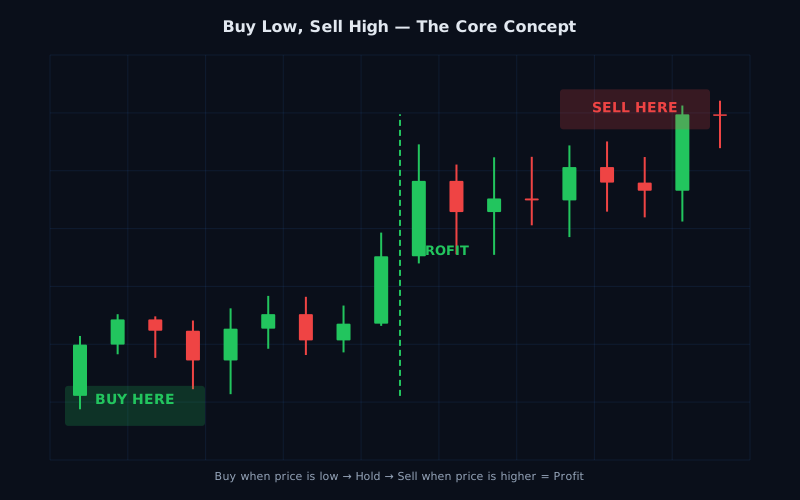
The Simple Idea: Buy Low, Sell High
At its core, trading is simple: you want to buy something when it's cheap and sell it when it's expensive. The difference between what you paid and what you sold it for is your profit.
What is a Broker?
You can't just walk up to the forex or stock market and start trading directly. You need a broker — a company that acts as your middleman and gives you access to the market.
Think of a broker like an estate agent. You want to buy a house (an asset), but you don't deal directly with the market — the estate agent handles the transaction for you. In return, they charge a fee. In trading, that fee is usually called the spread (more on that in Module 3).
Brokers provide you with a trading platform — a piece of software (usually MetaTrader 4/5 or something similar) where you can see charts, place trades, set stop losses, and track your performance.
What Happens When You Place a Trade?
Here's the step-by-step of what actually happens:
- You analyse the market and decide you think the price is going to go up
- You open a "buy" trade (also called going "long") through your broker's platform
- Your broker finds a seller and matches your order at the current market price
- The trade is now open — you own a position in the market
- If the price goes up, your trade is in profit. If it goes down, it's at a loss
- You close the trade when you decide to — either at a profit or a loss
Long vs Short — Going Both Ways
One of the most powerful (and surprising) things about financial markets is that you can make money whether prices go up or down. Here's how:
| Direction | What You Do | You Profit When... | Example |
|---|---|---|---|
| Going Long (Buy) | Buy first, sell later | Price goes UP | Buy EUR/USD at 1.0800, sell at 1.0900 |
| Going Short (Sell) | Sell first, buy back later | Price goes DOWN | Sell EUR/USD at 1.0900, buy back at 1.0800 |
Going short might feel strange at first — how can you sell something you don't own? Your broker essentially lends it to you. You sell it now, and when you close the trade, you buy it back. If the price went down, you buy it back cheaper than you sold it, and pocket the difference.
Demo Accounts — Practice for Free
Before you trade with real money, every beginner should start on a demo account. A demo account is exactly like a real trading account, except the money isn't real. Your broker gives you virtual funds (usually $10,000 or £10,000) to practice with.
There is absolutely no reason to risk real money before you've spent time on a demo account first. Even experienced traders use demo accounts to test new strategies. Think of it like a flight simulator — pilots spend hundreds of hours in the simulator before they ever take off in a real plane.
Most people who lose money trading do so because they rushed to a live account before they were ready. There is no glory in losing real money fast. Stay on demo until you're consistently profitable — then make the switch.
Trading is buying and selling financial assets with the aim of profiting from price movements. You need a broker to access the markets. You can profit going both up (long) and down (short). Always start on a demo account before touching real money.
- Broker = your middleman to access markets
- Long = you think price goes UP (buy first, sell later)
- Short = you think price goes DOWN (sell first, buy back cheaper)
- Demo account = practice with fake money, same real-market conditions
- Always start on demo — never skip this step
Quick Quiz
1. What is the role of a broker in trading?
2. Going "long" on a trade means you believe the price will...
3. With a "short" trade, when do you make a profit?
4. What is the main purpose of a demo account?
Who Moves the Markets?
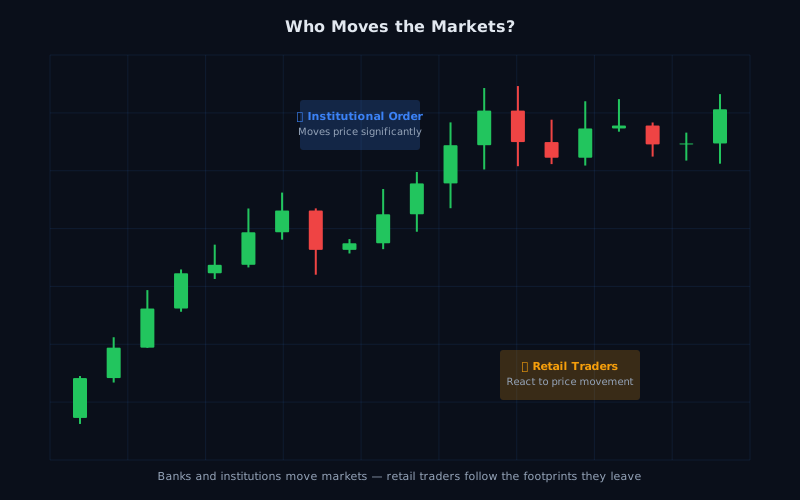
⏱ 6 min readUnderstanding who actually participates in financial markets is one of the most underrated lessons in trading. It's not just regular people sitting at their computers like you and me. There's a whole food chain of players, and knowing where you sit in that chain will completely change how you think about price movements.
1. Retail Traders — That's You
Retail traders are individuals who trade from home (or anywhere, really) using their own money. They typically have accounts ranging from a few hundred to a few thousand pounds/dollars. You're about to become one.
Retail traders make up a surprisingly small percentage of actual market volume — maybe 5-10%. But we're the most visible group online, and there's a huge industry built around selling courses, signals, and tools to us.
2. Institutional Traders — The Giants
Institutional traders are the big players: investment banks (Goldman Sachs, JPMorgan), hedge funds, pension funds, insurance companies, and central banks like the Bank of England or the Federal Reserve.
These entities trade with hundreds of millions or billions of dollars at a time. When a big hedge fund decides to buy or sell, they move the market. Their trades don't just appear and disappear — they leave footprints in the price action, and learning to read those footprints is what the intermediate course (Smart Money Concepts) is all about.
3. Market Makers — The Liquidity Providers
Market makers are entities (usually large banks or specialist firms) whose job is to ensure there's always someone on the other side of your trade. Without them, you'd place a buy order and nobody might want to sell to you — the market would freeze.
Market makers profit from the spread — the tiny difference between the buy price and sell price. They set both prices and pocket that gap on every single trade that passes through. It's a very profitable business when you're handling millions of trades per day.
The Trading Food Chain
| Player | Who They Are | Their Power |
|---|---|---|
| Central Banks | Bank of England, Federal Reserve, ECB | They set interest rates and can print money — the ultimate market movers |
| Institutional Investors | Goldman Sachs, hedge funds, pension funds | Trade billions, move markets with every decision |
| Market Makers | Large banks, specialist firms | Provide liquidity, profit from spread on every trade |
| Retail Traders | You and me, trading from home | Follow the bigger players' movements (ideally) |
Why Does This Matter to You?
Here's the important bit: because institutions trade in such massive sizes, they can't just buy or sell all at once — that would move the price against themselves. Instead, they have to build their positions over time, using specific price levels. This creates patterns and behaviour in the charts that you can learn to recognise.
When you understand that the big players need to enter and exit at specific zones, you stop seeing charts as random noise. You start seeing the footprints of the whales. That's the foundation of Smart Money Concepts — which you'll learn in the intermediate course.
The world's largest single forex transaction ever recorded was made by George Soros in 1992, when he famously "broke the Bank of England" by short-selling £10 billion worth of British pounds in a single day. He made over $1 billion in profit. Even governments aren't safe from institutional traders.
Markets are made up of retail traders, institutional traders, and market makers. Institutions trade billions and genuinely move markets. As a retail trader, your goal is to understand how big players behave and position yourself in the same direction — not against them.
Quick Quiz
1. Which group of traders has the most influence over price direction?
2. What is the main purpose of a market maker?
3. As a retail trader, what is the best approach when understanding institutional behaviour?
How Do People Make Money?
⏱ 7 min readLet's get into the numbers. How does a trade actually become a profit or a loss? And why do so many beginners struggle to make money consistently?
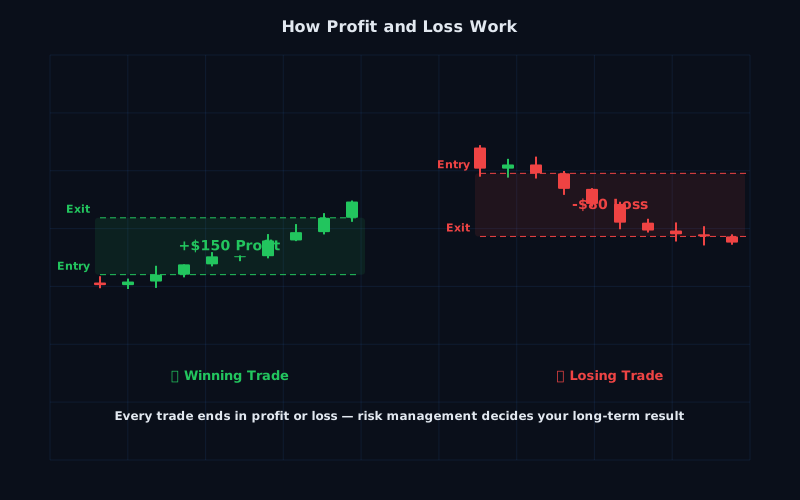
Profit and Loss — The Basics
Every trade has two moments: when you open it and when you close it. The difference between those two prices (adjusted for how much you traded) is your profit or loss. Simple as that.
📊 Example Trade #1 — A Winning Long Trade
📊 Example Trade #2 — A Winning Short Trade
Don't worry about "pips" yet — that's covered in Module 3. For now, just understand that every trade has an entry price and an exit price, and the gap between them is your profit or loss.
Why Do Most Beginners Lose Money?
Statistics suggest that around 70-80% of retail traders lose money. That sounds scary, but it's not because trading is impossible — it's because most people approach it the wrong way. Here are the most common reasons:
- No trading plan: They open trades based on feelings, tips from friends, or random social media posts. Without a plan, you're essentially gambling.
- No risk management: They risk too much money on each trade. One bad trade wipes out their account.
- Revenge trading: After a loss, they jump straight back into another trade — emotional and angry — trying to "win it back." This almost always makes things worse.
- Unrealistic expectations: They expect to turn £500 into £50,000 in three months. When it doesn't happen, they take bigger risks and blow their account.
- Giving up too soon: Trading is a skill. Like any skill, it takes time to develop. Most people quit after a few weeks before they've had the chance to learn properly.
Realistic Expectations — This is NOT Get Rich Quick
We need to be honest with you here: trading is not a fast path to wealth. Professional traders — people who do this full-time and have been doing it for years — are happy making 15-30% returns per year consistently. Anything above that is exceptional.
To put that in perspective: if you have a £10,000 account and make 20% per year, that's £2,000 profit. Not bad — but not the Lamborghini lifestyle you might have seen advertised online. The people selling you "£10,000 a day from your laptop" are almost always selling a dream, not reality.
Warren Buffett, one of the most successful investors of all time, averages around 20% annual returns. That's considered extraordinary. If someone is promising you 100% returns per month, they're either lying or about to blow up spectacularly.
Profit comes from the difference between your entry and exit price. Most beginners lose because they have no plan, no risk management, and unrealistic expectations. Focus on learning and developing your skill first — the profits follow when the foundation is solid.
- P&L = difference between entry and exit price
- Top 3 reasons beginners lose: no plan, no risk management, revenge trading
- Professional target: 15–30% per year (not per day!)
- Goal in Year 1: learn the skill, not make a fortune
- Realistic mindset = long-term edge
Quick Quiz
1. You buy EUR/USD at 1.0800 and sell at 1.0850. What happened?
2. Which of these is the biggest reason most beginner traders lose money?
3. What is a realistic annual return target for a professional trader?
Getting Started Checklist
⏱ 6 min readBefore you take your first step into the markets, let's make sure you have everything in order. This lesson is practical — by the end of it, you'll have a clear picture of exactly what you need and the right mindset going in.
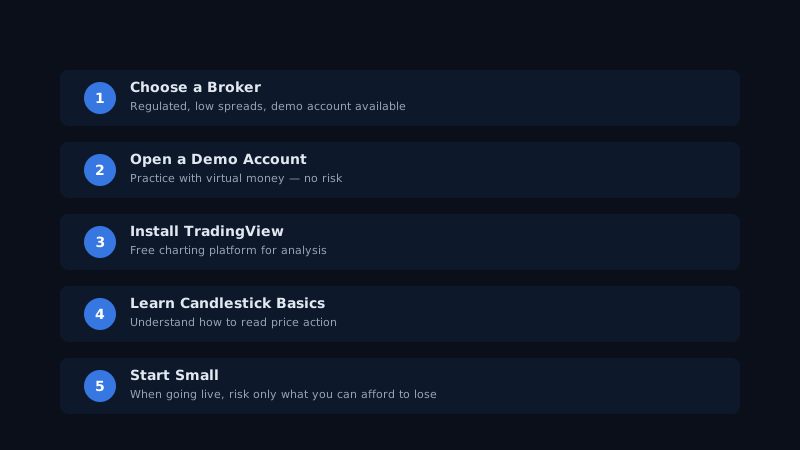
What You Actually Need
Here's the good news: you don't need much to get started. Here's what you do need:
- A computer or smartphone with internet access
- A free account with a reputable broker (we'll cover broker selection in Module 5)
- A demo account to practice on first — always start here
- A trading journal (could be a simple notebook or a spreadsheet)
- A few hours per week to learn and practice
- Patience — this is a marathon, not a sprint
How Much Money Do You Need?
This is a question everyone asks. Here's the honest answer: start with zero. Your first weeks or months should be entirely on a demo account — fake money, real market conditions. There's no point depositing real money before you understand what you're doing.
When you're consistently profitable on demo and ready to go live, you can start with as little as £100-£500. With proper risk management (which you'll learn in Module 5), even a small account can help you build skills and confidence.
This isn't just a legal disclaimer — it's the most important rule in trading. Only ever trade with disposable income. Never trade with your rent money, emergency savings, or money you've borrowed. The emotional pressure of trading with "scared money" will destroy your decision-making.
Time Commitment
You absolutely do not need to sit in front of charts all day. In fact, many successful traders only trade for 1-2 hours per day during specific sessions. What matters more than time at the screen is:
- Spending time learning (like you're doing right now)
- Reviewing your trades after they close
- Being selective and patient — waiting for good setups, not trading out of boredom
The Right Mindset
Your mindset going in will determine your results more than any strategy. Here are the mental shifts you need to make before you trade your first pip:
- Embrace losing trades: Even the best traders in the world lose on 40-50% of their trades. A loss is not a failure — it's part of doing business. The skill is in keeping losses small and letting winners run.
- Trust the process, not the outcome: Judge yourself on whether you followed your plan, not on whether that individual trade made money. A bad outcome from a good decision is just bad luck. A good outcome from a bad decision is just good luck — it won't repeat.
- Slow down to speed up: The traders who try to rush to big money are usually the ones who blow up the fastest. Take your time, build your knowledge, and the results will follow.
- Why I'm trading: (e.g. to build financial literacy, create a second income)
- My starting capital: £______ (can be £0 on demo)
- How many hours I'll study per week: ______
- My risk rule: Never risk more than ___% per trade
- My trading hours: I will trade between ______ and ______
- My goal for the next 3 months: (focus on learning, not money)
You don't need much to start — just a computer, a broker account, and the right mindset. Always start on demo. Never risk money you can't afford to lose. Trading doesn't require all-day screen time — quality beats quantity. Most importantly: your mindset is your most important tool.
Quick Quiz
1. What should you do before depositing real money with a broker?
2. Which of these is the most important trait for a new trader to develop?
3. What money should you NEVER use for trading?
What is a Price Chart?
⏱ 6 min readCharts are the trader's main tool. Before you can make any trading decisions, you need to be able to read a chart. The good news? A price chart is actually very simple — once you understand the basics, everything clicks.
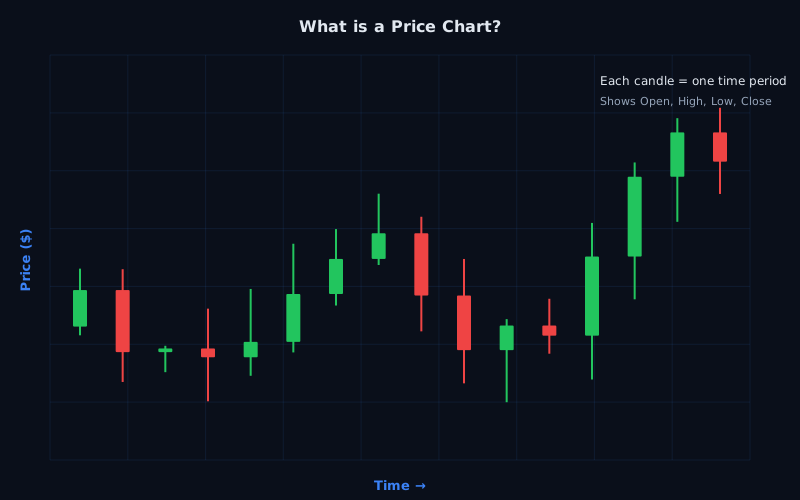
A Chart is Just a Picture of Price Over Time
That's it. That's all a price chart is. On one axis (the bottom, called the X axis) you have time. On the other axis (the side, called the Y axis) you have price. The chart simply plots where the price was at every moment in time, giving you a visual history of what the market has been doing.
Why Do Traders Use Charts?
Charts let you see patterns in price behaviour. Since markets are driven by human psychology — and humans tend to repeat the same behaviours — patterns that happened in the past often repeat in the future. By studying charts, traders try to:
- Identify the direction the market is currently moving
- Spot key price levels where the market has reacted before
- Find potential entry points for trades
- Manage their risk by knowing where they're wrong
The Three Main Chart Types
There are several ways to display the same price data. Here are the three you'll encounter most:
| Chart Type | What It Shows | Best For |
|---|---|---|
| Line Chart | Just the closing price connected by a line — the simplest view | Getting a quick overview of the overall trend |
| Bar Chart | Shows open, high, low, and close for each period as a vertical bar | More detail than a line chart, less visual than candlesticks |
| Candlestick Chart | Shows open, high, low, and close — but in a more visual, intuitive way | The most popular by far — used by most professional traders |
The vast majority of traders use candlestick charts. They give you the most information at a glance, and the patterns they form are extremely well-documented. In the next lesson, you'll learn exactly how to read them.
Candlestick charts were invented in Japan in the 1700s by a rice trader named Munehisa Homma. He used them to track rice prices and became one of the wealthiest traders of his time. Candlestick analysis is over 300 years old — and it still works today.
A price chart is simply a visual history of price over time. The X axis is time, the Y axis is price. Traders use candlestick charts because they show open, high, low, and close in an easy-to-read visual format — and they've been used successfully for over 300 years.
Quick Quiz
1. On a price chart, what does the X axis (horizontal) represent?
2. Which chart type is most commonly used by professional traders?
3. Where did candlestick charts originate?
Reading Candlesticks
⏱ 8 min readThis is one of the most important skills you'll develop as a trader. Every single candlestick on a chart is telling you a story — a story about the battle between buyers and sellers over a period of time. Once you can read that story, you'll never look at a chart the same way again.
What is a Candlestick?
Each candlestick represents a specific period of time. On a 1-hour chart, each candle covers 1 hour. On a daily chart, each candle covers a full day. Within that time period, a candle records four things:
- Open
- The price at which trading started for that period
- Close
- The price at which trading ended for that period
- High
- The highest price reached during that period
- Low
- The lowest price reached during that period
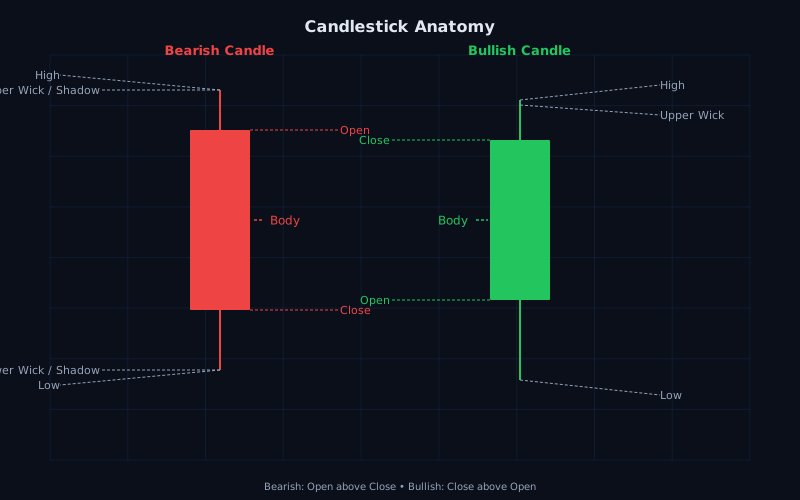
The anatomy of a candlestick — the body shows the open-to-close range, the wicks show the high and low extremes
Green (Bullish) Candles
When the close is higher than the open, buyers won the battle during that period. The candle is green (or sometimes white). This is called a bullish candle.
The bottom of the body is the open price. The top of the body is the close price. Buyers stepped in, pushed the price up, and the period closed higher than it opened.
Red (Bearish) Candles
When the close is lower than the open, sellers won the battle. The candle is red (or sometimes black). This is called a bearish candle.
The top of the body is the open price. The bottom of the body is the close price. Sellers dominated, pushed the price down, and the period closed lower than it opened.
The Wicks — The Full Story
The thin lines extending above and below the body are called wicks (or shadows). They show you how far price moved outside the open-close range before being pushed back:
- Upper wick: Price went this high, but sellers rejected it and pushed it back down
- Lower wick: Price went this low, but buyers rejected it and pushed it back up
A long wick signals strong rejection of a price level. If you see a long upper wick, it means buyers tried to push price higher but got defeated — sellers are strong at that level. A long lower wick means sellers tried to push price down but got defeated — buyers are defending that level.
What Candle Size Tells You
- Big body: Strong conviction. Buyers (green) or sellers (red) were firmly in control. The market had a clear direction.
- Small body: Indecision. Buyers and sellers were roughly equal. Neither side had control — often called a "doji."
- No wick (or very small): Price moved in one direction and didn't look back. Extreme conviction.
- Big wicks on both sides: A very volatile, uncertain period. Price whipsawed in both directions.
A candle with an almost non-existent body (where open and close are at nearly the same price) is called a Doji. It represents a moment of complete indecision in the market, and when it appears after a strong trend, it often signals a potential reversal.
Every candle records Open, High, Low, and Close (OHLC). Green candles = buyers won (close above open). Red candles = sellers won (close below open). Long wicks show rejection of price levels. Big bodies show conviction. Small bodies show indecision.
- OHLC = Open, High, Low, Close
- Green candle = bullish (close > open)
- Red candle = bearish (close < open)
- Wick = rejection of a price level
- Big body = conviction; small body = indecision (doji)
- Long lower wick = buyer rejection (support)
- Long upper wick = seller rejection (resistance)
Quick Quiz
1. A green (bullish) candlestick means...
2. What does a long upper wick on a candlestick indicate?
3. What is a "Doji" candle?
4. On a 4-hour chart, how much time does each candlestick represent?
5. A big-bodied red candle with tiny wicks suggests...
Timeframes Explained
⏱ 6 min readWhen you open a charting platform, you'll see options to view the same market on different "timeframes." This is one of those concepts that sounds technical but is actually incredibly intuitive once you get it.
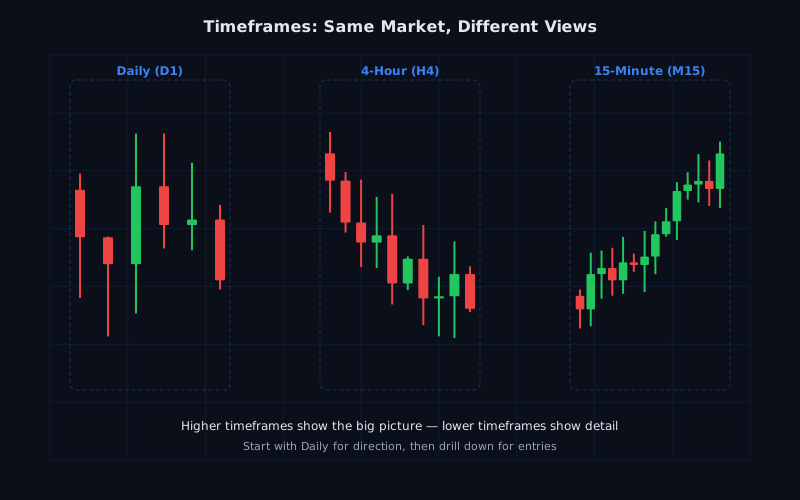
What is a Timeframe?
A timeframe determines how much time each candlestick represents. On a 15-minute chart, each candle covers 15 minutes. On a daily chart, each candle covers one full day. The market price data is the same — you're just looking at it through a different lens.
Common Timeframes Explained
| Timeframe | Each Candle = | Used For |
|---|---|---|
| M1 (1 minute) | 1 minute | Very short-term scalping — very fast, very noisy |
| M5 (5 minute) | 5 minutes | Short-term scalping |
| M15 (15 minute) | 15 minutes | Short-term intraday entries |
| H1 (1 hour) | 1 hour | Good balance of detail and clarity — great for beginners |
| H4 (4 hour) | 4 hours | Swing trading, identifying key levels |
| D1 (Daily) | 1 day | Big picture trend direction — beginners should always check this |
| W1 (Weekly) | 1 week | Long-term structure, major levels |
Higher vs Lower Timeframes
Higher timeframes (H4, Daily, Weekly) give you the "big picture." They filter out all the noise of short-term price fluctuations and show you the dominant trend and major price levels. The key question here is: which direction is price broadly moving over weeks or months?
Lower timeframes (M1, M5, M15, H1) show you the fine detail. They're where you look for specific entry points once you've understood the bigger picture. However, they contain a lot of "noise" — random short-term price movements that don't reflect the bigger picture.
Which Timeframe Should Beginners Use?
Start with these two:
- Daily (D1): Check this first, every time. It tells you what the overall trend is and where the major support/resistance levels are. Think of this as your "compass."
- 1-Hour (H1): Use this for your actual analysis and entries. It gives you enough detail to find good setups without being overwhelmed by noise.
The classic beginner mistake is to look only at the 5-minute chart. Everything looks like a trend on a 5-minute chart — but if you check the daily, you might be trying to buy into a market that's actually in a strong downtrend. Always know the bigger picture first.
A timeframe determines how much time each candle represents. Higher timeframes = big picture, major trends. Lower timeframes = fine detail, noisy. As a beginner, check the Daily chart for direction and use the 1-Hour chart for entries. Always know what the bigger timeframe is doing before trading the smaller one.
Quick Quiz
1. On an H4 (4-hour) chart, each candle covers...
2. Which combination of timeframes is best recommended for beginners?
3. Why is it important to check higher timeframes before trading on lower ones?
Your First Chart Analysis
⏱ 6 min readYou've learned what a chart is. You can read candlesticks. You understand timeframes. Now let's bring it all together and look at how to actually analyse a chart — simply and without overthinking it.
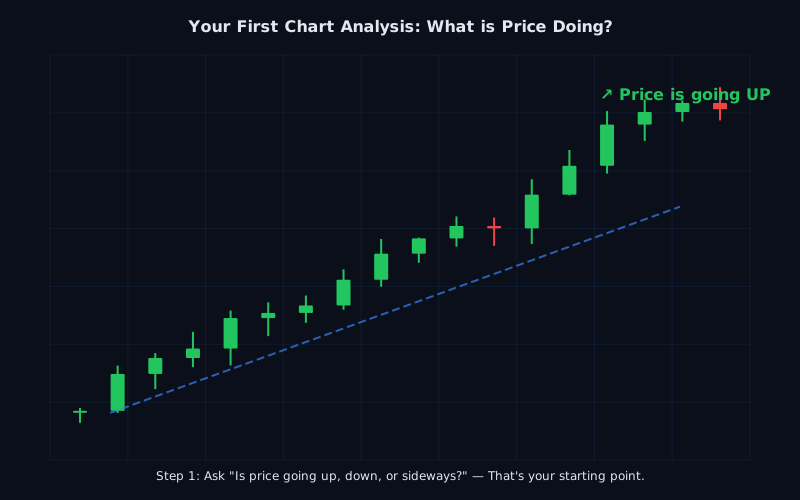
Step 1: Ask "What is Price Doing?"
The first and most important question you should ask when looking at any chart is: is price going up, down, or sideways? Nothing else matters until you answer this.
- Going up (uptrend): You see a series of higher peaks and higher valleys — the price keeps making new highs and when it pulls back, it doesn't go back as far as the previous low
- Going down (downtrend): You see lower peaks and lower valleys — each rally is weaker than the last, and each dip goes lower
- Going sideways (ranging): Price is bouncing between two roughly horizontal levels — no clear direction up or down
Step 2: Find the Obvious Levels
Once you know the direction, look for obvious price levels where price has reacted before. These are the areas where price bounced, reversed, or paused. You don't need any tools or indicators for this — just your eyes.
Draw a horizontal line at those levels. Ask yourself: "If price comes back here, what's likely to happen?" We'll go much deeper into this in Module 4 (Support and Resistance), but for now, just practice identifying these zones by eye.
Step 3: Keep it Simple
One of the biggest traps beginners fall into is overcomplicating the chart. They add 10 different indicators, draw lines everywhere, and end up more confused than when they started. The best traders usually have the cleanest charts.
For now, your analysis should just be:
- Check the daily chart — what direction is price broadly moving?
- Check the 1-hour chart — are there any obvious levels nearby?
- Describe what you see out loud (or in writing) — "Price is in an uptrend on the daily, currently pulling back to a previous support level on the 1-hour."
Open any free charting platform (TradingView is free at tradingview.com) and pull up EUR/USD on the daily chart. Write down in your journal:
- Is price going up, down, or sideways?
- Can you see any obvious horizontal levels where price bounced before?
- Now switch to the 1-hour chart and describe what you see
Don't worry if you're not sure yet — the point is to start looking and building the habit of observation.
Chart analysis starts with the simplest question: is price going up, down, or sideways? Then find obvious reaction levels. Keep your charts clean — less is more. The best analysis is often the most straightforward one.
Quick Quiz
1. What is the very first question you should ask when looking at a chart?
2. In an uptrend, what are you typically seeing on the chart?
3. Why is it better to keep your chart simple rather than adding lots of indicators?
Bull vs Bear
⏱ 5 min readIf you spend any time around traders, you'll hear these two words constantly: bull and bear. They're used to describe whether prices are going up or down, whether a trader thinks something will rise or fall, and even the general mood of the entire market.
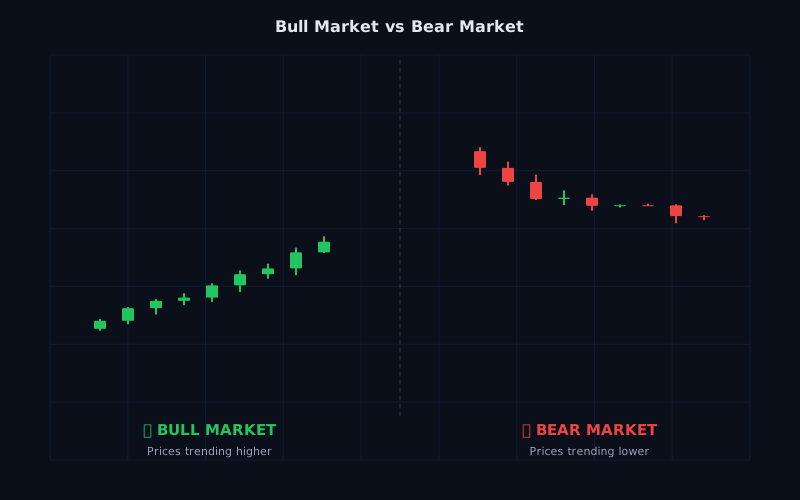
Bull Market — Everything is Going Up
A bull market is when prices are rising over a sustained period of time — think of a bull charging upwards, horns raised high. The general mood is positive: investors are confident, economies are growing, and most people's portfolios are getting bigger.
When someone says they're bullish, they mean they expect price to go up. They're looking to buy.
Bear Market — Prices are Falling
A bear market is when prices are falling over a sustained period — think of a bear swiping its paw downwards. The mood is pessimistic: investors are nervous, confidence is low, and portfolios are shrinking.
When someone says they're bearish, they mean they expect price to go down. They're looking to sell (or short).
| Term | Meaning | Trader's intention |
|---|---|---|
| Bullish | Expecting price to go UP | Looking to BUY (go long) |
| Bearish | Expecting price to go DOWN | Looking to SELL (go short) |
| Bull market | Extended period of rising prices | Buyers in control |
| Bear market | Extended period of falling prices | Sellers in control |
In Everyday Use
You'll use these words constantly. Here are some examples of how traders talk:
- "I'm bullish on GBP/USD this week — I think it's heading higher."
- "The market turned bearish after that news release — price dropped fast."
- "We've been in a bull market for two years, but I think a correction is coming."
- "I'm looking for a bearish setup on gold."
The origin of these terms is debated. One popular theory: "bull" comes from the way a bull tosses its horns upward when it attacks, and "bear" from the proverb "don't sell the bear's skin before catching it" — implying selling something you don't yet own (short selling). The terms have been used in finance since at least the 1700s.
Bullish = expecting prices to go up. Bearish = expecting prices to go down. Bull market = prices rising. Bear market = prices falling. These are two of the most-used words in all of trading — you'll use them every single day.
Quick Quiz
1. If a trader says "I'm bearish on EUR/USD," what does that mean?
2. A bull market is characterised by...
3. Which direction does a bull's attack go — helping you remember what "bullish" means?
Pips, Points & Lots
⏱ 7 min readWhen traders talk about profits and losses, they use specific units of measurement. These can seem confusing at first, but they're actually very logical once you understand the system. Let's break them down one by one.
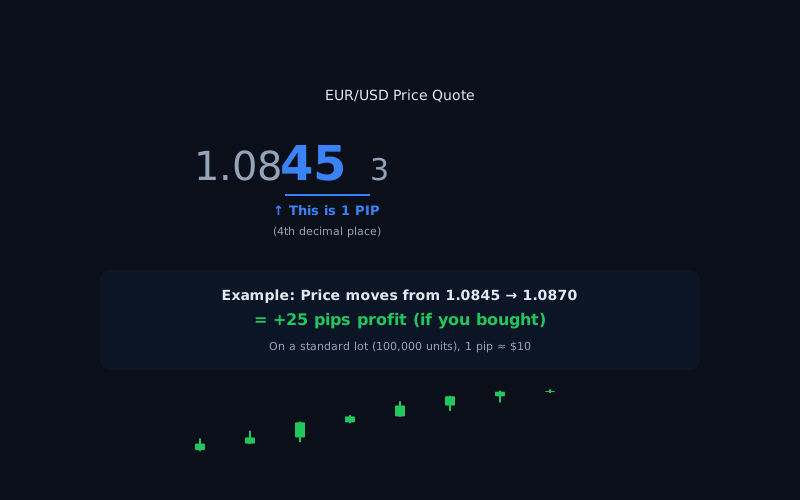
What is a Pip?
A pip stands for "Percentage in Point" (or "Price Interest Point"). In forex, a pip is the smallest standard price movement for a currency pair.
For most forex pairs (like EUR/USD, GBP/USD), prices are quoted to 4 decimal places. A pip is a movement in the 4th decimal place.
📊 Pip Example
For JPY pairs (like USD/JPY), prices are quoted to 2 decimal places, so a pip is the movement in the 2nd decimal place. Some brokers now quote to 5 decimal places ("pipettes") for more precision.
What is a Lot?
A lot is how much you're trading — it's your trade size. This matters massively because your lot size determines how much each pip is worth to you in real money.
| Lot Type | Units | Pip value (approx, EUR/USD) |
|---|---|---|
| Standard Lot | 100,000 units | ~$10 per pip |
| Mini Lot | 10,000 units | ~$1 per pip |
| Micro Lot | 1,000 units | ~$0.10 per pip |
So if you're trading a standard lot and EUR/USD moves 50 pips in your favour, you make approximately $500. The same 50-pip move on a micro lot = $5. Lot size is the single biggest lever in how much money you make or lose per trade.
Why Beginners Should Use Micro Lots
When you're learning, keep your lot sizes small. On a micro lot, even a 100-pip loss against you is only $10. That gives you plenty of room to practice without blowing your account. As you get more consistent, you can gradually increase your size.
The term "lot" in trading comes from the early days of the stock market, when shares were sold in physical certificates bundled together in fixed quantities — called "lots." The terminology stuck, even as everything went digital.
A pip is the smallest standard price movement in forex (4th decimal place for most pairs). Lot size determines how much each pip is worth to you. Standard lot = $10/pip, Mini = $1/pip, Micro = $0.10/pip. As a beginner, always start with micro lots to protect your capital while learning.
- Pip = smallest standard move = 4th decimal place for most FX pairs
- Standard lot = 100,000 units (~$10/pip)
- Mini lot = 10,000 units (~$1/pip)
- Micro lot = 1,000 units (~$0.10/pip)
- Beginners: always use micro lots first
Quick Quiz
1. EUR/USD moves from 1.1200 to 1.1250. How many pips is that?
2. How many currency units are in a standard lot?
3. You're trading a micro lot on EUR/USD. Each pip is worth approximately...
4. Why should beginners use micro lots when learning?
Leverage & Margin
⏱ 7 min readThis lesson covers one of the most powerful — and most dangerous — concepts in trading. Leverage can amplify your profits significantly, but it can also amplify your losses just as fast. Understanding it properly is non-negotiable before you ever trade with real money.
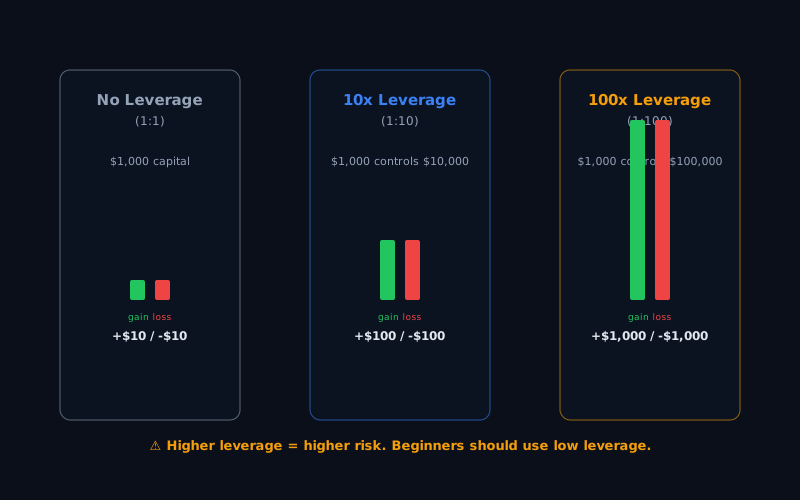
What is Leverage?
Leverage is borrowed money from your broker that lets you control a much larger position than your actual deposit.
📊 Leverage Example (1:100)
Leverage is a Double-Edged Sword
This example shows exactly why leverage is dangerous. A 1% price movement — which happens constantly in forex — would wipe out your entire deposit at 1:100 leverage. The higher your leverage, the smaller the price movement needed to blow your account.
What is Margin?
Margin is the amount your broker holds from your account as a deposit when you open a leveraged trade. It's not a fee — it's collateral. Think of it as the security deposit the broker requires before letting you borrow their money.
If your trade goes against you and your account balance falls close to the margin level, you'll get a margin call — your broker will notify you (or automatically close your trades) to prevent your account going negative.
The number one way beginners destroy their accounts is by using too much leverage. Brokers offer 1:500 leverage, but that doesn't mean you should use it. Most professional traders use 1:10 or less. When starting out: use the lowest leverage your broker offers, or none at all.
Leverage lets you control a larger position than your deposit. 1:100 leverage means £100 controls £10,000. Both profits AND losses are amplified. Margin is the collateral your broker holds. A margin call means you're running out of money. Beginners should use low leverage (1:10 or less) until they have real experience.
- Leverage = borrowed money to control bigger position
- Example: 1:100 leverage, £100 deposit → controls £10,000
- Margin = the deposit your broker holds as collateral
- Margin call = broker warning you're about to lose your deposit
- Rule: use low leverage (1:10 or less) when starting out
- Leverage amplifies both gains AND losses equally
Quick Quiz
1. With 1:50 leverage and a £200 deposit, what size position do you control?
2. What is a margin call?
3. Why is leverage considered a "double-edged sword"?
4. What leverage ratio is most recommended for complete beginners?
Common Trading Terms
⏱ 7 min readTrading has its own language, and when you're new, it can feel like everyone is speaking a foreign dialect. This lesson is your trading dictionary — the key terms you'll hear every day, explained clearly.
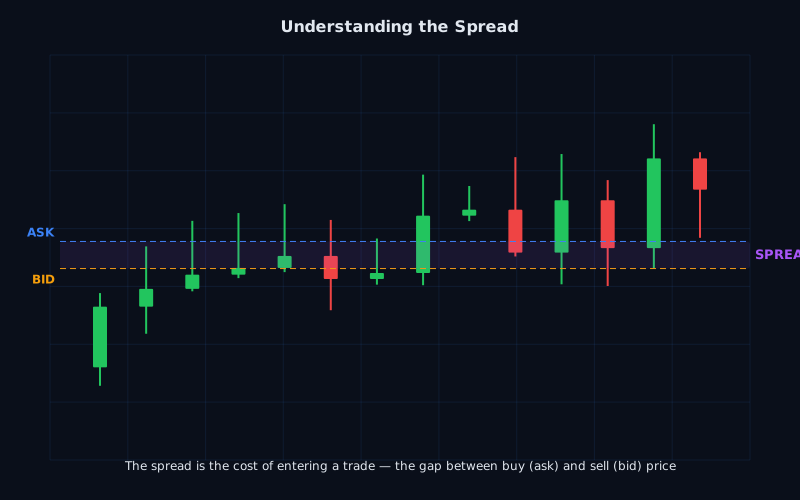
Spread
The spread is the difference between the buy price (ask) and the sell price (bid) of an asset. It's how brokers make their money.
When you look at a forex quote, you'll see two prices: the bid and the ask. For example: EUR/USD 1.0800 / 1.0802. The spread is 2 pips. Every time you open a trade, you start slightly at a loss equal to the spread — you have to make those 2 pips back before you're in profit.
Slippage
Slippage happens when your trade is filled at a different price than you intended. This usually happens during fast-moving markets or around major news events when prices are moving so quickly that by the time your order reaches the broker, the price has shifted.
For example: you try to buy at 1.0800 but because the market is moving fast, you get filled at 1.0803. That 3-pip difference is slippage.
Liquidity
Liquidity refers to how easily you can buy or sell an asset without significantly moving the price. A highly liquid market (like EUR/USD) has millions of buyers and sellers at any given moment — you can buy or sell instantly at a fair price. An illiquid market has few participants, so your trade might move the price against you, or you might struggle to exit your position.
Volatility
Volatility is how much price moves. High volatility means price is swinging around a lot — big moves in short periods. Low volatility means price is relatively stable. As a beginner, high volatility creates both opportunity (bigger moves = bigger potential profit) and risk (bigger moves = bigger potential loss).
Volume
Volume is the number of units traded during a specific period. High volume means lots of activity — many traders buying and selling. High volume often accompanies important market moves, confirming their significance. Low volume moves can be unreliable or easily reversed.
Consolidation
Consolidation is when price moves sideways within a relatively tight range, neither trending up nor down. Think of it as the market "taking a breath" between big moves. Consolidation phases often resolve with a breakout in one direction.
Breakout
A breakout happens when price moves decisively outside a range or beyond a key level it's been respecting. If price has been consolidating between 1.0800 and 1.0900 for a week, and then suddenly closes above 1.0900 with strong volume — that's a breakout. Breakouts often signal the start of a new trend or a significant continuation move.
- Spread
- Buy price minus sell price — the broker's fee on every trade
- Slippage
- Being filled at a different price than intended, usually in fast markets
- Liquidity
- How easily you can buy/sell without moving the price against yourself
- Volatility
- How much price moves — high volatility = big swings
- Volume
- Number of units traded in a period — confirms strength of moves
- Consolidation
- Price moving sideways in a range — "resting" between big moves
- Breakout
- Price escaping a range or breaking a key level with momentum
These seven terms — spread, slippage, liquidity, volatility, volume, consolidation, and breakout — will come up in every trading conversation. Learning them now means you'll understand trading content, news, and discussions far more easily from here on.
Quick Quiz
1. What is the "spread" in trading?
2. What is slippage?
3. In trading, "consolidation" refers to...
4. A "breakout" happens when...
5. EUR/USD is described as a "highly liquid" market. This means...
What is a Trend?
⏱ 7 min readOne of the most often-repeated pieces of trading wisdom is "the trend is your friend." It sounds like a cliché, but it's genuinely one of the most important concepts in trading. Understanding what a trend is — and how to identify one — is the foundation of everything else in technical analysis.
What Exactly is a Trend?
A trend is simply the overall direction that price is moving over a period of time. Markets can do three things:
- Move generally upward — an uptrend
- Move generally downward — a downtrend
- Move sideways — a range/consolidation
Key word: "generally." Price doesn't move in a straight line. Even in a strong uptrend, price regularly dips down before continuing higher. These dips are called pullbacks or retracements. They're completely normal and actually create trading opportunities.
Uptrend — Higher Highs and Higher Lows
An uptrend is defined as a series of higher highs (HH) and higher lows (HL). Each time price rallies, it reaches a higher peak than the last. Each time it pulls back, it holds higher than the previous pullback.
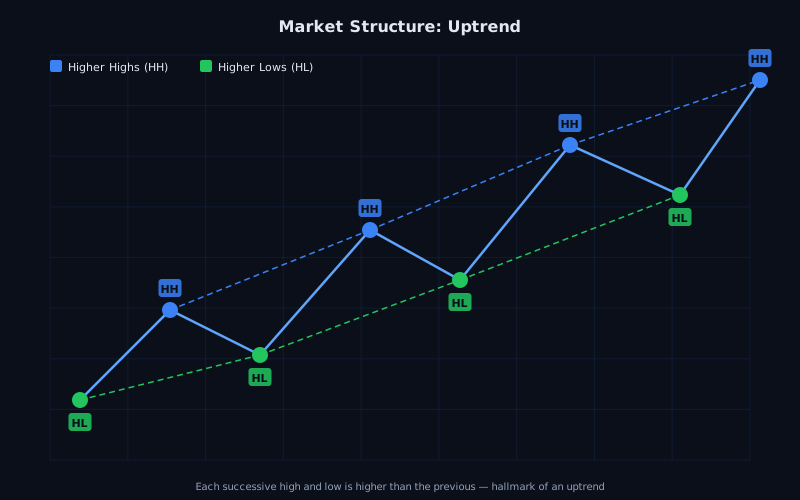
An uptrend: price makes a series of Higher Highs (HH) and Higher Lows (HL) — each rally goes higher, each pullback stays higher
Downtrend — Lower Highs and Lower Lows
A downtrend is the opposite: a series of lower highs (LH) and lower lows (LL). Each rally is weaker than the last, and each dip goes lower.
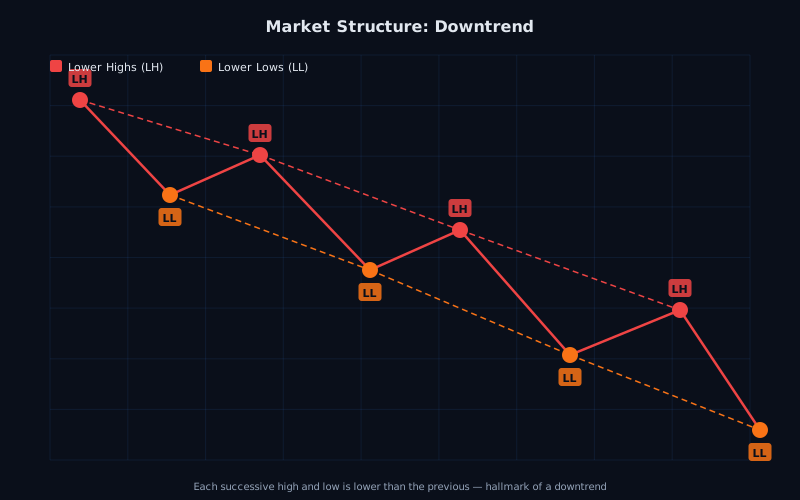
A downtrend: price makes a series of Lower Highs (LH) and Lower Lows (LL) — each rally fails higher, each dip goes lower
Why "The Trend is Your Friend"
When you trade with the trend, you have the majority of price movement on your side. If you're in an uptrend and you look for opportunities to buy (going long) on pullbacks, you're working with the natural momentum of the market. When you trade against the trend, you're fighting an uphill battle.
The concept of trend following is one of the oldest trading strategies in existence. The legendary Commodities Corporation (founded in 1969) made hundreds of millions using purely trend-following strategies. Many of today's most successful hedge funds still use trend following as their core approach.
An uptrend = higher highs and higher lows. A downtrend = lower highs and lower lows. Trading with the trend is easier and more reliable than trading against it. Trends never move in straight lines — pullbacks are normal and create buying (in uptrends) or selling (in downtrends) opportunities.
Quick Quiz
1. How is an uptrend formally defined in terms of market structure?
2. In a downtrend, what happens to each successive rally?
3. What is a "pullback" in an uptrend?
4. Why is trading with the trend generally more reliable than trading against it?
Support & Resistance
⏱ 7 min readSupport and resistance are the two most fundamental concepts in all of technical analysis. If you can identify these levels correctly, you'll have a huge advantage in understanding where price is likely to react and where to look for trade setups.
What is Support?
Support is a price level where buying pressure has historically prevented price from falling further. Think of it as a floor — every time price drops to that level, buyers step in and push it back up.
Why does this happen? Because traders have memory. If price dropped to 1.0800 three times in the past and bounced each time, traders start to expect that to happen again. When price approaches 1.0800 again, buyers pile in early (anticipating the bounce) and sellers take their profits. This creates the support level.
What is Resistance?
Resistance is a price level where selling pressure has historically prevented price from rising further. Think of it as a ceiling — every time price rises to that level, sellers step in and push it back down.
Same logic as support: traders remember where price was rejected in the past and act accordingly when price returns there. The more times price has respected a level, the more significant it becomes.
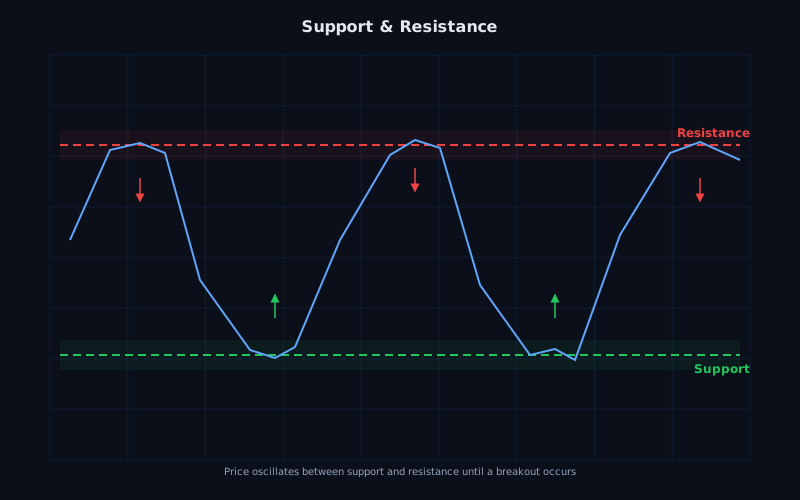
Support acts as a floor (price bounces upward from here); Resistance acts as a ceiling (price bounces downward from here)
How to Identify Support and Resistance
You don't need any special tools. Here's the process:
- Look for clusters of bounces: Find price levels where the market has touched and reversed multiple times. Two touches is okay, three or more is a strong level.
- Look at significant swing highs and lows: Major turning points in the chart create support/resistance levels.
- Look for round numbers: Prices like 1.0800, 1.1000, 1.1200 are psychological levels — many traders have orders placed at round numbers, making them significant.
What Happens When Support or Resistance Breaks?
This is the interesting part. When a support level is broken (price closes convincingly below it), that level often becomes resistance in the future. And when resistance is broken to the upside, it often flips and becomes support. This concept is called support/resistance flip (or "role reversal").
Support is a price floor where buyers step in. Resistance is a price ceiling where sellers step in. Both are created by trader memory and psychology. The more times a level has been tested, the stronger it is. When a level breaks, it often flips its role — support becomes resistance and vice versa.
- Support = price floor = buyers step in to push price up
- Resistance = price ceiling = sellers step in to push price down
- Look for: multiple bounces at the same level, major swing points, round numbers
- When support breaks → it often becomes resistance (and vice versa)
- The more times a level is tested, the more significant it becomes
Quick Quiz
1. What is a "support" level in price charts?
2. When a resistance level is convincingly broken to the upside, what often happens next?
3. Why are round numbers like 1.1000 or 1.2000 often significant as support/resistance levels?
4. What makes a support or resistance level stronger and more reliable?
Higher Highs, Higher Lows (and the Opposite)
⏱ 6 min readYou've learned what trends are, and you've seen the terms "Higher High" and "Higher Low" come up. This lesson digs deeper into those concepts because they are the absolute foundation of market structure analysis — and everything in the intermediate course builds on top of them.

Understanding Swing Points
Before we get into HH/HL, let's understand swing points. A swing high is a peak — a point where price moved up, reached a high, then turned back down. A swing low is a valley — a point where price moved down, reached a low, then turned back up. Swing points are the building blocks of market structure.
Higher High (HH) and Higher Low (HL) — Uptrend
In an uptrend:
- Higher High (HH): Each swing high reaches a higher price than the previous swing high. This tells you buyers are in control — they keep pushing price to new highs.
- Higher Low (HL): Each pullback (swing low) holds higher than the previous pullback. This tells you sellers are getting weaker — even on dips, buyers step in early.
Together, HH + HL = a confirmed uptrend. As long as this pattern holds, the trend is intact. Your job as a trader? Look for buying opportunities at or near the higher lows.
Lower High (LH) and Lower Low (LL) — Downtrend
In a downtrend:
- Lower High (LH): Each rally fails at a lower price than the previous rally. Buyers are trying to push price up but can't maintain it — sellers overwhelm each attempt.
- Lower Low (LL): Each dip goes lower than the previous dip. Sellers remain firmly in control, pushing price to new lows on every swing down.
LH + LL = a confirmed downtrend. Your job? Look for selling opportunities at or near the lower highs.
Open EUR/USD on TradingView on the Daily chart. Label the last 10 swing highs and swing lows on the chart. Then determine: is this market currently making HH + HL (uptrend), LH + LL (downtrend), or neither (ranging)?
Why This Matters So Much
These four labels — HH, HL, LH, LL — are the language of price structure. When you understand them, you can read any chart in the world and immediately know:
- What direction the market has been moving
- Whether the trend is strong or weakening
- Where potential trade opportunities exist (near the HLs in an uptrend, near the LHs in a downtrend)
HH + HL = uptrend (buyers in control, look to buy). LH + LL = downtrend (sellers in control, look to sell). Identifying these four points on any chart tells you the market's structural direction. This is the foundation of everything you'll learn in intermediate and advanced.
Quick Quiz
1. In an uptrend, what does a "Higher Low" tell you?
2. A market is making Lower Highs and Lower Lows. What is this called?
3. In a downtrend, where would you typically look for short (sell) trade opportunities?
4. What is a "swing high" in market structure?
When Structure Breaks
6 min readSo far we've talked about uptrends (higher highs, higher lows) and downtrends (lower highs, lower lows). But what happens when a trend stops behaving itself? What happens when an uptrend suddenly fails to make a new higher high? That's what this lesson is all about — recognising when something has changed.
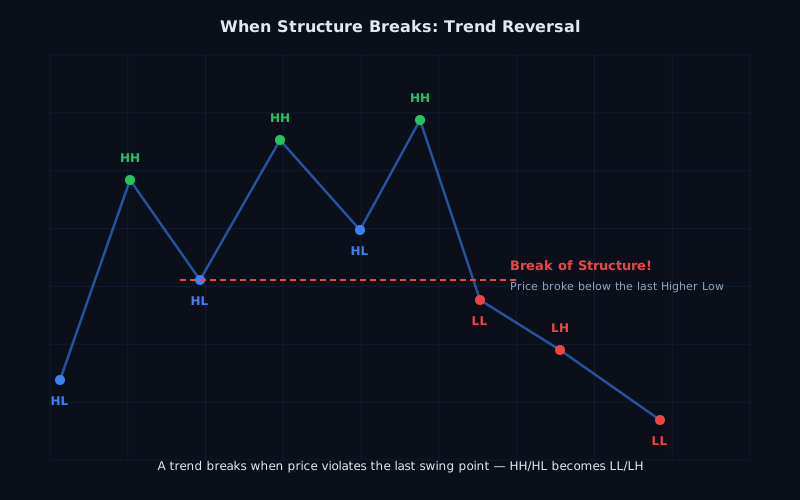
Understanding when structure breaks is one of the most important skills in trading. It's what separates traders who "hold and hope" from traders who adapt and act smartly. Let's break it down.
The Rules of a Healthy Uptrend
In a healthy uptrend, price keeps making Higher Highs (HH) and Higher Lows (HL). Every time price pulls back, it doesn't fall below the previous swing low. Every time it bounces, it reaches a new high. That's the pattern continuing in your favour.
The moment this pattern breaks — that's when you need to pay attention.
Signs That Structure May Be Breaking
Here's what to look for that might signal a change:
- Price fails to make a new Higher High — it pushes up but can't beat the last peak. Sellers are starting to overpower buyers.
- Price breaks below a Higher Low — this is a bigger warning sign. If a swing low that was supposed to hold doesn't hold, the uptrend structure is damaged.
- Momentum slows down — the candles get smaller, more indecisive. The energy behind the uptrend is fading.
In the intermediate course, you'll learn about specific terms for these moments: "Break of Structure" (BOS) and "Change of Character" (ChoCH). These are core Smart Money Concepts concepts. For now, just understand the idea — when the pattern breaks, something has changed.
The Analogy: Building Blocks
Imagine an uptrend is like stacking blocks. Each Higher High is a new block on top, and each Higher Low is the stable foundation underneath. As long as the foundation is solid, the tower keeps growing.
But if one of the foundational blocks breaks — if a Higher Low gets violated — the whole tower becomes unstable. That's your signal that the structure may be changing from bullish to bearish.
Why This Matters for Your Trading
If you're looking to buy (go long) in a market, you want to see healthy uptrend structure intact. If structure starts breaking, you either:
- Wait — don't buy a potentially broken uptrend. Be patient until new structure forms.
- Exit — if you're already in a trade and structure breaks against you, consider taking your profit or cutting your loss before it gets worse.
- Look the other way — a broken uptrend might be starting a new downtrend. Eventually, you might start looking for sell opportunities instead.
Don't Jump the Gun
One important warning: don't call a structure break too early. One failed push isn't always a reversal — sometimes it's just a pause before the trend continues. The key is to wait for confirmation. In the intermediate course, you'll learn exactly what confirmation looks like. For now, just train your eye to spot when price stops making higher highs or breaks a higher low. That awareness alone puts you ahead of most beginners.
When an uptrend fails to make a new higher high, or breaks below a higher low, the structure is weakening. When a downtrend fails to make a new lower low, or pushes above a lower high, the bearish structure is weakening. These moments of structural change are where the most significant trading opportunities appear — and they're the foundation of everything you'll learn in the intermediate course.
- Uptrend structure breaks when price fails to make HH or breaks below HL
- Downtrend structure breaks when price fails to make LL or pushes above LH
- A structural break = potential trend change (not confirmed yet)
- Terms to look up in Intermediate: BOS (Break of Structure), ChoCH (Change of Character)
- Don't trade immediately on a structure break — wait for confirmation
Quick Quiz
1. In an uptrend, what is a warning sign that structure may be breaking?
2. What should you do when you spot a potential structure break while in a long trade?
3. In the intermediate course, what are the two key terms for structural breaks?
Risk Management Essentials
Most beginners focus entirely on finding good trades. The pros focus on not losing. These 4 lessons teach you the single most important skill in trading.
The #1 Rule: Protect Your Capital
7 min readHere's a fact that surprises most people when they first hear it: professional traders don't think about making money first. Their primary focus is not losing money. Sounds backwards, right? But once you understand the math, it makes total sense.
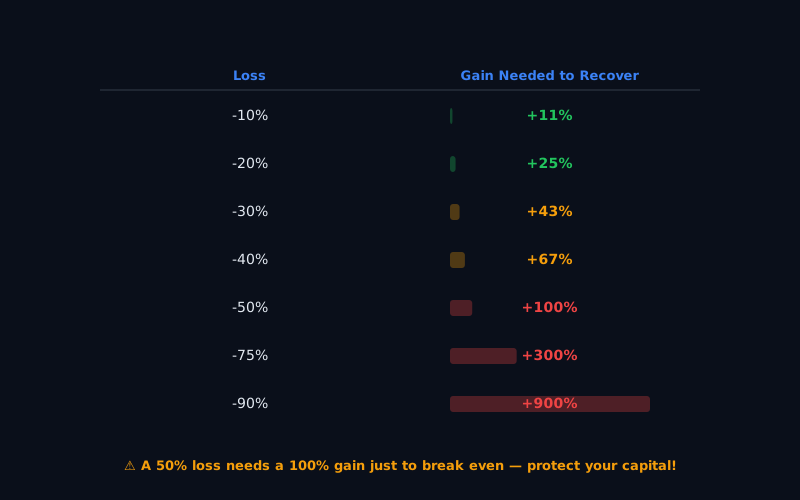
This lesson might be the most important one in the entire beginner course. Not because it's exciting — it's not. It's important because it's the difference between traders who last and traders who blow their accounts in the first three months.
The Brutal Math of Losses
Let's say you start with £1,000. You have a bad run and lose 50% — you're down to £500. To get back to £1,000, you now need to make a 100% return on your remaining money. Think about that: a 50% loss requires a 100% gain just to break even.
Let's take it further:
- Lose 25% → Need a 33% gain to recover
- Lose 50% → Need a 100% gain to recover
- Lose 75% → Need a 300% gain to recover
- Lose 90% → Need a 900% gain to recover
The deeper the hole, the harder it is to climb out. This is why professional traders obsess over protecting capital first. A trader who never loses more than 1-2% per trade can survive a losing streak of 20 trades and still have over 80% of their capital intact. A trader who risks 25% per trade can be wiped out in four bad trades.
The Surgeon Analogy
Think about a surgeon. Their primary goal isn't to perform the most surgeries or make the most money per operation — it's to not harm the patient. "First, do no harm." If a surgeon makes a mistake, the damage can be irreversible.
Trading is similar. Your capital is your patient. Protect it above everything else. Without capital, you cannot trade. Every careless trade that blows a chunk of your account sets you back further than any winning trade could bring you forward.
Why Beginners Get This Wrong
When most people first start trading, they think about the exciting part: making money. They dream about turning £500 into £5,000. They look for the trade that'll give them a big win. And in chasing that big win, they take outsized risks.
The result? They might win a few times, feel invincible, then one or two big losses wipe everything out. The account is gone, the confidence is shattered, and they quit. This is the most common story in retail trading.
Professional traders think differently. They ask: "What's the worst that can happen if I'm wrong?" before they even think about "How much could I make?" This defensive mindset is what allows them to stay in the game long enough to compound their profits over time.
What "Protecting Capital" Actually Means
It's not just about using stop losses (though that's a big part of it). Protecting capital means:
- Only risking a small percentage per trade — 1-2% of your account maximum (more on this in the next lesson)
- Not revenge trading — when you lose, the instinct is to trade immediately to "get it back." This almost always leads to more losses
- Not overtrading — trading too often means taking low-quality setups, which means more losses
- Knowing when not to trade — sometimes the best trade is no trade at all
- Having daily/weekly loss limits — if you've lost X amount today, stop. Come back tomorrow with a clear head.
You will have losing trades. Everyone does — even the best traders in the world. The goal is NOT to have a 100% win rate. The goal is to manage your losses so that when you do have a good run, it far outweighs your bad periods. A trader with a 40% win rate can be massively profitable if they manage their risk and reward correctly.
The Mental Game
There's also a psychological element to protecting capital. When you keep your risk small, losing trades don't hurt as much. You stay calm, you think clearly, and you make better decisions. When you risk too much and take a big loss, emotions take over — fear, anger, desperation. These emotions make you do stupid things in the market.
Small, managed risk keeps you rational. Rational traders make money. Emotional traders blow accounts.
Your number one job as a trader is to protect your capital. Not to make huge profits — that comes with time. First, learn to not lose. A trader who loses 25% per trade needs a 33% gain just to get even. A trader who loses 1-2% per trade can handle dozens of losses and still be in the game. Protect the account. Everything else follows.
- 25% loss needs 33% gain to recover. 50% loss needs 100% gain.
- Primary goal: Protect capital. Secondary goal: Grow capital.
- Risk management is more important than finding good setups
- Small consistent risk (1-2% per trade) = long-term survival
- Set daily loss limits — if you've lost X today, stop trading
Quick Quiz
1. If you lose 50% of your account, what return do you need to get back to even?
2. What is the PRIMARY focus of a professional trader?
3. Which of these is a good capital protection habit?
Position Sizing
8 min readPosition sizing is one of those topics that sounds boring but is absolutely game-changing once you get it. It answers the question: "How much should I trade?" And the answer isn't "as much as possible" — it's a calculated number based on your account size and how much you're willing to lose on that trade.
Get this right, and no single trade can destroy you. Get this wrong, and one bad trade can wipe you out.
The 1-2% Rule
The golden rule that professional traders follow: never risk more than 1-2% of your total account on a single trade.
Let's say you have a £1,000 trading account. 1% of £1,000 is £10. That means the maximum you should be willing to lose on any single trade is £10.
That might sound tiny. "£10? That's nothing!" But think about it this way: if you follow this rule strictly, you'd need to lose 50 trades in a row to blow your account — and that's virtually impossible if you have any trading skill at all.
Real examples:
- £500 account → max risk per trade: £5 (1%) to £10 (2%)
- £1,000 account → max risk per trade: £10 (1%) to £20 (2%)
- £5,000 account → max risk per trade: £50 (1%) to £100 (2%)
- £10,000 account → max risk per trade: £100 (1%) to £200 (2%)
Risk vs. Position Size — What's the Difference?
Here's a crucial distinction: risking 1% doesn't mean only trading 1% of your account. It means the potential loss on the trade is 1% of your account. You can enter a position worth much more than 1% — but your stop loss (where you exit if wrong) is placed so that the actual money lost is limited to 1-2%.
Example:
- You have a £1,000 account
- You want to risk 1% = £10 max loss
- You're trading GBP/USD and you place your stop loss 10 pips away from entry
- You need to find the right lot size so that 10 pips = £10 loss
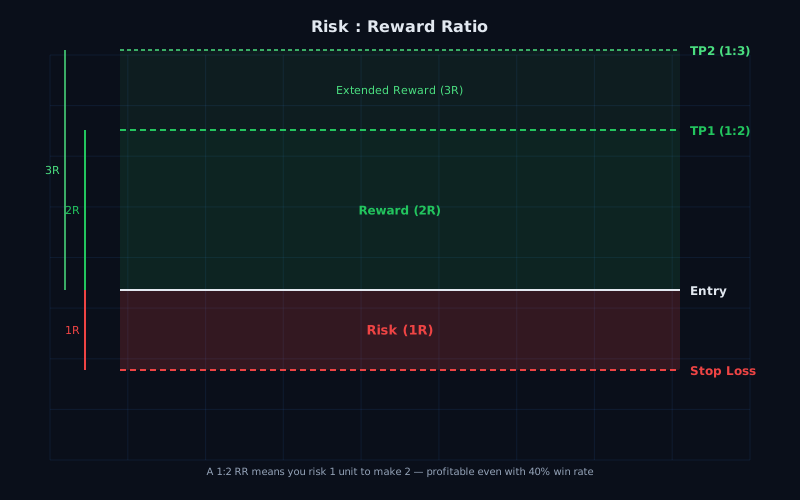
Risk-Reward: Every trade should have a defined risk (stop loss) and target (take profit). Size your position so your risk in pounds equals your planned 1-2% account risk.
How to Calculate Your Position Size
Here's the simple formula:
Position Size = Account Risk ÷ Trade Risk (in pips or points)
Don't worry about the exact maths right now — every trading platform has a position size calculator, and there are free online calculators for this. What matters is that you understand the concept: you're working backwards from "how much can I afford to lose?" to find the right trade size.
The Danger of "Winging It"
Many beginners just pick a random lot size that "feels right." £100 trade? Sure, why not. This is a recipe for disaster because their position size has nothing to do with their actual risk on that particular setup.
If their stop loss is far away (which it needs to be in certain situations), they could actually be risking 20% or 30% of their account without realising it. That's not trading — that's gambling.
Start Small, Then Scale
On a demo account, use realistic position sizes as if the money were real. When you move to a live account, start even smaller — use 0.5% risk per trade while you get comfortable. Once you're consistently profitable over at least 3 months, you can consider moving up to 1-2%.
There's no prize for risking more. The prize is staying in the game long enough to get good at this.
Never risk more than 1-2% of your account per trade. Position sizing means calculating the right trade size so that if your stop loss is hit, you only lose that predetermined amount. This keeps individual losses small and lets you survive long losing streaks without blowing up.
- Max risk per trade: 1-2% of total account
- Calculate: Account Risk ÷ Pip/Point Risk = Position Size
- Use a position size calculator — don't guess
- On first live account: start at 0.5% risk per trade
- Risk = potential loss if stop hits. Not total position value.
Quick Quiz
1. You have a £2,000 account and follow the 1% rule. What is your maximum risk per trade?
2. What does "risking 1% of your account" actually mean?
3. What is the right approach to position sizing?
4. Why is position sizing more important than finding the perfect trade?
Stop Losses & Take Profits
8 min readIf position sizing is the foundation of risk management, stop losses are the safety net. And take profits are how you actually lock in your gains. These two tools work together on every single trade. If you're not using them both, you're trading without a seatbelt.

What is a Stop Loss?
A stop loss is an automatic exit order that closes your trade if price moves against you by a certain amount. You set it when you enter the trade, and the broker executes it automatically — even if you're not watching.
Think of it like this: imagine you're going on holiday, and you leave your car keys with a friend. You say "If anything bad happens to my car, sell it immediately and send me the money." The friend is your stop loss — they act on your behalf to limit the damage when you're not there.
Without a stop loss, a trade that goes wrong can keep going wrong until you either manually close it (usually too late, after a massive loss) or it wipes your account entirely. We've all heard stories of traders who "held on hoping it would come back." Sometimes it doesn't. A stop loss prevents that nightmare scenario.
Where Do You Put Your Stop Loss?
This is where many beginners make mistakes. There are two bad approaches:
- Random stop — placing it wherever feels right without logic
- Stop based purely on money — "I'll lose £50, so I'll put my stop £50 away." This ignores what the chart is telling you.
The better approach: place your stop loss at a logical price level where your trade idea is clearly invalidated.
Examples:
- If you bought because price bounced off a support level — put your stop below that support. If price breaks through it, your reason for the trade is gone.
- If you sold at a resistance level — put your stop above that resistance. If price breaks above it, the setup is invalid.
Once you know where your stop goes logically, then you calculate your position size to make sure the financial risk is within your 1-2% rule. Never the other way around.
What is a Take Profit?
A take profit is the opposite of a stop loss — it's an automatic exit that closes your trade when price reaches your target. You define your profit target in advance, and when price gets there, the trade closes and the profit is yours.
Why is this useful? Because emotions. Without a predefined take profit, you might:
- Close too early because you get nervous ("Better take the £20 before it disappears")
- Get greedy and hold too long, then watch the trade reverse and wipe your profit
- Make inconsistent decisions based on your mood that day
A predefined take profit removes the emotional decision. You planned the exit before the trade started — now just let the plan run.
Risk-to-Reward Ratio: The Magic of 1:2
Here's where it all comes together. The risk-to-reward ratio compares how much you're risking to how much you're aiming to gain.
- 1:1 ratio — risk £10 to make £10. You'd need to be right more than 50% of the time just to break even.
- 1:2 ratio — risk £10 to make £20. Even if you're only right 40% of the time, you're profitable over many trades.
- 1:3 ratio — risk £10 to make £30. Even at a 33% win rate, you break even. At 40%, you're profitable.
The minimum target most traders use is 1:2 — aim to make at least twice what you're risking. This means you can lose the majority of your trades and still come out ahead overall, as long as you don't break your rules.
Example: You take 10 trades. All risk £10. Target is £20 (1:2 R:R).
- You win 4, lose 6 — profit: (4 × £20) - (6 × £10) = £80 - £60 = +£20 profit
A 40% win rate with 1:2 R:R is actually profitable. That's the power of a good risk-to-reward ratio.
One of the most destructive habits in trading is moving your stop loss further away when the trade is going against you. This is called "widening your stop" and it turns a controlled loss into a potentially catastrophic one. Place your stop, commit to it, and respect it. The market doesn't care about your feelings.
Some professional traders will move their stop loss to breakeven (their entry price) once the trade has moved a certain distance in their favour. This means the worst outcome becomes "no profit, no loss" rather than a loss. This is called "going to breakeven" and it's a powerful protection tool.
Every trade must have a stop loss and a take profit defined before you enter. The stop loss protects you from catastrophic losses. The take profit locks in your gains. Aim for at least a 1:2 risk-to-reward ratio — risk £10, target £20 minimum. This means you can be wrong more than half the time and still be profitable long-term.
- Stop loss = automatic exit to limit your loss if trade goes wrong
- Take profit = automatic exit to lock in your gain when target is reached
- Place stop at a logical level where your trade idea is invalidated
- Minimum Risk:Reward ratio = 1:2 (risk £10, target £20)
- NEVER widen your stop loss when a trade goes against you
- Once in profit, consider moving stop to breakeven to protect gains
Quick Quiz
1. What is a stop loss?
2. You risk £15 on a trade. What is the minimum take profit target to achieve a 1:2 risk-to-reward ratio?
3. Where should you logically place your stop loss when buying at a support level?
4. A trader with a 40% win rate using 1:2 risk-to-reward on 10 trades of equal size would…
Building Good Trading Habits
7 min readYou've learned about protecting capital, position sizing, and stop losses. Now let's talk about the habits that hold everything together. Even if you understand all the theory, bad habits will undermine you. Trading is a performance skill — like a sport or a musical instrument — and daily habits determine how fast you improve.
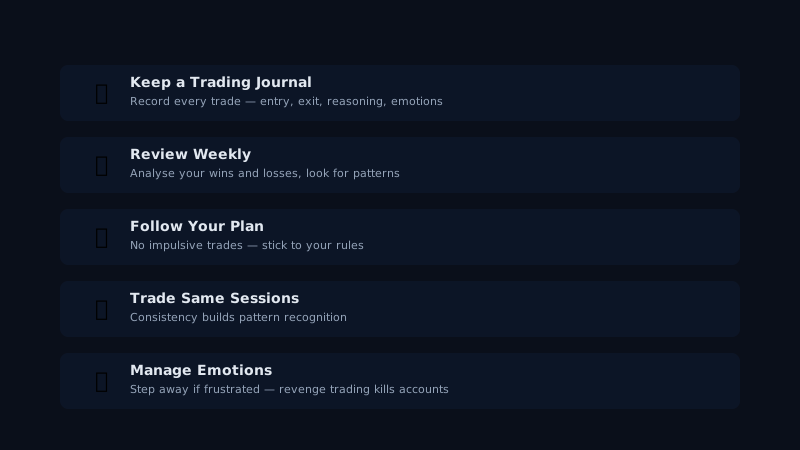
The traders who last aren't necessarily the smartest. They're the most disciplined. Here's what good trading habits actually look like.
1. Keep a Trading Journal From Day One
A trading journal is a record of every single trade you take — what you saw, why you entered, what happened, and what you could do better. It sounds tedious. It is, a little. But it's also the single fastest way to improve.
Without a journal, you'll make the same mistakes over and over and never realise it. With a journal, you'll start to spot patterns in your own behaviour. "I always lose when I trade on Mondays." "My best setups come from the London session." "I overtrade when I'm stressed." These insights are gold — you can only find them by reviewing your data.
What to include in your journal:
- Date and time of trade
- Asset traded (e.g. GBP/USD)
- Direction (long or short)
- Entry price, stop loss, take profit
- Position size and risk in £/£
- Your reasoning (why did you take this trade?)
- Screenshot of the chart at entry
- Result: win, loss, or breakeven
- Review: what did you do well? What could you improve?
2. Review Your Trades Weekly
Set aside 30-60 minutes every weekend to go through your journal. Look at your trades from the past week. Where did you follow your rules? Where did you break them? What was the market doing that you didn't see at the time? This review process is where most of the real learning happens.
3. Don't Revenge Trade
Revenge trading is when you take a loss, feel angry or frustrated, and immediately jump into another trade to "win it back." This almost always leads to another loss — because you're trading from emotion, not logic. You haven't waited for a proper setup. You're just reacting.
When you have a losing trade, the right response is to step away from the screen. Take a walk. Have a coffee. Come back with a clear head. The market will still be there.
4. Don't Overtrade
There's a temptation to feel like you need to always be in a trade. "What if I miss a move?" But quality always beats quantity in trading. A trader who takes 3 high-quality setups per week will almost always outperform a trader who takes 20 mediocre setups per week.
Overtrading erodes your account through spreads and commissions (even good setups have to overcome the cost of entering the trade), and it leads to taking setups that don't meet your criteria — which means more losses.
5. Set Daily and Weekly Loss Limits
Decide in advance: "If I lose more than X today/this week, I stop trading." For example: "If I lose 3% of my account in one day, I shut the computer down and walk away." This prevents the "just one more trade" spiral that can turn a bad day into a disaster.
6. Take Breaks
Trading requires mental focus. After intense screen time, your decision-making degrades. Take breaks during the trading session, take full days off regularly, and take proper holidays. The markets will always be there when you return. Burnout from staring at charts leads to bad decisions.
Many of the world's top traders attribute 80% of their success to psychology and discipline, and only 20% to their actual trading strategy. Having a great strategy means nothing if you can't execute it consistently. Building good habits is how you build consistency.
Good trading habits are what separate those who last from those who quit. Keep a journal, review weekly, never revenge trade, don't overtrade, and set loss limits. These habits create consistency — and consistency creates profitability over time.
Write these down and stick them somewhere you'll see them before every trading session:
- 📌 I will never risk more than ___% of my account per trade
- 📌 I will always have a stop loss set before entering a trade
- 📌 I will never move my stop loss to increase risk
- 📌 If I lose ___% in a single day, I stop trading that day
- 📌 I will not revenge trade — I will walk away after a loss
- 📌 I will record every trade in my journal, win or lose
- 📌 I will review my trades every weekend
- 📌 Quality over quantity — I only take setups that meet all my criteria
Quick Quiz
1. What is the main purpose of keeping a trading journal?
2. What is "revenge trading"?
3. Why should you set a daily loss limit?
Trading Sessions & When to Trade
The forex market is open 24 hours a day, 5 days a week. But not all hours are created equal. These 3 lessons teach you when to trade — and when to stay off the charts.
The 24-Hour Market
6 min readOne of the unique things about the forex market is that it never sleeps during the trading week. Unlike the stock market (which has set open and close times), forex trades 24 hours a day, 5 days a week — from Sunday evening through to Friday night (GMT).
This sounds amazing at first. "I can trade whenever I want!" But the reality is more nuanced. The market isn't equally active at all hours. Some times of day are packed with activity and big moves. Others are quiet and slow, with price barely moving. Understanding this is crucial to trading well.
Why Does the Market Never Close?
Forex is a global market. When traders in London finish their day, traders in New York are still active. When New York closes, Tokyo and Sydney open. There's always a financial centre somewhere in the world with banks and traders buying and selling currencies.
This is different from buying shares in a UK company — the London Stock Exchange opens at 8am and closes at 4:30pm. Outside those hours, you can't trade those shares on the exchange. Forex has no such restriction.
The Three Major Sessions
Even though forex trades 24 hours, we can divide the day into three main trading sessions based on which major financial centre is most active:
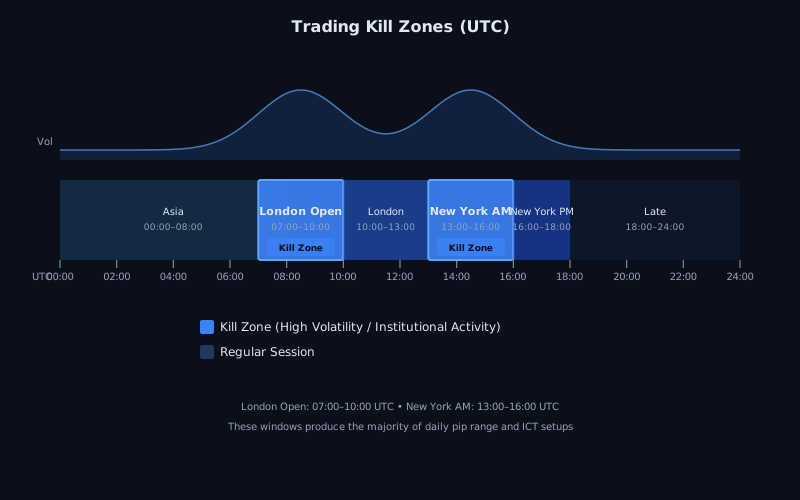
The 24-hour forex market broken into the three major sessions. Notice how London and New York overlap — this is the highest-volume period of the day.
The Overlap: London + New York (1PM – 5PM GMT)
When two sessions are open at the same time, you get the highest trading volume of the day. The London-New York overlap (roughly 1pm to 5pm GMT) is when markets are most active, spreads are tightest, and moves are most significant.
This overlap is when many professional traders do most of their work. High volume means the moves that happen here tend to be meaningful — there's real money behind them, not just low-liquidity "noise."
What About Weekends?
Forex is closed from Friday evening (around 10pm GMT) to Sunday evening (around 11pm GMT). During this time, no trading happens. However, news events can occur over the weekend, which can cause "gaps" — sudden jumps in price — when the market reopens on Sunday evening. This is something to be aware of if you have trades open heading into the weekend.
Forex trades 24 hours, 5 days a week, across three major sessions: Asia (quiet), London (most active), and New York (second most active). The London-New York overlap (1PM–5PM GMT) is the busiest period. Most professional traders focus on the London and New York sessions, where moves are driven by real institutional volume.
- Asia Session: 11PM – 8AM GMT (quiet, range-building)
- London Session: 8AM – 5PM GMT (most active, GBP/EUR pairs)
- New York Session: 1PM – 10PM GMT (very active, USD pairs)
- London-NY Overlap: 1PM – 5PM GMT (highest volume period)
- Forex closes Friday ~10PM and reopens Sunday ~11PM GMT
Quick Quiz
1. How many hours per day is the forex market open?
2. Which session is generally considered the most active in the forex market?
3. Approximately when does the London-New York overlap occur (in GMT)?
Finding Your Trading Time
6 min readNow that you know when the major sessions are, let's talk about which one is right for you. The good news: you don't need to trade all day. In fact, trying to trade all day is a recipe for overtrading, fatigue, and bad decisions. The goal is to find the 1-3 hour window where the best opportunities appear — and focus your energy there.

The London Session (8AM – 5PM GMT)
The London session is the most popular for traders based in the UK and Europe — and for good reason. It's when the big moves on GBP/USD, EUR/USD, and other European pairs happen. Banks and institutions in London are executing their largest orders.
The first hour or two of the London session (8AM – 10AM GMT) is often particularly interesting. Price has been sitting quietly during the Asia session building up "pressure," and when London opens, that pressure often releases into a directional move. Traders call this period a "kill zone" — more on that in the Intermediate course.
For a UK-based trader with a 9-5 job, the early London open before work and the early afternoon during lunch can both offer opportunities.
The New York Session (1PM – 10PM GMT)
New York opens at 1PM GMT. This is when USD becomes the king currency. US economic data (like jobs reports, interest rate decisions, GDP numbers) releases in the New York session — these can cause massive moves in minutes.
The first few hours of New York (1PM – 4PM GMT) overlap with London. During this overlap, you get the best of both worlds: European volume + American volume = maximum liquidity and the largest, most decisive price moves of the day.
The Asia Session (11PM – 8AM GMT)
The Asia session is generally the quietest of the three, with price often moving in narrow ranges. It's dominated by JPY (Japanese Yen), AUD (Australian Dollar), and NZD (New Zealand Dollar) pairs.
For most beginners, the Asia session isn't the best starting point — the ranges can be choppy and low volume means "random" price moves that don't follow clean patterns. However, advanced traders often use the Asia session to identify the range that will later get broken by London — a key concept you'll explore later.
You Don't Need to Trade All Day
Here's a liberating truth: many profitable traders only trade for 1-2 hours per day, during their preferred session. Some only trade 3-5 times per week. Quality always beats quantity.
The traders who sit at their screens for 10+ hours a day often end up taking low-quality setups out of boredom, overtrading, and burning out. Find your window, set your criteria, trade only when the market meets them, then step away.
The Practical Reality: Work Around Your Life
If you have a full-time job, you might only be able to trade during lunch breaks or evenings. That's completely fine — in fact, the New York session after 5PM GMT gives you several hours of active market. If you're in the UK, that's 5PM–10PM. Perfectly workable.
The key is consistency. Pick a time window that works with your life, develop a routine for that window, and stick to it. Don't try to catch every move in every session — you'll run yourself ragged.
Some of the most respected traders in the world only trade for 1-2 hours per day. They have a tight set of criteria, wait patiently for a setup to appear in their window, take it, and walk away. The rest of the time they're reading, backtesting, journaling, or living their normal lives. Trading doesn't have to consume your entire day.
You don't need to trade all day. Pick 1-2 hours that work with your schedule and focus there. London (8AM–5PM GMT) is best for GBP/EUR. New York (1PM–10PM GMT) is best for USD. The overlap (1PM–5PM GMT) is the highest-volume window. Asia (11PM–8AM) is quiet — best avoided for beginners. Find your window and be consistent.
- My available trading window: _______________
- Which session overlaps with my schedule: _______________
- Best pairs to focus on during that session: _______________
- I will NOT try to trade all day — quality over quantity
- London-NY overlap (1PM–5PM GMT) = highest volatility and best moves
Quick Quiz
1. If you're interested in trading GBP/USD with the most volume, which session should you focus on?
2. A trader is available from 6PM to 9PM GMT every evening. Which session does this fall in?
3. Why is the Asia session generally NOT recommended for beginners?
What's Next? Your Journey Continues
5 min readYou made it. Seriously — completing the beginner course is a bigger deal than it sounds. Most people who say they want to learn trading never get past watching a few YouTube videos. You've actually done the work, read through six modules, answered the quizzes, and now you have a genuine foundation. That's something to be proud of.
Let's quickly recap what you've learned, and then let's talk about what's coming next.
What You Now Know
- Module 1: What financial markets are, how trading works, who the players are, how people make money, and what you need to get started
- Module 2: How to read price charts and candlesticks, what timeframes mean, and how to start analysing what you see
- Module 3: The language of trading — bulls vs bears, pips and lots, leverage, spreads, volatility, and all the key terms
- Module 4: Market structure — uptrends, downtrends, support and resistance, higher highs and higher lows, and what happens when structure breaks
- Module 5: Risk management — protecting your capital, position sizing, stop losses, take profits, and building good habits
- Module 6: Trading sessions — the 24-hour market, Asia/London/New York, when the best opportunities arise, and finding your own trading window
This is more than most beginner traders ever learn before opening a live account. You're ahead of the game.
What's Coming in the Intermediate Course
The Intermediate course introduces you to Smart Money Concepts (SMC) — a framework for understanding how institutional traders (banks, hedge funds) actually move the market. This is where trading gets genuinely fascinating.
Here's a teaser: you've probably noticed something if you've ever tried to trade. You enter a trade that looks perfect. Your stop loss is set just below a "safe" level. And then… price dips exactly to your stop, takes you out, and immediately shoots in the direction you predicted.
That's not bad luck. That's not random. That's institutional traders hunting your stop loss.
In the Intermediate course, you'll learn:
- Break of Structure (BOS) and Change of Character (ChoCH) — the precise moments when trends shift, as seen by institutional eyes
- Liquidity — what it is, where it pools up, and how smart money targets it to fill their large orders
- Order Blocks — specific price zones where institutions placed large orders, and why price returns to them
- Fair Value Gaps (FVGs) — imbalances left in the market when price moved too fast, and why these act as powerful magnets
- Kill Zones — the precise time windows within each session where the highest-probability moves occur
Spend at least 2-4 weeks practising on a demo account with what you've learned in the beginner course. Get comfortable reading charts, identifying trends, drawing support and resistance, and using proper position sizing. The intermediate course will build directly on these foundations — so make sure they're solid first.
Your Homework Before the Intermediate Course
- Open a demo account — if you haven't already. Trade it as if it were real money.
- Set up your trading journal — start logging every trade from day one, even on demo.
- Practice reading market structure — every day, pull up a chart and ask: uptrend, downtrend, or sideways? Where is support? Where is resistance? Is the structure intact?
- Practice reading candlesticks — look at individual candles and ask what story they're telling. Strong close? Rejection wick? Indecision?
- Study trading sessions — track what happens when London opens and when New York opens. Notice the volume increase. See where the big moves happen.
The foundation you've built here is real. Markets, charts, candlesticks, structure, risk management, sessions — you now understand the language of trading. The next step is to practise on a demo account until these concepts feel second nature, and then move to the Intermediate course where you'll start understanding the why behind what the market does — and how to trade with the institutions, not against them.
- Financial markets: places to buy/sell currencies, stocks, crypto, commodities
- Price moves up/down based on supply and demand
- Broker = your gateway to the market; start with a demo account
- Long = buy (expecting price up); Short = sell (expecting price down)
- Candlestick = visual summary of price action in a time period
- Uptrend = HH + HL; Downtrend = LH + LL; Sideways = range
- Support = floor; Resistance = ceiling
- 1 pip = smallest forex price movement (4th decimal place)
- Leverage = borrowed power (use with extreme caution)
- Risk max 1-2% of account per trade
- Always use a stop loss and take profit
- Aim for minimum 1:2 risk-to-reward ratio
- London session (8AM–5PM GMT) = most active
- London-NY overlap (1PM–5PM GMT) = highest volume
- Keep a journal. Review weekly. Don't revenge trade.
Beginner Course Complete!
You've completed all 6 modules of the Introduction to Trading course. You're ready to start practising on a demo account and build toward the Intermediate course.