What is J3's Asia Sweep?
8 min readJ3's Asia Sweep Strategy is a simplified, rules-based trading model built around one of the most reliable recurring price patterns in the forex and indices market: the Asia session liquidity sweep during the London open. The strategy is directly inspired by ICT's "Judas Swing" and "Search and Destroy" concepts — the idea that price will first move in one direction to collect liquidity (stop losses) before reversing sharply in the opposite direction.
In J3's own words: "This is pretty much a Judas Swing / Search and Destroy Model. I will not sell this nor will anyone else — this is just my thoughts and attempt on simplifying it. I'm not trying to remodel it into my own model — it's simply what I have swapped etc to make it work."
The simplicity of this model is its greatest strength. At its core, the strategy is just four words: sweep, fail, confirm, enter. Price sweeps the Asia session high or low, fails to sustain beyond it, shows a reversal confirmation, and you enter toward the opposite Asia extreme.
The Judas Swing Foundation
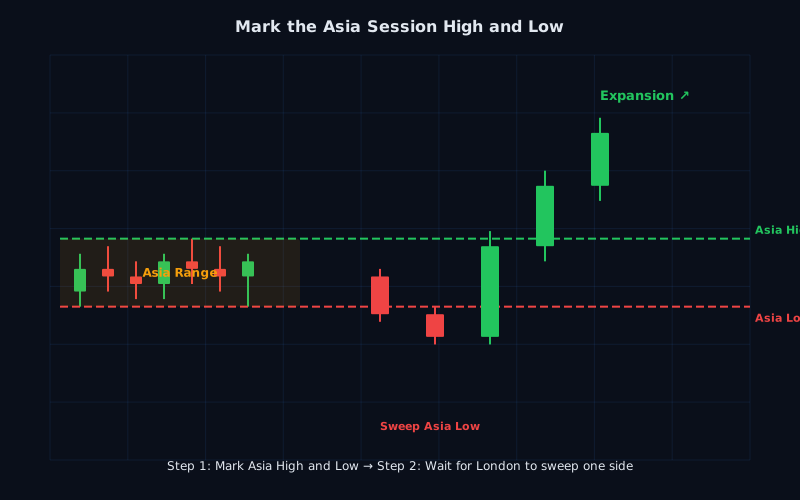
The Asia session (typically midnight to 7–8 AM London time) tends to create a relatively tight range as the major institutional participants in London and New York are not yet active. This range — the Asia High (AH) and Asia Low (AL) — represents the consolidated price delivery of the quieter session. The stops from retail traders who traded the Asia range sit just above the AH and just below the AL.
When London opens, institutional algorithms target these stops. Price makes a move to sweep the Asia High or Low — collecting the stop losses of those retail traders — then reverses sharply toward the opposite extreme. This is the Judas Swing: the initial London move is the "Judas" — a false, deceptive move before the real directional intent is revealed.
Key Characteristics
- ALL entries on the 1-minute timeframe. No exceptions — this is J3's specific approach.
- No daily bias required. The strategy is context-independent. You do not need to know whether the week is bullish or bearish. The Asia High and Asia Low provide all the context needed.
- London session only (8:00–11:00 AM London time). The strategy is invalidated after 11:00 AM as the NY open changes the dynamics.
- Works on specific pairs and instruments known for clean Asia range formation and London liquidity sweeps.
Best Pairs for J3's Strategy
| Instrument | Why It Works |
|---|---|
| GBP/USD | High volatility at London open; clear Asia range; very reactive to London institutional flow |
| EUR/USD | Most liquid forex pair; clean Asia range; reliable sweeps and reversals |
| GBP/JPY | Extremely volatile; sweeps tend to be large and decisive; excellent RR potential |
| USD/JPY | Good range formation during Asia; reliable reversal patterns |
| XAU/USD (Gold) | Excellent sweep patterns; very responsive to London open; high pip value |
| NASDAQ (NAS100) | Works well; slightly different timing — requires awareness of US pre-market |
J3's Asia Sweep is a simplified Judas Swing model. The premise: London opens and sweeps the Asia session high or low (collecting retail stops), then reverses toward the opposite extreme. All entries are executed on the 1-minute chart. No daily bias needed — the Asia range is the only context required.
The "Judas Swing" concept is named after the biblical betrayal by Judas Iscariot — a deceptive move that appears trustworthy before the reversal. In markets, the initial London move appears to be the start of a real trend, encouraging breakout traders to enter, only for price to violently reverse and trap them. Understanding the deception is the edge.
Quick Quiz
1. What is the core premise of J3's Asia Sweep strategy?
2. What timeframe are ALL entries executed on in J3's strategy?
3. Does J3's strategy require a prior daily bias before trading?
4. After what time is J3's strategy considered invalidated?
The Keyword Glossary
5 min readBefore diving into the mechanics of J3's Asia Sweep Strategy, it is essential to understand the specific terminology used throughout this course. Many of these terms come directly from the ICT framework covered in the Intermediate and Advanced courses, but J3's strategy also uses some specific shorthand that is unique to this model.
If any of these terms are unfamiliar, revisit the relevant lessons in the Intermediate or Advanced courses before continuing. The strategy assumes you are comfortable with the concepts behind FVGs, Order Blocks, and Market Structure.
Strategy Terminology Reference
| Keyword | Meaning | Context in J3's Strategy |
|---|---|---|
| MSS / ChoCH | Market Structure Shift / Change of Character | The reversal confirmation after the Asia sweep — required before entry |
| FVG | Fair Value Gap | The primary entry zone — the gap left by the reversal candle after the sweep |
| AL | Asia Low | The lowest price reached during the Asia session — a key sweep target and eventual TP |
| AH | Asia High | The highest price reached during the Asia session — a key sweep target and eventual TP |
| OB | Order Block | The last opposing candle before an impulse move — used as entry zone alongside FVGs |
| PD Array | Premium/Discount Array | Collection of ICT levels (FVGs, OBs, BPRs, etc.) used to identify entry zones |
| BOS | Break of Structure | Confirms trend continuation; a BOS in the reversal direction after sweep = strong signal |
| NDOG / WOG | New Daily / Weekly Opening Gap | Reference levels used to provide context; act as additional magnets for price |
| TRL | Trending Range Low | The most recent significant low in a bullish trending structure |
| TRH | Trending Range High | The most recent significant high in a bearish trending structure |
| ERL-L | External Range Liquidity — Lows | Previous swing lows below the current range; targets for bearish sweeps |
| ERL-H | External Range Liquidity — Highs | Previous swing highs above the current range; targets for bullish sweeps |
| J3Z | J3's Zone (Point of Interest / Reactions) | J3's personal markup for high-probability entry zones combining FVG + OB confluence |
The Two White Lines
In J3's chart setup, two white lines mark the Asia Open and Asia "Close" (the transition to London at 8:00 AM). These lines visually define the Asia range on every chart. Everything between the two white lines is the Asia range — the AH forms at the top of this range and the AL at the bottom.
Once the second white line appears (8:00 AM London), you stop tracking new Asia highs and lows. Whatever high and low formed between the two white lines are your fixed AH and AL for the session. Price alerts should be set at both levels before London opens.
- AH = Asia High | AL = Asia Low — mark these BEFORE London opens
- J3Z = J3's Zone = FVG + OB confluence entry zone
- MSS/ChoCH = the non-negotiable reversal confirmation after sweep
- Two white lines = Asia Open and Asia Close (8:00 AM London) on chart
- ERL-H and ERL-L are secondary targets beyond the Asia range
Quick Quiz
1. What does "J3Z" stand for?
2. What do the two white lines on J3's charts represent?
3. What are ERL-H and ERL-L used for in J3's strategy?
Indicator Setup
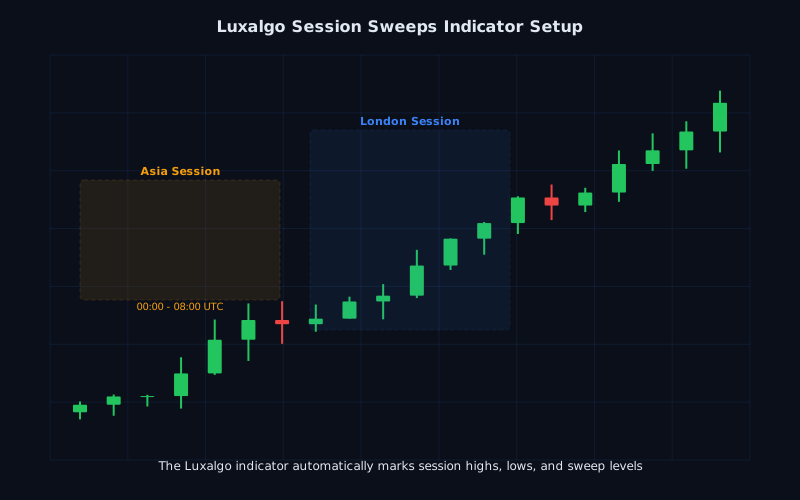
6 min readProper chart setup is the foundation of J3's Asia Sweep Strategy. Unlike many trading approaches that load charts with multiple overlapping indicators, J3's setup is deliberately minimal. The most important tool is the Luxalgo Session Sweeps indicator — a purpose-built TradingView indicator that automatically marks Asia session highs and lows and highlights when these levels are swept.
Step 1: Install the Luxalgo Session Sweeps Indicator
- Open TradingView and navigate to any chart.
- Click on "Indicators" in the top toolbar.
- Search for "Luxalgo — Session Sweeps" in the indicator search bar.
- Add the indicator to your chart.
- This is the only required indicator for J3's strategy. Keep the chart clean — no moving averages, no RSI, no MACD needed.
Step 2: Configure in London Timezone
The most important configuration step: set the indicator times in London timezone (GMT/BST). J3's session times are:
| Session | London Time | Purpose |
|---|---|---|
| Asia Session | 10:00 PM – 07:00 AM (GMT) / 11:00 PM – 08:00 AM (BST) | Defines the Asia range (AH and AL) |
| London Session | 08:00 AM – 01:00 PM (GMT/BST) | The sweep window — where the strategy operates |
| NY AM Session | 07:00 AM – 01:00 PM (NY / EST) | Secondary context if London continues |
| NY PM Session | 01:00 PM – 07:00 PM (NY / EST) | Strategy already invalidated by this point |
Step 3: Configure the Indicator Colours
The Luxalgo Session Sweeps indicator shows a box highlighting where a sweep occurs. To avoid confusion between bullish sweeps (Asia Low swept) and bearish sweeps (Asia High swept), configure the colours to stand out clearly:
- Bullish sweep (Asia Low swept, expect move UP): Set to a bright colour — J3 recommends green or teal so it is immediately obvious.
- Bearish sweep (Asia High swept, expect move DOWN): Set to a contrasting colour — red or orange works well.
- The box the indicator draws shows the exact level that was swept — this is your reference zone for confirming the sweep and timing the reversal.
Timeframe for Analysis vs Execution
Run the indicator on a 1-minute or 5-minute chart. For context and pre-session analysis (covered in Lesson 22.2), use higher timeframes (15M, 1H, 4H). For actual entry execution, the 1-minute chart is where J3 enters all trades — as stated explicitly in the original strategy notes.
The Luxalgo Session Sweeps indicator is your primary tool. Set it to London timezone. Use contrasting colours for bullish vs bearish sweeps. Keep the chart clean — this indicator is all you need to identify sweep events. Execution is on the 1-minute chart.
Many professional traders who use the Asia Sweep strategy manually mark the Asia High and Low rather than using an indicator. Both approaches work — the indicator is simply more convenient and removes the manual error of mislabelling the session range. Use whichever method keeps your chart clean and your process consistent.
Quick Quiz
1. Which indicator is used in J3's strategy to identify Asia session sweeps?
2. In which timezone must the indicator settings be configured?
3. What timeframe is used for actual trade entries in J3's strategy?
Pre-Session Analysis
8 min readThe 30 minutes before London opens (7:30–8:00 AM London time) is your preparation window. This is not trading time — it is analysis time. The quality of your pre-session preparation directly determines the quality of your execution when the sweep occurs. Never start your pre-session routine at 8:00 AM — be ready before the open.
Step 1: Mark the Asia High and Low
The most important action in your pre-session routine is marking the AH and AL precisely on your chart. The Luxalgo indicator will do this automatically, but verify it manually:
- Identify the highest wick reached during the Asia session (the AH).
- Identify the lowest wick reached during the Asia session (the AL).
- Draw horizontal lines at both levels. These are your primary sweep targets and eventual take profit levels.
- Set price alerts at both the AH and AL. You want to be notified the instant price approaches either level — this prevents missing the sweep while away from the screen.
Step 2: Top-Down Analysis (4H → 15M → 5M → 1M)
While daily bias is not required for J3's strategy, higher timeframe context significantly increases the probability of your entries. Spend 10–15 minutes doing a quick top-down sweep:
- 4H chart: Is the overall structure bullish or bearish? Are there any major HTF FVGs or OBs near the AH or AL? If the AL sits directly on a 4H bullish FVG, a sweep of the AL followed by a reversal is extremely high probability.
- 15M chart: Identify FVGs, Order Blocks, and supply/demand zones near the AH and AL. These become your entry zones if a sweep occurs.
- 5M chart: Check for any clear structure (swing highs/lows) that might be swept or act as confirmation levels.
- 1M chart: This is your execution chart. Familiarise yourself with the recent price action. The sweep and reversal will play out here.
Step 3: Identify HTF Key Levels Near AH/AL
Before London opens, mark the following on your chart — these are confluent levels that make the setup higher probability:
- HTF Fair Value Gaps (4H and 1H) near or overlapping with the AH or AL
- Order Blocks on 15M or 1H timeframes that align with the Asia extremes
- Supply and Demand zones from previous sessions near the AH/AL
- NDOG / NWOG levels — the daily and weekly opening gaps that may act as magnets for price after the reversal
- Previous Day High (PDH) and Previous Day Low (PDL) — liquidity points that often align with or extend beyond the Asia range
Pre-session routine: 30 minutes before London opens. Mark AH and AL precisely. Set price alerts. Run top-down analysis (4H → 1M). Mark HTF levels near the Asia extremes. When the sweep occurs, you should already know your entry zones — no searching under pressure during live market conditions.
Do NOT start your pre-session analysis after London has already opened. Traders who try to analyse and execute simultaneously make rushed decisions and miss key levels. The first 15 minutes of London can be the entire sweep and reversal — if you are not ready, you miss the setup entirely.
Quick Quiz
1. When should your pre-session analysis begin?
2. Which top-down sequence does J3's pre-session analysis follow?
3. What should you set on your chart BEFORE London opens to avoid missing the sweep?
Identifying Valid Sweeps
9 min readNot every touch or break of the Asia High/Low qualifies as a valid sweep for J3's strategy. A valid sweep is one that is engineered by institutional participants to collect retail stop losses — and it has specific, identifiable characteristics that distinguish it from a genuine breakout. Learning to distinguish valid sweeps from false signals is the most critical skill in this strategy.
What Makes a Sweep Valid?
Price must actually trade beyond the AH or AL — not just touch it. The wick must pierce the level cleanly. A "near miss" that reverses 1–2 pips before the level is not a valid sweep; it may be, but the indicator sweep box will not have triggered, reducing confidence.
Validate the sweep by confirming there is no opposing Break of Structure before price sweeps the level. If price has already made a clear BOS in one direction before sweeping the opposite Asia extreme, the setup is compromised — the structure may be continuing rather than reversing.
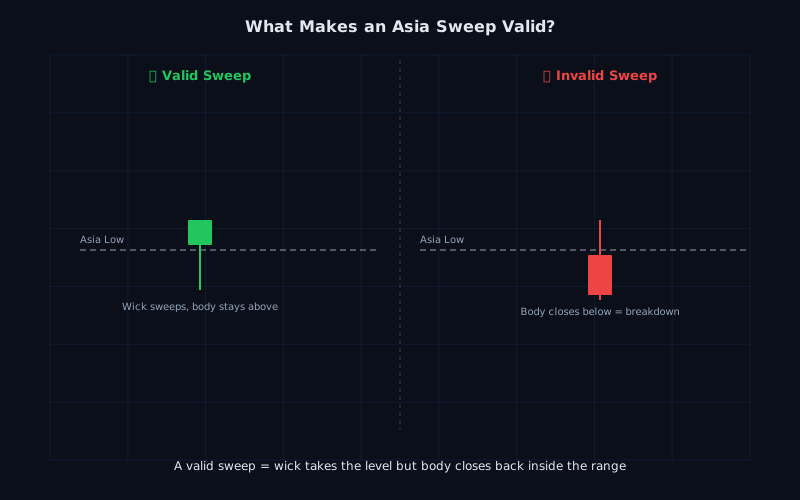
After the sweep, the 5-minute or 15-minute chart should show clear rejection candles — candles with wicks probing beyond the AH/AL but bodies closing back inside the Asia range. These large-wick candles on the 5M/15M chart are the fingerprint of institutional absorption: smart money selling into the breakout buyers (for a bearish sweep of the AH) or buying into the breakdown sellers (for a bullish sweep of the AL).
The strongest sweeps occur when the Asia extreme aligns with a higher timeframe point of interest — an HTF FVG, an Order Block, a Supply or Demand zone, or a BPR. When price sweeps the AL and simultaneously touches a 4H bullish FVG, the probability of reversal increases dramatically. This alignment is what separates A-grade sweeps from B-grade sweeps.
After sweeping, price must fail to maintain beyond the Asia extreme. There should be no sustained follow-through — no continuation of the breakout. The candle that sweeps the level should close back inside the Asia range (or very close to it). If price continues strongly in the sweep direction, this is a breakout, not a sweep — do not counter-trend trade it.
Wick Sweeps vs Body Closes
A wick sweep (price wicks beyond the level but the candle closes back inside) is the cleanest and most reliable signal. The wick represents the stop-hunt — price ventured out, collected the stops, and immediately returned. A body close beyond the level is a much weaker sweep signal; it suggests price wants to go further in that direction. In practice, treat body closes beyond the level with significant caution — they often indicate the setup has failed before it started.
A valid sweep requires: (1) price takes out the Asia extreme, (2) no prior opposing BOS, (3) HTF rejection candles (5M/15M wicks), (4) reaction to an HTF concept (FVG/OB), (5) failure to sustain beyond the level. The more of these conditions that align, the higher the grade of the setup. Wick sweeps are preferred over body close sweeps.
Quick Quiz
1. Which type of sweep is considered the cleanest and most reliable signal?
2. If price has already made a clear BOS in one direction before sweeping the opposite Asia extreme, what does this suggest?
3. What makes an Asia sweep highest probability?
Confirmation & Entry
10 min readThe sweep has occurred. You have validated it against the criteria in Lesson 23.1. Now comes the most critical phase: waiting for confirmation before entering. This is where most traders fail the strategy — they see the sweep and enter immediately, before the reversal is confirmed. J3's strategy is explicit: wait for the sweep, confirm the reversal, then enter on the FVG or OB.
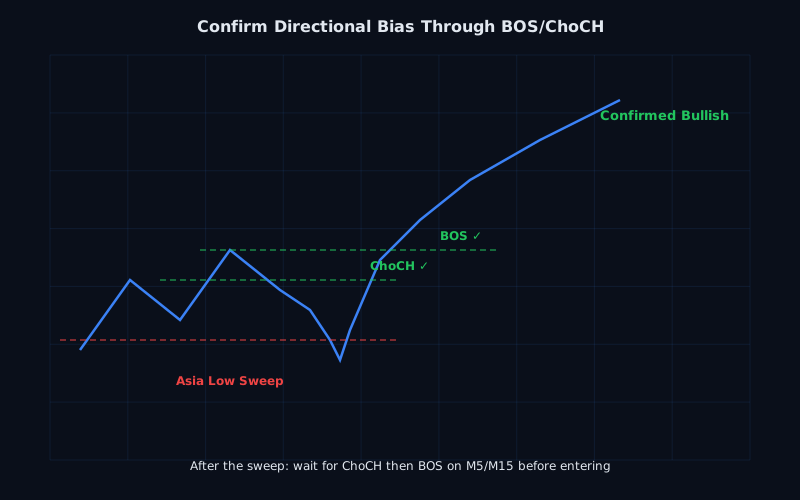
Step 1: Confirm Directional Bias Through BOS/ChoCH
After the sweep, price must show a Break of Structure (BOS) or Change of Character (ChoCH) in the reversal direction before you enter. This is the non-negotiable confirmation step. On the 1-minute chart:
- For a bullish reversal (Asia Low was swept): price must break above a recent 1M swing high — creating a higher high. This BOS confirms that buyers have taken control.
- For a bearish reversal (Asia High was swept): price must break below a recent 1M swing low — creating a lower low. This BOS confirms that sellers have taken control.
The ChoCH (Change of Character) is the first BOS in the reversal direction. It is often the strongest signal because it is the earliest possible confirmation of the flip.
Step 2: Identify the Entry Zone (FVG or OB)
After the ChoCH/BOS creates a displacement candle, that candle typically leaves behind a Fair Value Gap — the J3Z (J3's Zone) entry area. Your entry options:
| Entry Type | How | Probability | Notes |
|---|---|---|---|
| HTF FVG Entry | Enter at a 15M or 1H FVG that aligns with the reversal | Highest | Requires HTF FVG to exist near the sweep level; not always available |
| 1M FVG Entry | Enter at the FVG created by the ChoCH displacement candle | High | Most commonly available; J3's default entry method |
| 1M OB Entry | Enter at the Order Block (last opposing candle before the displacement) | High | Used when FVG is partially filled or ambiguous |
| J3Z Confluence | Enter where 1M FVG and 1M OB overlap (J3's preferred zone) | Highest of LTF entries | The overlapping zone of FVG + OB on 1M = J3Z |
Step 3: Execute on the 1-Minute Chart
Once your entry zone is identified, wait for price to retrace into it on the 1-minute chart. You do not chase price — if price moves to target without retracing to your zone, you missed the setup. There will be another one tomorrow. The entry is placed at:
- The CE (50%) of the 1M FVG for most entries (highest precision).
- The body zone of the 1M OB if entering from an OB instead.
- The overlap of both (J3Z) if available — this is the premium entry.
Using Both Asia LQ Points and 15M–1H Levels
J3's strategy explicitly says to use both Asia liquidity points (AH and AL) and 15-minute to 1-hour timeframe highs and lows as reference levels. The 15M/1H levels provide secondary entry zones and additional confluence when the primary 1M FVG aligns with them. This means your entry zone might sit on both a 1M FVG and a 15M supply/demand zone — this is the highest-confidence version of the entry.
The entry sequence: Sweep validates → BOS/ChoCH confirms on 1M → Identify FVG/OB (J3Z) left by displacement → Wait for retracement to zone → Enter at CE of FVG or OB body. Never enter at the sweep itself. Never enter without BOS/ChoCH confirmation. The retracement entry is what gives 1:3 RR potential.
The most common mistake in this strategy is entering at the sweep itself — before any confirmation. Price sweeps the AL and you immediately buy, hoping it will reverse. This catches the very bottom of the move — but only 50% of the time. Without the BOS/ChoCH confirmation, you are trading the guess, not the confirmation. Wait for the structure shift.
Quick Quiz
1. After the Asia sweep, what must occur BEFORE entering a trade?
2. What is "J3Z"?
3. Where precisely within an FVG does J3 prefer to enter?
Key Points & Levels
9 min readThe Asia Sweep Strategy is built on identifying and correctly marking key price levels before the London session opens. These levels form the confluence framework — the more levels that align at the same price, the higher the probability of a reaction there. This lesson covers each level type, how to identify it, and how it functions within J3's strategy.

Supply Levels (Red Zones)
A Supply level is a price zone where selling pressure previously overwhelmed buying — causing price to drop sharply. On J3's charts, supply levels are marked in red. Identifying supply:
- Look for the last few candles before a significant downward move — particularly 3 or more bullish candles followed by a sharp drop.
- The cluster of bullish candles before the drop is the supply zone — this is where institutional sellers entered to push price lower.
- A supply level with a Protected High means the high above the supply zone has not been swept — indicating we are bearish and want to avoid sweeping that high to maintain bearish bias.
In J3's strategy, supply levels near the Asia High act as additional bearish confluence — if the AH aligns with a supply zone, a sweep of the AH is even more likely to reverse downward from that zone.
Demand Levels (Blue Zones)
A Demand level is the opposite: a zone where buying overwhelmed selling, causing price to rise sharply. Identifying demand:
- Look for the last few candles (or single candle) before a significant upward move.
- A cluster of bearish candles followed by strong bullish momentum defines the demand zone.
- Mark using a rectangle tool. Pay special attention to zones tested multiple times without breaking — repeated tests without breakdown indicate strong institutional buying at that level.
Demand levels near the Asia Low provide bullish confluence — a sweep of the AL into a demand zone is a high-probability reversal setup.
Order Blocks (Orange Zones)
Order Blocks in J3's strategy are similar to supply and demand zones but more specific: they are formed by a single candle just before a significant price movement (not a cluster of candles). The OB is the last opposing candle before the impulse.
- Single bearish candle before a large bullish impulse = Bullish OB (orange, demand context)
- Single bullish candle before a large bearish impulse = Bearish OB (orange, supply context)
- OBs are used as entry zones when they overlap with FVGs at the entry point (creating the J3Z)
FVGs (Purple Zones)
In J3's visual system, FVGs are marked in purple. As covered in the foundational courses: three consecutive candles in one direction, with a gap between candle 1 and candle 3. The entry within the FVG uses the middle / OTE range — the 50% CE level. FVGs are the most common entry tool in J3's strategy.
Optimal Trade Entry (OTE) — Fibonacci Golden Zone
For higher-confidence entries, J3 uses the Fibonacci tool to identify the OTE zone (61.8%–78.6%). Process:
- After the sweep and BOS/ChoCH, price will begin a retracement.
- Draw the Fibonacci from the swing low of the sweep to the first swing high of the reversal (bullish setup).
- The 61.8%–78.6% retracement zone is the golden zone (OTE) — the highest probability entry area.
- If your FVG or OB sits within this golden zone, that is the J3Z: FVG + OB + OTE = maximum confluence.
Equilibrium — Premium/Discount via Gann Box
J3 uses the Gann Box tool to identify Premium and Discount zones within the current dealing range. Key principle:
- Mark the relevant swing low and swing high with the Gann Box.
- Above the 0.5 (50%) level = Premium zone — ideal for selling.
- Below the 0.5 level = Discount zone — ideal for buying.
- If your FVG entry is in the discount zone (below 50%), it is even more probable for long trades.
- Avoid buying in premium — "You do not want to buy whilst above as we have a chance of pushing further [down]."
- Red zones = Supply (last candles before a big drop) — bearish context
- Blue zones = Demand (last candles before a big rise) — bullish context
- Orange zones = Order Blocks (single candle before impulse)
- Purple zones = FVGs (3-candle imbalance, enter at CE/OTE range)
- Fib 61.8%–78.6% = OTE golden zone — overlap with FVG/OB = maximum confluence
- Gann Box 50% = Equilibrium — buy in discount, sell in premium
Quick Quiz
1. In J3's colour system, what colour are FVGs marked?
2. What does the Gann Box 0.5 level represent?
3. What is the OTE (Optimal Trade Entry) golden zone on the Fibonacci tool?
Stop Loss Placement
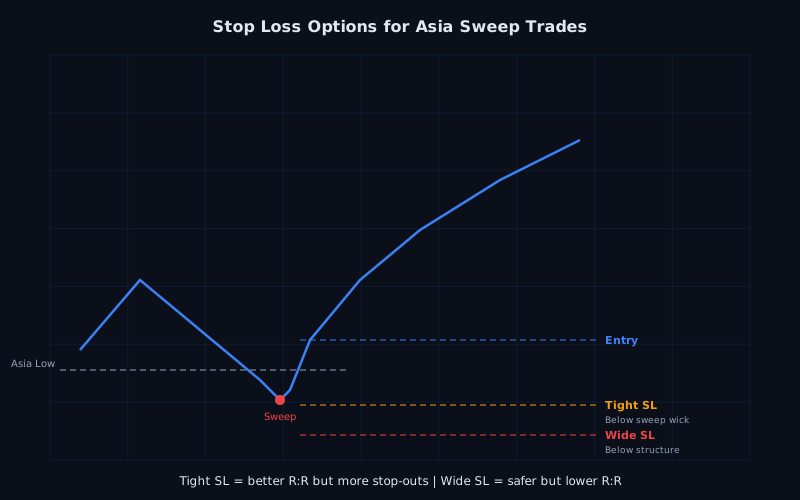
7 min readStop loss placement in J3's Asia Sweep strategy follows a clear, structured approach with two distinct options — a tight stop and a wider stop — both of which can achieve the target 1:3 risk-to-reward ratio. The choice between them depends on your risk tolerance and your confidence in the setup. Importantly, both are valid and neither is "wrong."
Option 1: Tight Stop Loss
The tight stop is placed just beyond the entry zone itself:
- If entering from an FVG: Place the stop loss just below the full FVG (for long entries) or above the full FVG (for short entries). The logic: if price closes a full body through the FVG, the entry zone is invalidated and the setup is over.
- If entering from an Order Block: Place the stop loss just below the low of the OB (long) or above the high of the OB (short). Same principle — a close through the OB body invalidates the setup.
The tight stop allows for excellent risk-to-reward ratios (often 1:4 or better) because the stop distance is small. The trade-off: a tight stop may be hit by normal price noise before the trade moves in your direction. This is acceptable — the win rate may be slightly lower, but the RR compensates over many trades.
Option 2: Wider Stop Loss
The wider stop is placed at the most recent swing point — beyond where price would need to go to structurally invalidate the reversal thesis:
- For long entries (bullish reversal after AL sweep): Stop below the actual sweep low — the lowest point reached when the Asia Low was swept. This is the absolute structural invalidation point: if price goes below the sweep, the reversal has failed completely.
- For short entries (bearish reversal after AH sweep): Stop above the actual sweep high — the highest point reached when the Asia High was swept.
As J3 notes: "You'll still achieve 1:3 risk-reward ratio, just with a wider stop. If price drops to that level, it's unlikely we'd see a reversal anytime soon." The wider stop reduces the chance of being stopped out by noise, but requires a slightly larger position size adjustment to maintain proper % risk.
Choosing Between Tight and Wide
| Factor | Use Tight SL | Use Wide SL |
|---|---|---|
| HTF confluence at entry | High confluence — tight is fine | Moderate confluence — give more room |
| Pair volatility | Low volatility pairs (EUR/USD) | High volatility pairs (GBP/JPY, Gold) |
| Entry precision | Entered at exact CE/OTE | Entered slightly away from optimal zone |
| Account risk | Both maintain 1% account risk — just adjust lot size accordingly | Same |
Never move your stop loss further away once the trade is live in an attempt to avoid being stopped out. If you entered correctly, the tight stop at the FVG boundary is structurally valid. Moving the stop wider mid-trade is a psychological response, not a strategic one, and it destroys your expected RR.
Two valid SL approaches: Tight (below/above entry FVG or OB) or Wide (below/above the actual sweep extreme). Both achieve 1:3 RR — the difference is stop distance and lot size adjustment. Always determine your SL placement BEFORE entering the trade, not after. The SL defines your risk; decide it while calm, not while the trade is moving.
Quick Quiz
1. Where is the tight stop loss placed when entering from an FVG?
2. Where is the wider stop loss placed in J3's strategy?
3. What RR ratio can both the tight and wide stop achieve, according to J3?
Take Profit Targets
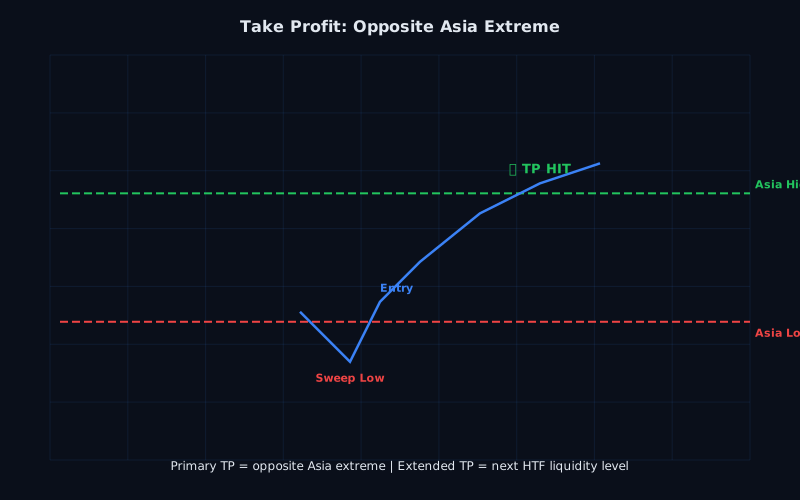
7 min readTake profit placement in J3's Asia Sweep strategy is strategically simple: the primary target is always the opposite Asia extreme. If the Asia Low was swept and you are long, your primary TP is the Asia High. If the Asia High was swept and you are short, your primary TP is the Asia Low. This symmetry is what gives the strategy its excellent risk-to-reward potential — the Asia range itself is the natural target distance.
Primary Take Profit: Opposite Asia Extreme
The reasoning behind targeting the opposite Asia extreme:
- The London sweep is engineered to take price from one Asia extreme to the other — this is the full Judas Swing thesis.
- The opposite Asia extreme has liquidity (stop orders from traders who traded the Asia session in the wrong direction).
- Algorithms are programmed to deliver price to the opposite extreme after a sweep — this is the "true" directional move of the London session.
Partial Take Profits
J3 acknowledges that partial take profits are an option but personally prefers running the full trade to the Asia extreme:
"Can use partial take-profits — mark out the nearest highs/lows and secure profits at those levels. Personally prefer letting trades run to Asian highs as partial take-profits can reduce overall gains."
If you choose to take partials, mark the following on your chart before entry and take partials as price hits each:
- Nearest swing high/low on the 1M chart between entry and the Asia extreme
- 15M or 1H timeframe high/low levels that lie between entry and the Asia extreme
- Any HTF FVG or BPR between entry and the Asia extreme
Break-Even Management
J3's strategy includes a specific break-even rule: move stop loss to break-even at 1.5% profit. This protects gains once the trade is significantly in your favour without cutting the trade short of its full target.
- At 1.5% account profit on the trade → move SL to entry price (break-even)
- This allows the trade to "run free" toward the Asia extreme with zero risk remaining
- Do not move to break-even too early — only at 1.5% profit, not at the first sign of a move in your direction
Additional Targets Beyond the Asia Extreme
In some sessions, price will achieve the Asia extreme TP and continue further. Additional targets if you choose to hold a portion of the trade:
- 5-minute to 1-hour timeframe highs/lows beyond the Asia extreme
- Previous Day High (PDH) or Previous Day Low (PDL)
- External Range Liquidity (ERL-H or ERL-L) — the broader liquidity pools beyond the daily range
- NWOG (New Week Opening Gap) if it sits beyond the Asia extreme
Primary TP = opposite Asia extreme. Move to break-even at 1.5% profit. J3 personally prefers full TP at Asia extremes over partials — partials reduce overall gains when the trade works. Set your TP as a limit order at the Asia extreme immediately upon entry. Let the trade run.
Quick Quiz
1. What is the primary take profit target in J3's Asia Sweep strategy?
2. At what profit level does J3 recommend moving the stop loss to break-even?
3. Does J3 personally prefer partial take profits or full TP at the Asia extreme?
Real Trade Examples
10 min readThe following are four real historical setups that demonstrate J3's Asia Sweep strategy in action across different instruments and days. These examples span a single trading week — four winning setups in five days — and are presented to show the repeatability of the strategy when the rules are followed correctly. As J3 notes: "4 winning setups found in one week (not cherry-picked)."
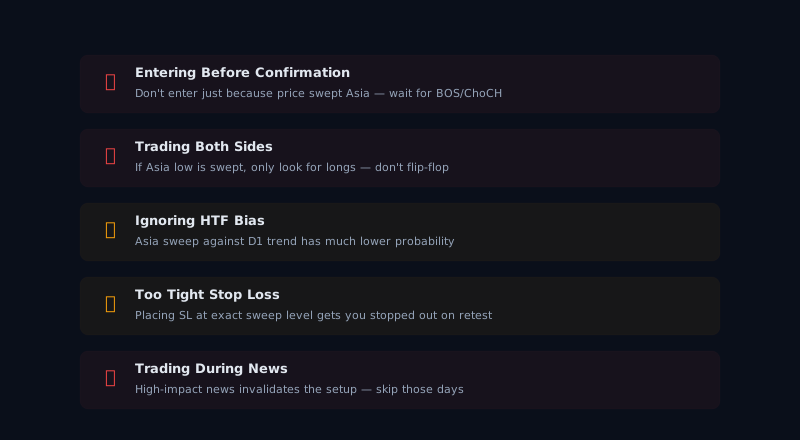
For each example below, mentally walk through the checklist: Was the sweep valid? Was there a BOS/ChoCH confirmation? Was the entry on an FVG or OB? Was the TP at the opposite Asia extreme? Use these as training material to develop pattern recognition.
Example 1: NASDAQ — December 9
NASDAQ (NAS100) formed a clean Asia range overnight. Asia session lows were at a notable level — with a 1H bullish FVG sitting just below the AL, providing HTF confluence.
At approximately 8:15 AM London time, the Asia session low was swept with a wick candle on the 5-minute chart — price briefly dipped into the 1H FVG below the AL and immediately reversed. No BOS in the bearish direction before the sweep.
On the 1-minute chart, a bullish displacement candle created a ChoCH — the first higher high after the sweep, confirming bullish intent. This displacement candle left a 1M bullish FVG directly above the entry level.
Price retraced into the 1M FVG (CE level). Entry long at CE. SL below the full FVG. TP at the Asia High. Price reached the Asia High by 10:20 AM London time — completing the Judas Swing in approximately 2 hours. Final RR: approximately 1:3.2.
Example 2: GBP/USD — December 10
GBP/USD formed a well-defined Asia range. Asia Highs were at a bearish supply zone on the 15M chart — a cluster of bullish candles before a previous drop, marked in red. HTF confluence confirmed.
London open produced a sharp bullish spike that swept the Asia High into the 15M supply zone. The sweep candle on the 5M chart showed a large upper wick — body closed well below the AH. Classic wick sweep into supply.
1M chart: bearish ChoCH confirmed after the sweep. Bearish displacement candle created a 1M bearish FVG. Price retraced up into the FVG (CE). Short entry at CE. SL above the sweep high. TP at the Asia Low.
GBP/USD sold off strongly through the rest of the London session, reaching the Asia Low target by 11:00 AM London time. Final RR: approximately 1:3.5. Break-even was moved after 1.5% profit, making the remainder of the trade risk-free.
Example 3: EUR/USD — December 11
EUR/USD presented a slightly different scenario — the Asia Low was swept, but instead of immediately targeting the Asia High, price initially struggled at the equilibrium (50% of the dealing range). The setup remained valid because:
- The sweep of the Asia Low was clean (wick sweep, no body close beyond)
- ChoCH confirmed on 1M with displacement
- The pause at equilibrium was within an open 1M FVG — no structure break in the bearish direction during the pause
- Price ultimately broke above equilibrium and continued to the Asia High
Lesson from this example: the strategy sometimes requires patience after entry. Price retracing to equilibrium mid-trade is normal as long as the structure has not broken bearishly (for a bullish trade). The SL at the FVG boundary was not hit.
Example 4: GBP/JPY — December 13
GBP/JPY is the highest-volatility pair in J3's recommended list. On December 13, the Asia session was particularly tight — a compressed range — which historically means a more explosive London sweep. Key observations:
- Asia Low swept with a sharp wick on the 1M chart, touching a demand zone that had been identified in pre-session analysis
- Immediate ChoCH on 1M — the reversal was decisive and fast
- FVG entry was only available briefly before price accelerated — early entry at the OB was also valid here
- Given GBP/JPY's volatility, the wider SL was used (below the sweep extreme) to avoid being stopped by noise
- Price reached Asia High target in under 90 minutes — very fast delivery
Four winning setups in a single week demonstrates the strategy's repeatability. Each followed the same framework: sweep → confirmation → FVG/OB entry → opposite Asia extreme target. The variations (occasional pauses, different volatility profiles) are normal — the process holds across all of them.
Quick Quiz
1. In the NASDAQ December 9 example, what HTF level added confluence to the Asia Low sweep?
2. In the EUR/USD December 11 example, price paused at equilibrium (50%) mid-trade. The setup remained valid because:
3. Why was the wider SL used for GBP/JPY on December 13?
Common Mistakes
8 min readUnderstanding the common mistakes made by traders using J3's strategy is as important as understanding the strategy itself. Many traders learn the rules but consistently break one or two of them — often the same mistake repeatedly. This lesson catalogues the most frequent errors, their causes, and their solutions.
Mistake 1: Entering Too Early — Before Confirmation
What it looks like: Trader sees the sweep and immediately enters at the sweep extreme, before any BOS/ChoCH confirmation. Sometimes this "works" — but only half the time, and with much worse average RR.
Why it happens: Fear of missing the reversal. The sweep looks obvious and the trader does not want to wait for confirmation, risking a worse entry price.
The fix: Accept that a confirmation entry will always be slightly worse than the theoretically perfect entry at the sweep extreme. This is the cost of confirmation — and it is worth it. A strategy with 65% win rate (confirmed entries) beats a strategy with 50% win rate (sweep-level entries) every time.
Mistake 2: Ignoring HTF Market Structure
What it looks like: Trader takes a sweep reversal setup against a strong HTF trend — for example, shorting after an Asia High sweep when the 4H chart is in a clear bullish structure.
Why it happens: Over-focus on the Asia range without checking higher timeframes. The 1M chart looks perfect; the 4H chart tells a different story.
The fix: Always include the 4H chart in your pre-session top-down analysis. Note whether the HTF structure aligns with the expected sweep direction or opposes it. HTF alignment doesn't guarantee success, but HTF opposition significantly increases failure probability.
Mistake 3: Not Waiting for Institutional Order Flow
What it looks like: Trader takes the sweep trade but enters before there is any clear FVG or OB to anchor the entry. Entry is taken "in the middle" of price action without a defined level.
Why it happens: Impatience. The reversal looks like it is starting and the trader does not wait for the displacement candle to create the entry zone.
The fix: No FVG = no entry. No OB = no entry. If price has reversed but no clean entry zone has formed, wait. If price reaches the Asia extreme target without retracing to your zone, you missed the trade — accept it and prepare for tomorrow.
Mistake 4: Poor Position Sizing
What it looks like: Trader sizes positions based on "feel" rather than a fixed percentage rule. After a few wins, over-sizes the next trade. After a loss, under-sizes out of fear.
The fix: Always risk a fixed % per trade (J3 recommends following standard risk management: 1–2% of account per trade). Calculate lot size from the stop distance and account balance every single time — never guess.
Mistake 5: Over-Complicating the Strategy
What it looks like: Trader adds additional indicators, requires 7 conditions to align before entering, second-guesses every setup, changes rules daily.
Why it happens: Lack of trust in simplicity. The strategy feels "too simple" compared to the complex analysis the trader has been learning.
The fix: Trust the process. As J3 states directly: "The strategy itself is easy and easy to follow. Do not over complicate it. It is literally just a sweep and a reversal." Complexity is not an edge. Consistency is.
Mistake 6: Trading After 11:00 AM — Ignoring the Invalidation Time
What it looks like: It is 11:15 AM London time. The Asia Low was swept at 9:00 AM but there was no clean reversal. Price is now testing the Asia Low again. Trader takes the setup anyway.
Why it happens: Attachment to the morning's analysis. The trader has been watching the setup all morning and still wants it to work.
The fix: The strategy has one hard rule: stop monitoring for Asian session sweeps after 11:00 AM London time. After 11:00 AM, NY session dynamics take over. The Judas Swing model no longer applies. Close the charts and come back tomorrow.
If you identify yourself in any of these six mistakes, do not try to fix all of them at once. Pick the one you commit most frequently and focus on eliminating it for 10 consecutive trading days before moving to the next. Behavioural change is sequential, not simultaneous.
Quick Quiz
1. What is the most common reason traders enter too early in J3's strategy?
2. According to J3, what is the hard cut-off time after which the strategy is invalidated?
3. J3's own words on the complexity of this strategy are:
The Complete Checklist
8 min readThis is the culmination of the entire J3 Asia Sweep course — a single, comprehensive checklist that captures every rule of the strategy. Print this checklist, put it next to your trading station, and check off every item before entering any trade. If any item cannot be checked, the trade does not meet the criteria.

Pre-Session Checklist (7:30–8:00 AM London)
- Luxalgo Session Sweeps indicator installed and configured in London timezone
- Asia High (AH) marked with a horizontal line on the chart
- Asia Low (AL) marked with a horizontal line on the chart
- Price alert set at the Asia High
- Price alert set at the Asia Low
- 4H top-down analysis completed — overall structure noted
- 15M chart analysed — FVGs, OBs, Supply/Demand zones near AH and AL marked
- NDOG and NWOG levels marked on chart
- HTF key levels near AH/AL noted (do they add confluence?)
During Session — Sweep Validation (8:00–11:00 AM London)
- Asia High or Asia Low has been swept (Luxalgo box triggered)
- Sweep type: wick sweep (preferred) or body close sweep (lower confidence)
- No opposing BOS occurred before the sweep (validates the sweep)
- 5M or 15M chart shows clear rejection candle(s) at the sweep level
- Sweep aligns with HTF concept (FVG, OB, Supply/Demand) — adds A-grade confidence
- Price fails to sustain beyond the swept level — no continuation in sweep direction
Confirmation Phase — Before Entry
- BOS or ChoCH confirmed on 1M chart in the reversal direction
- Displacement candle identified after ChoCH
- 1M FVG created by the displacement candle — identified and marked
- OR: 1M Order Block identified at the last opposing candle before displacement
- OR: J3Z identified — FVG and OB overlap on 1M (highest LTF confluence)
- HTF FVG entry available (optional but increases probability if available)
- Entry zone is in Discount (long) or Premium (short) via Gann Box check
- Fibonacci OTE zone drawn — does entry zone align with 61.8%–78.6%?
Trade Execution
- Entry price determined: CE (50%) of FVG or OB body zone
- Stop Loss determined: below FVG (tight) or below sweep extreme (wide)
- Take Profit set: at opposite Asia extreme (AH or AL)
- Position size calculated: fixed % of account (1% recommended)
- Break-even rule noted: move SL to entry at 1.5% account profit
- Limit order placed at entry zone — do not chase price
- TP limit order placed at opposite Asia extreme
Post-Trade
- Trade logged in journal: pair, time, entry, SL, TP, grade, setup description
- Did all checklist items apply? (Be honest — no retroactive approvals)
- If stopped out: was the SL placement correct structurally?
- Move to break-even when 1.5% account profit is reached
- Stop monitoring for new setups after 11:00 AM London — strategy is invalidated
TL;DR — The One-Sentence Summary
Sweep Asia Low/High → Fail to break → BOS/ChoCH opposite direction → Enter on FVG/OB → Target opposite Asia extreme → 1:2–3 RR
Trade window: 8:00–11:00 AM London. Timeframe: 1 minute. No daily bias required. Do not over-complicate it. It is literally just a sweep and a reversal.
Quick Reference Card
| Element | Rule |
|---|---|
| Trading Window | 8:00 AM – 11:00 AM London time only |
| Invalidation Time | After 11:00 AM — strategy is off for the day |
| Entry Timeframe | 1-minute chart — all entries here |
| Sweep Type | Wick sweep preferred; body close = lower confidence |
| Confirmation Required | BOS or ChoCH on 1M — non-negotiable |
| Entry Zone | 1M FVG (CE preferred) or OB body or J3Z (both) |
| Stop Loss | Tight: below FVG/OB | Wide: below sweep extreme |
| Take Profit | Opposite Asia extreme (AH if short, AL if long) |
| Break-Even | Move SL to entry at 1.5% account profit |
| Target RR | 1:2 minimum, 1:3 target |
| Best Pairs | GBP/USD, EUR/USD, GBP/JPY, USD/JPY, XAU/USD, NAS100 |
| Daily Bias? | Not required — Asia range provides all context |
Final Quiz — J3's Asia Sweep Strategy
1. What is the complete, correct sequence for J3's strategy?
2. At what account profit level do you move your stop loss to break-even?
3. You see a perfect Asia Low sweep at 10:55 AM London time. Do you take the trade?
4. Which of these correctly describes the J3Z (J3's Zone)?