Who is "Smart Money"?
8 min readIn every financial market there is a hierarchy. At the very top sit the institutions — central banks, commercial banks, investment banks, hedge funds, and large asset managers. These entities collectively move trillions of dollars every single day. In the SMC/ICT trading community, this group is called Smart Money.
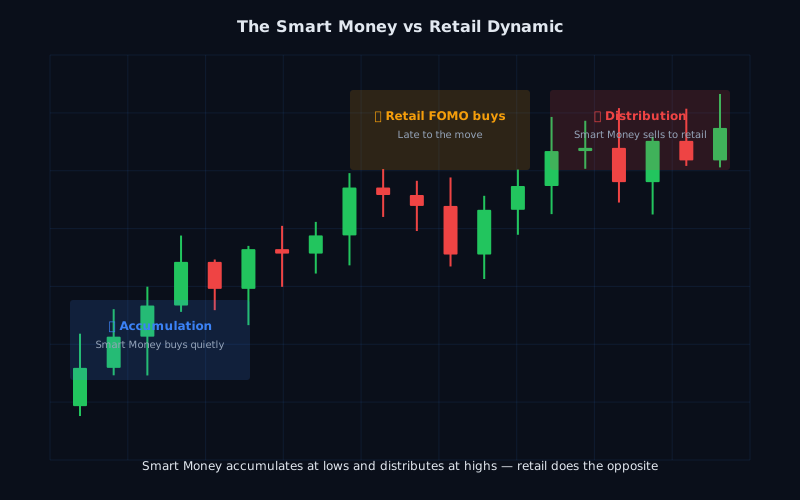
The Players in the Market
Think of the financial market as a food chain with three tiers:
- Tier 1 — Central Banks: The Federal Reserve, ECB, Bank of England. They set monetary policy and control currency supply. Their decisions move markets for months.
- Tier 2 — Commercial & Investment Banks: JPMorgan, Goldman Sachs, Citibank. They execute massive client orders, provide liquidity to the market, and have direct access to the interbank market where real price is set.
- Tier 3 — Hedge Funds & Asset Managers: They manage billions in capital on behalf of clients. They move large enough positions to visibly shift price action on charts.
- Tier 4 — Retail Traders: You, me, and the 95% of people trading from their phones and laptops. Our collective positions represent a small fraction of daily volume.
How Smart Money Moves Markets
Here is the fundamental problem that smart money faces: they have so much capital that they cannot simply click "buy" at any price. If JPMorgan wants to buy 50,000 gold contracts, placing that order all at once would immediately spike the price upward — they would be trading against themselves.
Instead, institutions accumulate positions gradually and they do so in a way that is deliberately disguised. They need liquidity — which means they need willing sellers to sell to them (or buyers to buy from them). This is where retail traders come in. Retail stop losses, breakout entries, and predictable patterns provide the liquidity that smart money needs to fill their massive orders.
Why 95% of Retail Traders Lose
The statistics are brutal but true: the vast majority of retail traders lose money. The reasons are not simply bad luck — they are structural. Retail traders are taught to use the same patterns and indicators that institutions have learned to exploit:
- Breakout trading above resistance → Smart Money already sold there, retail buys and gets trapped
- Placing stops below support → Smart Money sweeps those stops to collect liquidity before reversing up
- RSI overbought/oversold signals → Institutions push price into those zones deliberately to trigger retail entries
Once you understand that institutional players engineer price movements to collect retail liquidity, you will never look at a chart the same way.
Smart Money does not trade with you — they trade against you. Their goal is to find your stops, trigger them, and then move price in the opposite direction. Learning to recognize this manipulation is the foundation of SMC trading.
The Bank for International Settlements estimates daily forex market turnover exceeds $7.5 trillion. Retail traders represent less than 5% of that volume — yet retail is consistently on the wrong side of the trade.
- The market hierarchy: Central Banks → Commercial Banks → Hedge Funds → Retail
- Smart Money needs retail liquidity to fill large orders
- 95% of retail traders lose because they follow predictable patterns institutions exploit
- Institutions accumulate positions gradually, disguising their intent
Quick Quiz
1. Why do large institutions need retail trader liquidity?
2. What percentage of retail traders statistically lose money?
3. Which entity sits at the TOP of the market hierarchy?
The Retail Trader Trap
9 min readSmart money does not just trade passively — they actively engineer situations to harvest liquidity from retail traders. Understanding how these traps work is the difference between being the prey and becoming the predator.
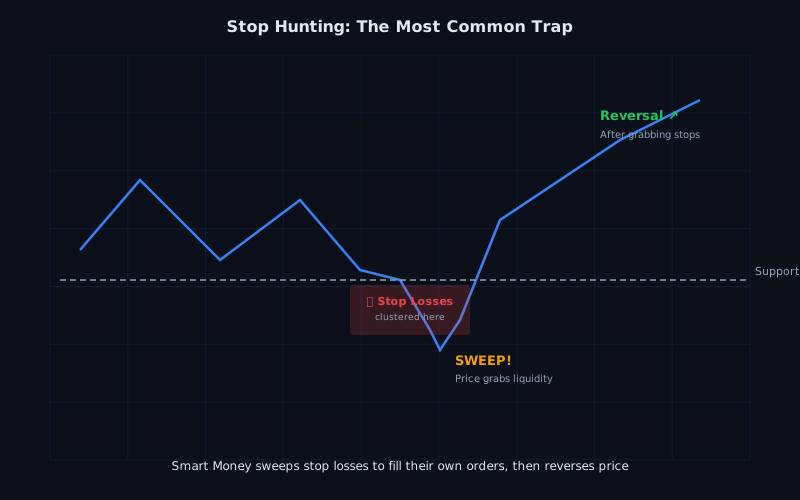
Stop Hunting: The Most Common Trap
Retail traders are taught to place their stop losses in obvious, logical places: just below a support level, just above a resistance level, below the last swing low. Institutions know these patterns well because they have been watching retail behavior for decades.
Stop hunting works like this:
- Price approaches a known support level where retail longs have placed their stops
- Smart money pushes price briefly below that level — triggering mass stop loss orders (which are sell orders that become market orders)
- Those stops flood the market with sell orders, giving institutions the liquidity they need to buy large positions cheaply
- Price reverses sharply upward — retail traders are stopped out at the bottom, institutions are filled long at the perfect price
False Breakouts as Manipulation
False breakouts are one of the most studied phenomena in technical analysis — yet most traders still fall for them. They occur when price appears to break a key level with conviction, enticing breakout traders to enter, then immediately reverses.
From an SMC perspective, this is not random. The false breakout is a deliberate liquidity sweep. Smart money is collecting the breakout entries and the stop losses above/below resistance/support. Once collected, price has no reason to continue in that direction — it reverses to its true intended target.
How to Avoid Being "The Liquidity"
The key paradigm shift is this: instead of entering at the same place as every other retail trader, you need to wait for the trap to complete before entering. This means:
- Do not use obvious stop loss placement — put SLs at structural invalidation points, not round numbers
- Do not chase breakouts — wait for the breakout, the sweep, and the reversal confirmation
- Treat equal highs and equal lows as bait — price will always go for obvious liquidity before making its real move
- Never trade counter-trend from a visible support/resistance level — that's exactly where smart money wants you to be trapped
The most dangerous moment in trading is when a setup looks "perfect." Textbook patterns at obvious support/resistance with multiple indicator confirmation are often engineered by smart money to attract maximum retail participation before reversing.
Retail stop losses are not just risk management — they are the raw material that smart money uses to fill their positions. Wherever retail stops cluster, institutional orders follow. Learn to identify these clusters and wait for the sweep before entering.
- Stop hunting: price moves to trigger stops, then reverses — this is deliberate
- False breakouts = liquidity sweeps in disguise
- Equal highs/equal lows are liquidity pools — price targets them before the real move
- Rule: wait for the sweep and reversal confirmation before entering
Quick Quiz
1. What is "stop hunting" in SMC terms?
2. What should you do after spotting a liquidity sweep?
3. Equal highs and equal lows on a chart represent:
Thinking Like Smart Money
10 min readThe single biggest shift you need to make as a trader is a conceptual one. You need to stop asking "will this support hold?" and start asking "where is the liquidity, and which direction will smart money hunt it?"

Supply and Demand vs Support and Resistance
Traditional technical analysis teaches support and resistance — price levels where price has bounced before. The SMC view is fundamentally different. Where retail traders see support, smart money sees demand. Where retail sees resistance, smart money sees supply.
The critical difference is what happens to those levels over time:
- Support/Resistance (retail view): "The more times price tests this level, the stronger it gets"
- Supply/Demand (institutional view): "Every time price returns to a zone, it uses up the orders sitting there. Multiple tests = diminishing institutional interest"
This explains why "well-tested" support levels often break — the institutional orders that created that level have already been consumed through previous tests. The zone is now weakened, not strengthened.
Institutional Order Flow
Order flow is the invisible backbone of every price move. Every candlestick on your chart represents a battle between buyers and sellers, but the size and intent of those orders matters enormously.
Institutional order flow has specific characteristics you can learn to recognise:
- Displacement: A sudden, strong impulsive move with large candles and minimal wicks — this is institutional momentum
- Consolidation before displacement: Price often ranges before a big institutional move — this is the accumulation phase
- Precise reactions at key levels: When price hits an unmitigated order block or FVG and reverses within a few candles, that's institutions defending their positions
Why Price Moves Between Liquidity Zones
If you zoom out and watch enough charts, you will notice that price rarely moves randomly. It oscillates between pools of liquidity — from one cluster of stop losses to another. This is not a coincidence. Institutions drive price from one liquidity pool to the next because that is how they fill and exit their positions.
The model is: Smart Money sweeps liquidity → accumulates/distributes a position → drives price to the next liquidity pool → repeats. Once you see this, you begin to think less about "which way will price go?" and more about "what is the nearest untapped liquidity, and when will they go for it?"
Price moves from one liquidity zone to another. Your job is not to predict direction — it is to identify where the next liquidity pool is, wait for price to sweep it, and then enter in the direction of the reversal back toward the opposing pool.
ICT (Inner Circle Trader) describes this model as "Smart Money hunts liquidity on both sides of the market." Before a major move in any direction, you will almost always see a sweep of the opposing liquidity first.
Quick Quiz
1. According to SMC, what happens when a support level is tested multiple times?
2. What does institutional "displacement" look like on a chart?
3. In the institutional price delivery model, price moves:
Break of Structure (BOS)
8 min readA Break of Structure (BOS) is one of the most fundamental concepts in SMC market analysis. It tells you whether the current trend is continuing or whether something more significant is happening. Every major move starts with a BOS.
What is a Break of Structure?
In an uptrend, price makes Higher Highs (HH) and Higher Lows (HL). A BOS occurs when price takes out the previous Higher High — confirming that the uptrend is still in play. Each BOS to the upside is a continuation signal.
In a downtrend, price makes Lower Lows (LL) and Lower Highs (LH). A BOS to the downside (breaking the previous Lower Low) confirms downtrend continuation.
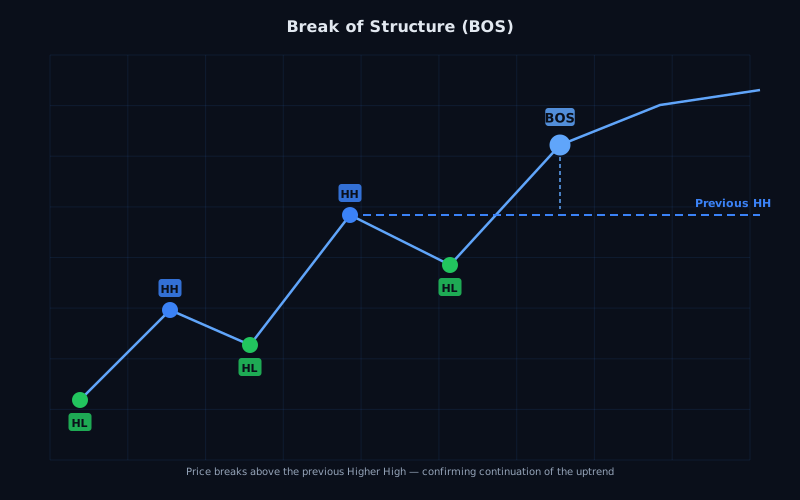
BOS confirms trend continuation — each break of the previous swing high (in an uptrend) validates the bullish structure.
Internal vs External Structure
Not all BOS signals are equal. SMC distinguishes between two types:
- External BOS: A break of a significant swing high or low on the current timeframe. This is the "big picture" structure that defines the overall trend direction.
- Internal BOS (iBOS): A smaller break of structure within a retracement or consolidation phase. This often signals that the retracement is ending and the main trend is about to resume.
Internal BOS is particularly powerful for entries — when you see an iBOS in the direction of the HTF trend, it often precedes a strong move in that direction.
How to Identify a BOS on Charts
- Identify the last significant swing high (in an uptrend) or swing low (in a downtrend)
- Draw a horizontal line at that level
- Wait for a candle to close above (uptrend BOS) or below (downtrend BOS) that line
- A BOS is confirmed on the close of the candle, not just the wick
A wick beyond a swing level alone does NOT confirm a BOS. You need a candle body close above/below the level. Wick sweeps beyond a level often signal a liquidity grab, which is actually the opposite of a genuine BOS — it can be a reversal signal instead.
A Break of Structure confirms trend continuation. External BOS defines the macro trend. Internal BOS within a pullback is your entry signal to trade in the direction of that macro trend.
Quick Quiz
1. A bullish BOS is confirmed when:
2. What does an Internal BOS (iBOS) within a pullback signal?
Change of Character (ChoCH)
9 min readIf the BOS tells you a trend is continuing, the Change of Character (ChoCH) is the first warning shot that a trend is about to end. It is the earliest signal of a potential reversal — and learning to spot it before it becomes obvious gives you an enormous edge.
What is a Change of Character?
In an uptrend (HH, HL pattern), price is expected to continue making Higher Lows. A ChoCH occurs when price breaks below the most recent Higher Low — breaking the pattern of the uptrend for the first time. This is the "character" of the trend changing.
It is important to note: a ChoCH does NOT confirm a full reversal. It is a warning sign. It says "the trend may be ending — start looking for short opportunities" rather than "the trend has definitely ended — sell now."
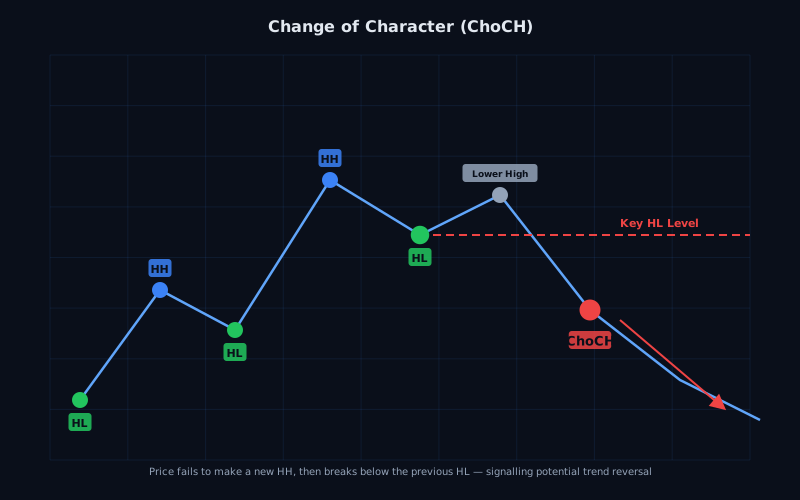
ChoCH: The first break of a Higher Low in an uptrend. This is the early warning that smart money may be shifting direction.
ChoCH vs BOS: The Critical Distinction
- BOS (bullish): Price breaks a previous Higher High → trend continuation UP
- BOS (bearish): Price breaks a previous Lower Low → trend continuation DOWN
- ChoCH (from bullish to bearish): Price breaks a Higher Low for the first time → potential reversal DOWN beginning
- ChoCH (from bearish to bullish): Price breaks a Lower High for the first time → potential reversal UP beginning
How to Trade the ChoCH
The ChoCH itself is not your entry — it is your directional bias shift. After a bearish ChoCH:
- Shift bias from bullish to bearish
- Look for price to retrace upward into an Order Block or FVG left behind by the ChoCH move
- Wait for confirmation (another bearish BOS or rejection from the OB)
- Enter short at the Point of Interest, targeting the next low
ChoCH = the first crack in the trend's armor. It shifts your bias but does not give you a trade entry directly. Use it to prepare for a reversal setup, then wait for the retracement to your Point of Interest to enter.
Quick Quiz
1. In an uptrend, a ChoCH occurs when:
2. After a bearish ChoCH, what should you do?
Market Structure Shift (MSS)
8 min readThe Market Structure Shift (MSS) is often confused with the ChoCH, but they represent different stages of the same process. Where the ChoCH is the first warning, the MSS is the confirmation that the trend has truly changed.
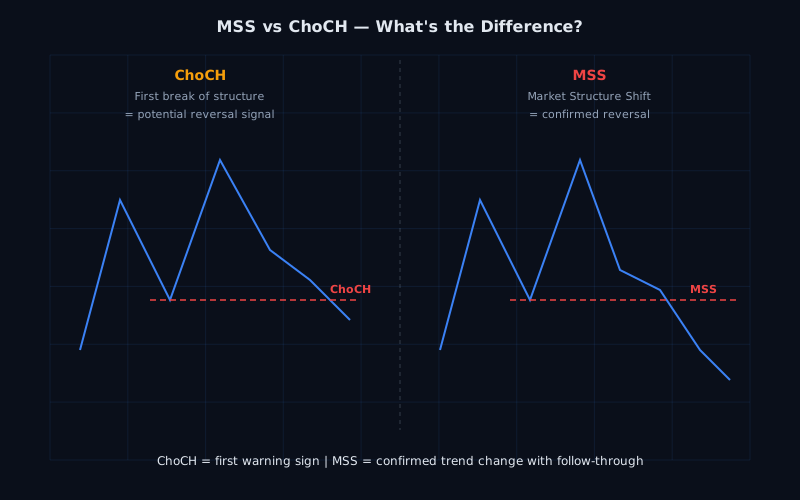
MSS vs ChoCH: What's the Difference?
In practice, different traders use these terms slightly differently. In the most common SMC framework:
- ChoCH: The first break of a Higher Low (in an uptrend). This is the initial warning — it can still be a deep retracement rather than a reversal.
- MSS: After the ChoCH, if price fails to make a new High and then breaks below the ChoCH low — this is the MSS. Now you have two pieces of bearish structural evidence: the ChoCH and the MSS.
Some traders use the terms interchangeably, especially on lower timeframes. What matters more than the labels is the concept: you need at least one decisive break of the previous trend structure to confirm a direction change.
Multi-Timeframe Structure Analysis
Structure is fractal — it looks the same on every timeframe. The key principle is alignment: the highest probability trades occur when structure on multiple timeframes points in the same direction.
- 4H / Daily (HTF): Defines the macro trend. Never trade against this.
- 1H / 15M (MTF): Defines the intermediate trend. Used to identify entry zones.
- 5M / 1M (LTF): Used for precise entry timing and stop placement.
A ChoCH on the 1M timeframe is almost meaningless. A ChoCH on the 4H timeframe is a major event. Always frame your analysis from HTF down to LTF — never start with a small timeframe and work up.
MSS = confirmed direction change. Trade in the direction of the MSS when it aligns with the HTF trend. Multi-timeframe alignment — HTF trend + MTF structure break + LTF entry confirmation — produces the highest probability setups.
- ChoCH = first warning of trend change (early signal)
- MSS = confirmation of trend change (late but higher probability)
- Always analyze HTF → MTF → LTF, never bottom-up
- The higher the timeframe of the MSS, the more significant the move
Quick Quiz
1. Which timeframe should you analyze FIRST when doing market analysis?
2. A Market Structure Shift (MSS) represents:
Putting It All Together
10 min readNow it is time to synthesise BOS, ChoCH and MSS into a coherent framework you can apply to live charts. The skill here is not just identifying the individual signals — it is reading the narrative of the market through structure.
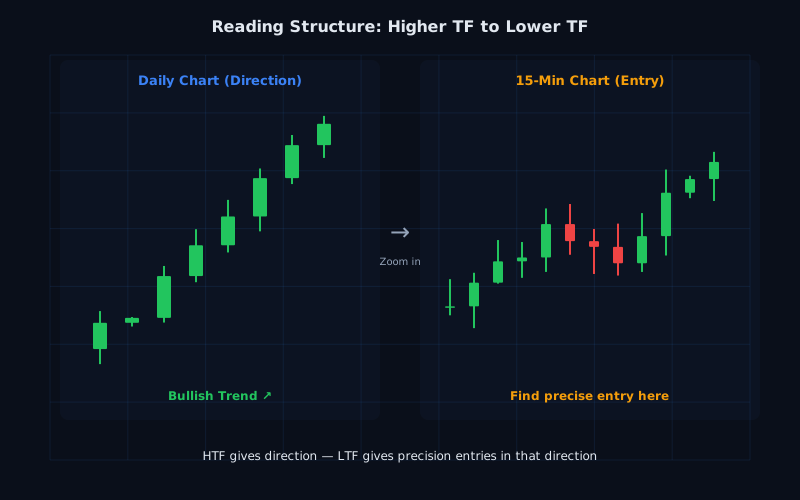
Reading Market Structure: HTF to LTF
A practical top-down analysis approach:
- Daily/4H — Define macro structure: Is price in an uptrend (HH, HL) or downtrend (LH, LL)? Has there been a recent MSS? What is the overall bias?
- 1H/15M — Identify intermediate structure: Where is price within the HTF range? Is it at a premium (upper half) or discount (lower half)? Look for ChoCH/BOS on this timeframe.
- 5M/1M — Find entry: Wait for an internal BOS or ChoCH in the direction of the HTF bias. Look for an Order Block or FVG on this timeframe to enter from.
Practice Exercise
Open any major pair (EURUSD, GBPUSD, XAUUSD) on TradingView. Follow this drill:
- Open the 4H chart. Mark the last 5 swing highs and swing lows with horizontal lines.
- Label each: HH, HL, LH, LL. Identify whether the current structure is bullish or bearish.
- Note whether any ChoCH or MSS has occurred in the last 10 bars.
- Drop to the 1H chart. Repeat the exercise within the last 4H swing range.
- Drop to the 5M chart. Find the most recent BOS or ChoCH. What would your entry plan be?
Do this exercise daily for two weeks. Market structure will become second nature.
- Top-down analysis order: Daily/4H → 1H/15M → 5M/1M
- At each timeframe: label HH, HL, LH, LL
- Identify whether structure is bullish or bearish at each level
- Only enter when HTF and MTF both agree on direction
- Use LTF BOS/ChoCH as your actual entry trigger
Quick Quiz
1. In a top-down analysis, what does the 5M/1M timeframe provide?
2. When should you consider taking an entry according to top-down analysis?
Understanding Liquidity
8 min readIn trading, liquidity is the ability to buy or sell without significantly moving the price. It is the foundation of every smart money strategy. Without understanding liquidity, you will never truly understand why price moves where it does.
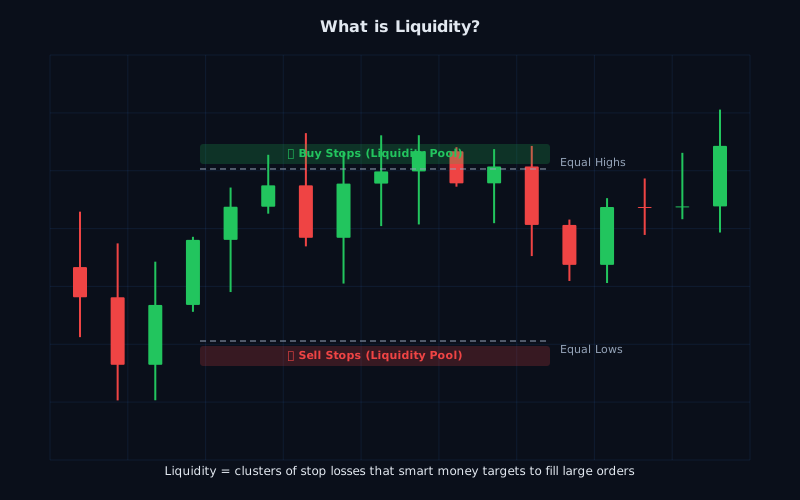
What is Liquidity in Markets?
Liquidity exists wherever there are willing buyers and sellers with pending orders. In the forex and futures markets, liquidity pools form at predictable locations — places where a large number of traders have placed their orders, particularly stop losses.
The most significant liquidity pools form at:
- Previous swing highs and swing lows — both buy stops (above highs) and sell stops (below lows) cluster here
- Round numbers — 1.3000, 1.2500 on EURUSD. Retail traders love round numbers; so does smart money (to raid them)
- Equal highs and equal lows — double tops/bottoms in retail terms; liquidity pools in SMC terms
- Recent swing points — any time price pauses and reverses, stop orders accumulate at that level
Stop Losses as Liquidity
This is the key insight that changes how you see the market. Every retail trader who enters a long trade places a stop loss below their entry. That stop loss is a pending sell order sitting in the market, waiting to be triggered. Multiply that by thousands of retail traders, and you have a massive pool of sell orders sitting just below a key support level.
For a large institution that needs to sell a huge position, they need buyers. Those triggered stop losses (which become market buy orders at the broker) provide exactly that. The institution sells into those buy orders, filling their short position at the best possible price — right as retail traders are getting stopped out.
The concept of "liquidity" in SMC is essentially the same as "float" in equity markets or "open interest" in futures. The key difference is that SMC focuses specifically on how stop orders and pending orders accumulate at predictable price levels.
Liquidity is fuel for institutional order execution. Smart money drives price to liquidity pools not to trend higher or lower, but because they need those stop orders to fill their positions. Once the liquidity is collected, price reverses toward the next pool.
Quick Quiz
1. In SMC, what do retail stop losses represent?
2. Which of the following is NOT a typical liquidity pool location?
Buy Side & Sell Side Liquidity
9 min readLiquidity is not uniform across the chart. It sits on two sides of price — above and below — and understanding this duality is essential for predicting where price will move next.
Buy Side Liquidity (BSL)
Buy Side Liquidity sits above swing highs. It consists of:
- Stop losses of traders who are short (their stops are above price)
- Buy stop orders from breakout traders waiting for a new high
- Limit orders from institutions looking to sell into retail buying
When price runs up into BSL, it is "sweeping Buy Side Liquidity." This move upward collects all the buy orders sitting above previous highs — which allows smart money to fill large sell positions into all that buying pressure. After the BSL sweep, price often reverses sharply downward.
Sell Side Liquidity (SSL)
Sell Side Liquidity sits below swing lows. It consists of:
- Stop losses of traders who are long (their stops are below price)
- Sell stop orders from breakout traders waiting for a new low
- Limit orders from institutions looking to buy into retail selling
When price drops into SSL, it sweeps those sell orders — allowing smart money to fill large buy positions cheaply. After the SSL sweep, price often reverses sharply upward.
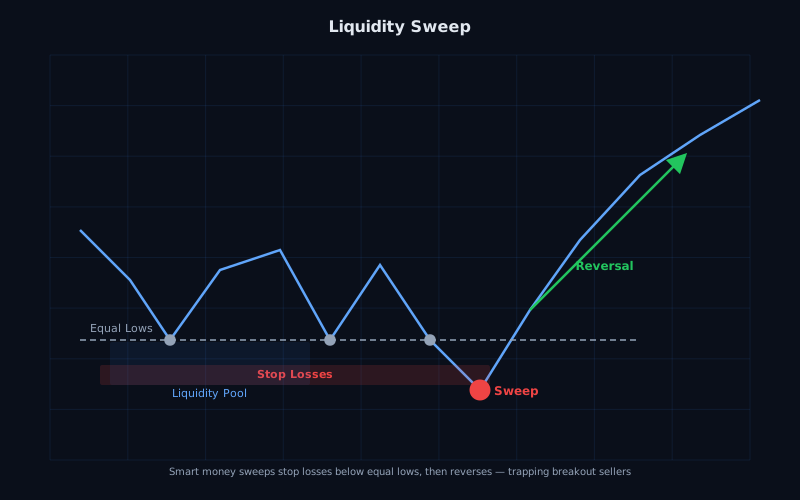
BSL pools form above swing highs; SSL pools form below swing lows. Smart money sweeps one side before reversing to the other.
The Classic Liquidity Cycle
The typical smart money liquidity cycle plays out like this:
- Price consolidates, building up BSL above and SSL below
- Smart money pushes price down to sweep the SSL (stop out all longs)
- Having filled their buy orders, smart money drives price upward toward BSL
- Price runs into BSL (stop out all shorts who entered after the SSL sweep)
- Smart money sells into that BSL, driving price back down — and the cycle repeats
Every swing high has BSL above it. Every swing low has SSL below it. Smart money's goal is always to sweep one side of liquidity before driving price toward the opposite side. Identify which side was last swept, and you know the likely next direction.
Quick Quiz
1. Buy Side Liquidity (BSL) is located:
2. When smart money sweeps Sell Side Liquidity (SSL), what typically happens next?
Liquidity Sweeps
9 min readThe liquidity sweep is the cornerstone of many SMC-based trading strategies. It is the specific price action event where smart money raids a liquidity pool — and it is what precedes the highest-probability reversals.
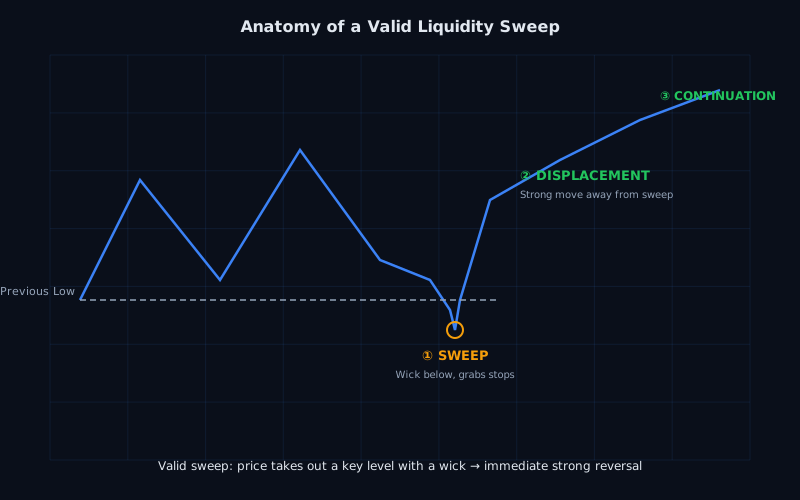
Anatomy of a Valid Sweep
A liquidity sweep has three distinct phases:
- The Approach: Price moves toward a known liquidity pool (previous high or low)
- The Sweep: Price violates the level — taking out the stop orders sitting there
- The Rejection/Reversal: Price quickly reverses back in the opposite direction, often with a large opposing candle
The speed and character of the rejection matters greatly. A sharp, aggressive reversal candle after the sweep is far more significant than a gradual drift back.
Wick Sweeps vs Body Closes
There are two types of sweep by candle character:
- Wick sweep (preferred): Price briefly pierces the level with a wick but the candle body closes back on the other side of the level. This is a "wick beyond and back" — it shows strong rejection of that price level. This is the classic, clean sweep pattern.
- Body close sweep: The candle body closes beyond the level. This is stronger confirmation that the level was taken, but the reversal must then be confirmed by a ChoCH or MSS on the lower timeframe.
When NOT to Trade a Sweep
Not every sweep is tradeable. Avoid acting on a sweep when:
- The sweep occurs during a major news event (NFP, CPI, FOMC) — news volatility can create fake sweeps
- There is no HTF confluence — the sweep should align with an HTF Point of Interest
- Multiple sweeps have already occurred at the same level — depleted liquidity is less reliable
- The sweep happens outside your session window — liquidity is thinner at unusual times
- There is no subsequent structural confirmation (ChoCH/BOS) in the reversal direction
Beginner traders often enter immediately when they see a wick sweep — before confirmation. This is one of the most common mistakes. Always wait for the ChoCH or BOS on the lower timeframe to confirm that the reversal is real before entering. Missing a few pips of entry is far better than entering a fake reversal.
The sweep itself is not your trade entry — it is your trade setup. The sweep creates the context. The structural confirmation (ChoCH on LTF) is your trigger. The FVG or Order Block in the new direction is your entry.
Quick Quiz
1. What is the PREFERRED candle pattern for a valid liquidity sweep?
2. When should you avoid trading a liquidity sweep?
Trading Liquidity Setups
10 min readNow we put everything together into a tradeable setup. The liquidity-based trade is one of the cleanest in all of SMC — sweep, confirm, enter, target. Once you master this four-step process, you have a repeatable edge.
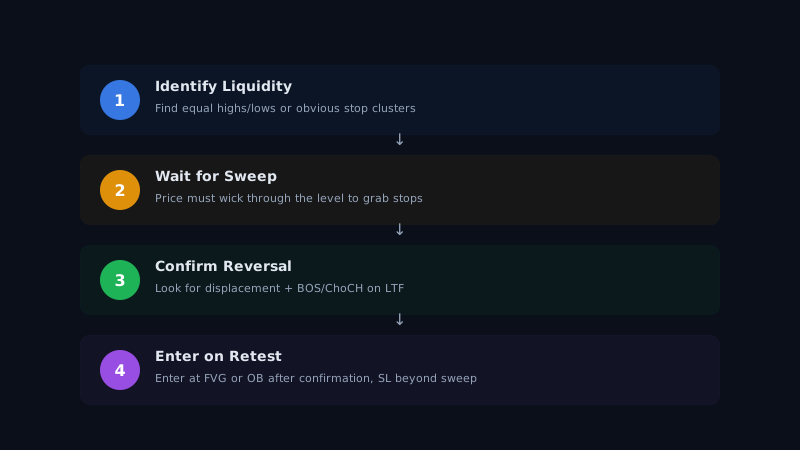
The Four-Step Liquidity Trade Process
Mark the nearest swing high (BSL) and swing low (SSL) on your chart. Which was more recently formed? Which has had more time to accumulate stops?
Price must sweep through that pool — either with a wick or a close. Do NOT enter during the sweep. Watch. Be patient.
Drop to a lower timeframe (5M or 1M). Look for a ChoCH or internal BOS in the direction opposite to the sweep. This is your green light.
After confirmation, wait for price to retrace slightly into the FVG or Order Block created by the reversal move. Enter there with your stop below/above the sweep extreme. Target the opposing liquidity pool.
Examples Across Multiple Pairs
GBPUSD (forex): Price sweeps the London session low (SSL sweep during NY open), wicks sharply back above, 5M ChoCH forms, then price retraces into a 5M FVG. Long entry at FVG midpoint, stop below sweep low, target the previous day's high (BSL).
XAUUSD (gold): Price spikes above equal highs in the Asia session (BSL sweep), aggressive bearish rejection candle, 1M bearish ChoCH confirms, price retraces into 1M Order Block. Short entry at OB, stop above sweep high, target equal lows below.
NASDAQ: Price sweeps the overnight low (SSL) 15 minutes into the NY open, sharp V-recovery forms, 5M structure breaks bullish. Long entry on first LTF FVG, targeting the NY session open price (likely BSL cluster).
- The liquidity trade framework: Sweep → Confirm (ChoCH/BOS) → Retracement to FVG/OB → Enter → Target opposing LQ
- Never enter on the sweep itself — wait for structural confirmation
- Stop loss goes at the sweep extreme (the actual level that was swept)
- Target: the opposing liquidity pool (BSL if you swept SSL, and vice versa)
Quick Quiz
1. In a liquidity sweep setup, where is the stop loss typically placed?
2. What is the primary target in a liquidity sweep trade?
What is an Order Block?
9 min readThe Order Block (OB) is one of the most powerful concepts in the ICT/SMC framework. It represents the last opposing candle before a significant impulsive move — and it is the location where institutional orders were placed to kick-start that move.
The Definition
An Order Block is defined as: the last bearish candle (or series of bearish candles) before a bullish impulse move, or the last bullish candle (or series) before a bearish impulse move.
The logic is institutional: to create a large upward move, smart money needed to fill a large buy order. They did so at a specific price range — which is now encoded on your chart as that last bearish candle before the up-move. When price returns to that range, those same institutional orders are often waiting to defend it.
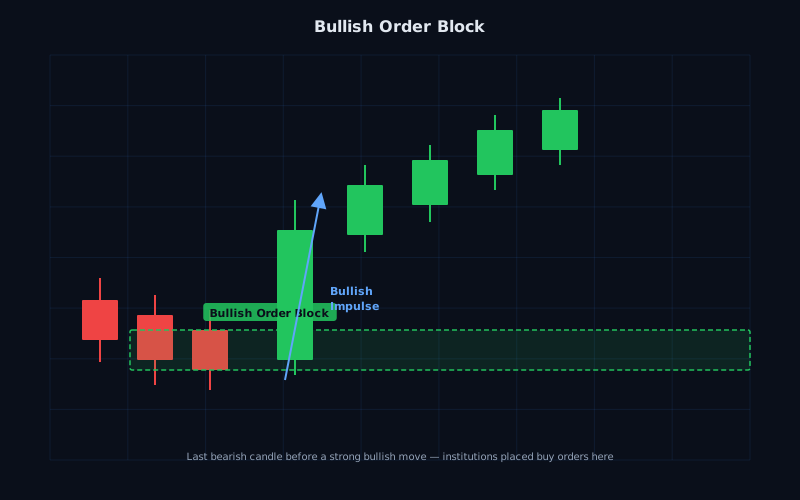
Bullish Order Block: The last bearish candle before a strong bullish displacement. When price returns to this zone, institutions defend it.
Why Order Blocks Form
Think about what institutional accumulation looks like. A large bank wants to buy 10,000 lots of EURUSD. They cannot buy it all at once — they need to spread the accumulation over time. As they buy, price does not immediately shoot up because they are also selling to prevent the price from moving against them too early.
The last wave of that accumulation often appears as a bearish candle — institutions are selling enough to keep price contained while buying the underlying position. When they finish accumulating, the price explodes upward. That containment zone (the last bearish candle) is the Order Block.
Key Characteristics of a Valid OB
- Occurs immediately before a strong, impulsive displacement move
- The impulse after the OB should leave a Fair Value Gap (this is a strong confirmation)
- The OB should be "unmitigated" — price has not returned to it since the initial impulse
- HTF OBs (daily, 4H) are significantly more powerful than LTF OBs (5M, 1M)
An Order Block is where institutional money entered the market. When price returns to that zone, those same institutions are likely to defend their position, creating a high-probability reversal. The more powerful the original move, the more significant the Order Block.
Quick Quiz
1. A Bullish Order Block is defined as:
2. For an Order Block to be considered valid and tradeable, it should be:
Bullish vs Bearish Order Blocks
8 min readOrder Blocks appear in two forms — bullish and bearish. Each has its own structure, identification criteria, and trading approach. Mastering both allows you to trade in all market conditions.
Bullish Order Block
A Bullish OB is the last down candle(s) before a strong bullish impulse. Visually, it sits at the bottom of a retracement that precedes a large up-move. Key features:
- The body of the last bearish candle defines the OB zone (open to close of that candle)
- The impulse after it should be significantly larger than the OB candle
- Ideally, the impulse creates a Fair Value Gap above the OB
- Entry: when price returns to the OB zone (ideally the upper half, or the "consequent encroachment" — the 50% level)
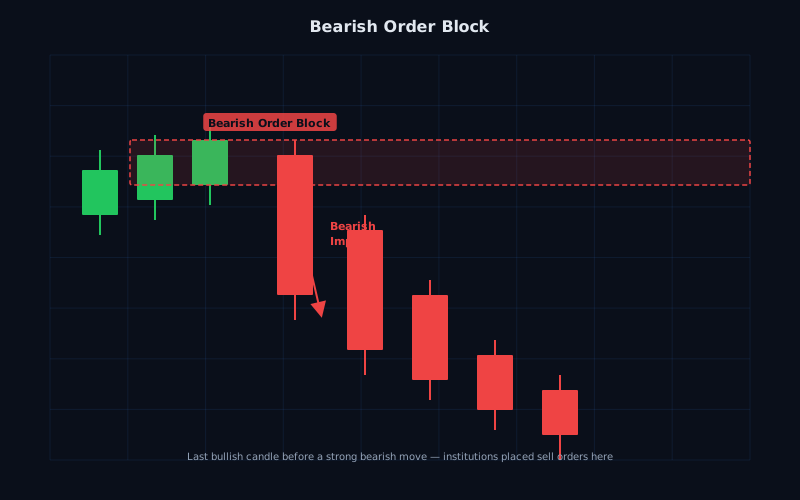
Bearish Order Block: The last bullish candle before a strong bearish displacement. Price returning to this zone is a high-probability short setup.
Bearish Order Block
A Bearish OB is the last up candle(s) before a strong bearish impulse. It sits at the top of a rally before a large down-move. Features:
- The body of the last bullish candle defines the OB zone
- The bearish impulse below should be strong with minimal wicks
- Ideally accompanied by a bearish FVG below the OB
- Entry: short when price returns to the OB zone (lower half of the candle body preferred)
Multi-Timeframe OBs: Nested Precision
OBs exist on every timeframe simultaneously. A 4H bullish OB defines a large reaction zone. Within that 4H OB, you can often find a 15M or 5M OB that gives you a more precise entry with a tighter stop loss — dramatically improving your risk-to-reward ratio.
This "nested OB" approach is one of the most powerful precision entry techniques in SMC.
Use HTF OBs to identify your zone of interest. Then zoom into LTF OBs within that zone for precise entries with tight stops. The combination of HTF confluence + LTF OB entry can produce risk-reward ratios of 1:5 or greater.
Quick Quiz
1. What defines the zone of a Bullish Order Block?
2. What is the benefit of using nested OBs (HTF + LTF)?
When Order Blocks Fail
7 min readNo concept in trading works 100% of the time, and Order Blocks are no exception. Knowing when an OB is likely to fail — and how to manage that scenario — is just as important as knowing when to trade it.
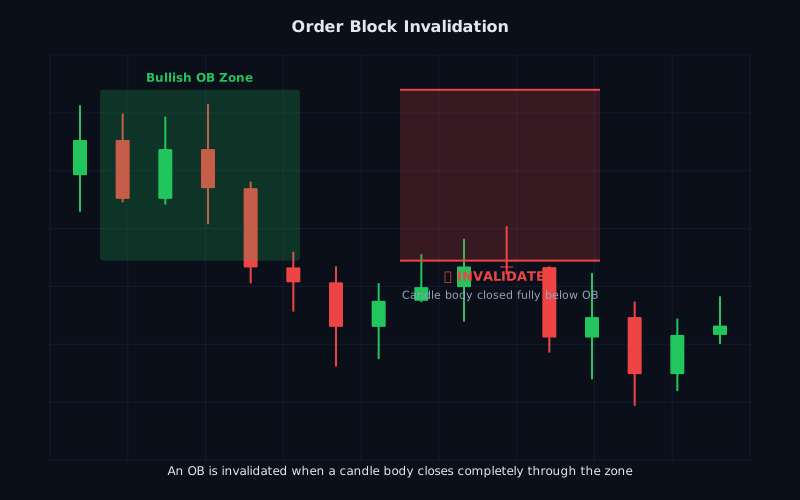
Invalidation: The Full Close Beyond
An Order Block is considered invalidated when price closes its candle body fully beyond the OB zone. A wick beyond the OB is not invalidation (it may even be a sweep). But when a candle body closes completely through the OB zone — taking out both the open and the close of the OB candle — the institutional orders that created that OB have likely been consumed or defended at a lower level.
Multiple Taps = Weakening
The first time price returns to an OB is the highest probability reaction. By the second tap, some of those institutional orders have been filled. By the third tap, the OB zone is significantly weaker. As a general rule:
- First tap: Highest probability. Enter with full confidence.
- Second tap: Reduced probability. Enter with smaller size or require additional confirmation.
- Third+ tap: Low probability. Avoid or skip. The zone is likely exhausted.
Time Decay
OBs formed very recently (last few hours on LTF, last few days on HTF) are fresher and more likely to hold. OBs that are weeks or months old on the daily chart may still be valid if unmitigated, but they should be treated with slightly more caution — market conditions change over time.
HTF vs LTF Conflicts
When a 4H bullish OB conflicts with a bearish daily structure shift, the HTF always wins. Never trade a LTF OB against the HTF directional bias. The OB that is aligned with the higher timeframe is the only one worth trading.
If price closes its body fully through your OB stop loss zone, exit immediately. Do not hold hoping for a return. A breached OB often becomes a breaker block — which means smart money is now using it as supply/resistance, not support. The opposite of what you need.
Quick Quiz
1. An Order Block is considered invalidated when:
2. Which tap of an Order Block has the HIGHEST probability?
Trading Order Block Setups
10 min readThe Order Block is your Point of Interest (POI). Now you need a complete playbook for how to enter, protect, and exit an OB-based trade from start to finish.
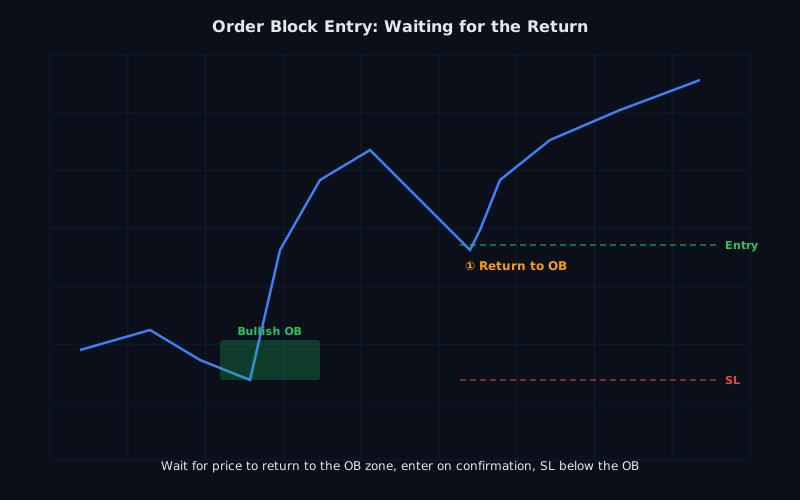
Entry: Waiting for the Return
After the OB is formed by the initial impulse move, you do not enter immediately. You wait. Price must retrace back to the OB zone. During that wait, you should:
- Mark the OB zone (top and bottom of the last opposing candle body)
- Set a price alert at the top of the zone (for bullish OBs)
- Check whether the HTF structure still supports your directional bias
- Note whether there is a Fair Value Gap overlapping the OB (higher confluence)
Confirmation Signals at the OB
When price arrives at the OB, look for one of these confirmation signals before entering:
- Rejection wick: A clear wick that enters the OB zone and then the candle body closes back away — showing price is rejecting the zone
- Engulfing candle: A bullish engulfing candle forming at a bullish OB
- LTF ChoCH/BOS: Drop to the 1M or 5M chart and look for a bullish market structure break at the OB — strongest confirmation
Entry, SL, and TP Placement
Entry: At the 50% level of the OB zone (the midpoint of the last opposing candle body), or on the LTF confirmation signal.
Stop Loss: Below the bottom of the OB zone for a bullish OB (a few pips below), or above the top for a bearish OB. If the entire OB zone is violated, the thesis is wrong — no reason to stay in.
Take Profit:
- TP1: The first liquidity target above (previous swing high / BSL) — consider taking 50% here
- TP2: The HTF target (the next major high, or the point opposite the original impulse)
- Move SL to break-even after TP1 is hit
- Entry: 50% of OB zone or on LTF confirmation (ChoCH/BOS at the OB)
- SL: Below/above the entire OB zone (if price closes beyond, thesis is invalid)
- TP1: Next swing high/low (partial profits)
- TP2: HTF liquidity target (let runners work)
- Move to break-even after TP1 is hit
Quick Quiz
1. Where is the ideal entry point within a Bullish Order Block?
2. After hitting TP1 in an OB trade, you should:
What is a Fair Value Gap?
9 min readA Fair Value Gap (FVG) is a three-candle pattern that reveals an imbalance between buyers and sellers in the market. When price moves so quickly that it leaves a "gap" in price delivery — a zone where not all orders were matched — that inefficiency becomes a magnet for price to return and fill.
The Three-Candle Pattern
Identifying an FVG requires exactly three consecutive candles:
- Candle 1 (left): Any direction — defines the right edge of the gap
- Candle 2 (middle): A large, strong candle moving in one direction — the impulse candle
- Candle 3 (right): Any direction — defines the left edge of the gap
The FVG is the space between the high of Candle 1 and the low of Candle 3 (for a bullish FVG). There is no overlap — price moved too fast to trade in that price range, creating an imbalance.
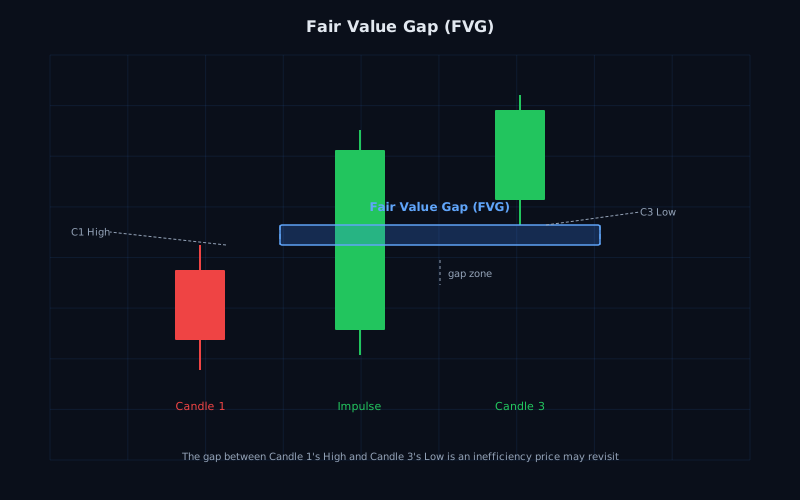
The Fair Value Gap: space between Candle 1's high and Candle 3's low (bullish). Price seeks to return and fill this inefficiency.
Why Price Returns to Fill FVGs
Markets are fundamentally efficiency-seeking mechanisms. When price moves through a level so fast that orders cannot be matched at those prices, there are unfilled orders left behind. Think of it as market "unfinished business."
Smart money also uses FVGs strategically. They intentionally create these imbalances to generate the momentum needed for a large move. Once the move is underway, they allow price to return to the FVG — filling their remaining orders at better prices — before continuing in the original direction.
Statistically, a very high percentage of FVGs get "filled" (price returns to trade within the gap) within a short timeframe, particularly on lower timeframes.
FVGs are closely related to the concept of "liquidity voids" in traditional order flow analysis. In equity markets, they are similar to opening gaps. The SMC framework treats them as institutional price delivery zones rather than simple chart patterns.
A Fair Value Gap is an area where price delivery was inefficient. Markets are drawn to fill these inefficiencies. When an FVG aligns with other SMC confluences (Order Block, liquidity sweep), it becomes one of the highest probability entry zones available.
Quick Quiz
1. A bullish Fair Value Gap is the space between:
2. Why does price tend to return to fill Fair Value Gaps?
Types of FVGs
8 min readNot all FVGs are created equal. As you advance in SMC, you will encounter several variations — each with its own characteristics and trading implications.
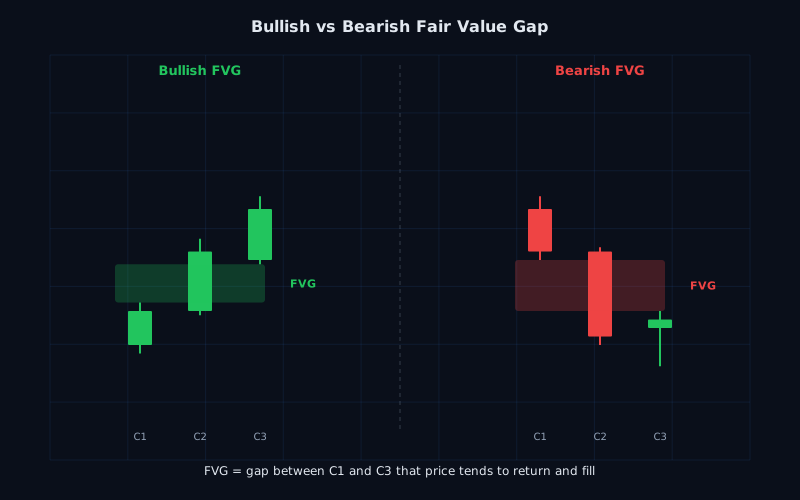
Bullish vs Bearish FVG
This is the basic distinction:
- Bullish FVG: Created by three upward-moving candles. The gap is between the high of candle 1 and the low of candle 3. Price is expected to return to fill it from above and then continue higher.
- Bearish FVG: Created by three downward-moving candles. The gap is between the low of candle 1 and the high of candle 3. Price returns to fill from below and then continues lower.
Inverse Fair Value Gap (IFVG)
An Inverse FVG (IFVG) is what happens when an FVG gets fully breached. Instead of price bouncing from the FVG as expected, it powers through. When this happens, the FVG "flips" — a bullish FVG that is fully violated becomes a bearish resistance zone (IFVG), and vice versa.
IFVGs are significant because they represent a failed setup — meaning institutional intent has changed. An IFVG now acts as the opposite Point of Interest.
Consequent Encroachment (CE)
The Consequent Encroachment is the 50% level of the FVG — the exact midpoint of the gap. This is the highest probability entry point within an FVG for two reasons:
- It represents the mean of the imbalance — the mathematical "fair value" within the inefficiency
- Institutions often defend the 50% of their FVG rather than the full extent
When targeting an FVG entry, aim for the CE (50%) rather than just entering anywhere in the gap. This gives you a tighter and more precise entry.
The 50% level (Consequent Encroachment) of any FVG is the highest probability entry zone. If an FVG gets fully violated, it flips to an Inverse FVG with the opposite directional bias. Always be aware of which FVGs have been violated and which remain intact.
Quick Quiz
1. What is "Consequent Encroachment" in relation to an FVG?
2. An Inverse FVG (IFVG) forms when:
FVG + Order Block Confluence
9 min readIf the Order Block is a point of interest and the FVG is a point of interest — what happens when they occupy the same price zone? You get the highest-probability setup in all of SMC: the OB + FVG confluence zone.
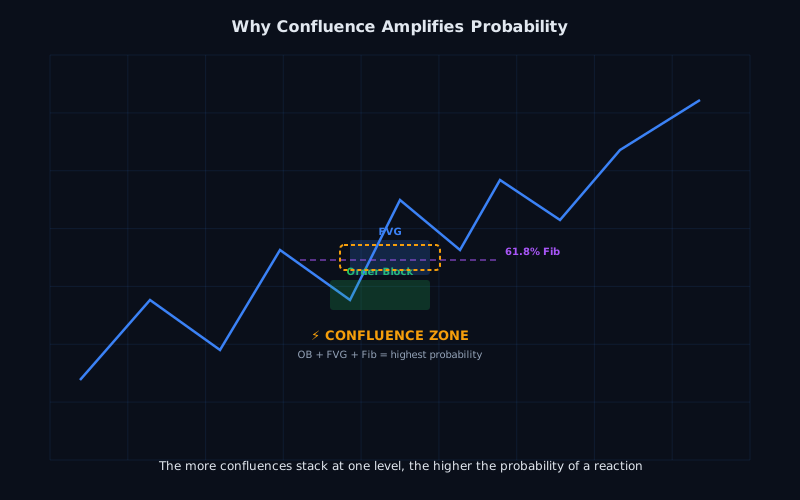
Why Confluence Amplifies Probability
In trading, confluence means multiple independent reasons pointing to the same conclusion. When two independent SMC concepts — the OB and the FVG — both identify the same price zone as significant, the probability of a reaction at that zone increases substantially.
Here is the logic stacked:
- The Order Block tells you institutions entered here
- The FVG tells you price delivery was inefficient here — orders remain unfilled
- When both overlap, you have institutional entry interest AND unfilled orders at the same zone
- Add a liquidity sweep preceding the return to this zone and you have a complete setup
How to Identify an OB+FVG Confluence Zone
- Find a strong impulse move with an FVG clearly visible in the 3-candle pattern
- Identify the OB (last opposing candle before the impulse)
- Check: does the FVG overlap with the OB? If the FVG sits within or adjacent to the OB candle body — you have confluence
- Mark this entire zone as your highest-priority entry area
- Wait for price to return with a sweep of opposing liquidity first (optional but adds further confluence)
Entry Techniques for Confluence Zones
Conservative approach: Wait for price to reach the CE (50%) of the FVG within the OB zone. Set a limit order there. Stop below the bottom of the OB.
Aggressive approach: Drop to the 1M chart when price enters the zone. Wait for a micro ChoCH (1M market structure shift) in the direction of your trade. Enter on the first 1M FVG in that direction. Stop is tighter but entry is more precise.
When an OB and an FVG overlap, you have the highest concentration of institutional interest on the chart. These zones produce the sharpest, most decisive reactions. Prioritise them above single-concept setups every time.
Quick Quiz
1. Why is an OB + FVG confluence zone higher probability than either alone?
2. In the conservative OB+FVG entry technique, where is the entry placed?
Trading FVG Setups
9 min readThe FVG is one of the most versatile tools in SMC — it can be used as an entry zone, a target, or an invalidation level. Understanding all three roles makes you a significantly more complete trader.
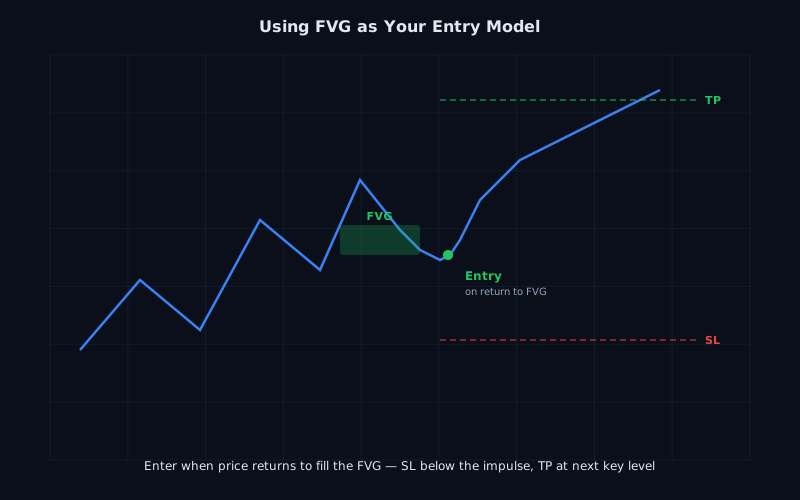
FVG as Entry
The most common use: entering long when price retraces into a bullish FVG (or short when price rallies into a bearish FVG). The CE (50%) is the preferred entry point. Stop loss sits below the bottom of the FVG for long entries.
FVG as Target
If you are already in a trade, unfilled FVGs above (for longs) or below (for shorts) represent price magnets. When setting your take profit targets, mark any FVGs that exist in the direction of your trade. Price is drawn to fill them — use them as TP levels.
FVG as Invalidation
If price is holding above a bullish FVG and then closes its body below it — your long thesis is invalidated. The FVG failed to hold price. This is your signal to exit. Similarly, a rally closing above a bearish FVG invalidates your short.
Position Sizing for FVG Trades
FVGs on higher timeframes (1H, 4H, Daily) have larger gaps, which means wider stops — requiring smaller position sizes. FVGs on lower timeframes (5M, 1M) have tighter gaps, allowing larger position sizes for the same dollar risk. Always calculate: Position Size = (Account Risk $) ÷ (Stop Loss in pips × Pip Value)
- FVG as Entry: wait for price to reach CE (50%) of FVG, enter with stop below FVG
- FVG as Target: unfilled FVGs ahead are price magnets — use them as TP levels
- FVG as Invalidation: full candle body close beyond the FVG = thesis failed, exit
- Position sizing formula: Risk $ ÷ (SL pips × pip value)
Quick Quiz
1. How can a Fair Value Gap be used as a TAKE PROFIT target?
2. A bullish FVG trade is invalidated when:
Fibonacci Retracement
8 min readFibonacci ratios appear throughout nature — in spiral shells, galaxy formations, and even the proportions of the human face. In financial markets, these same ratios define the natural retracement levels that price tends to respect. Learning to use Fibonacci correctly transforms your ability to time entries with precision.
The Golden Ratios
The Fibonacci sequence (1, 1, 2, 3, 5, 8, 13, 21...) produces a series of ratios that have remarkable properties. The key levels used in trading are:
- 38.2% — Shallow retracement. Common in strong trends. A 38.2% pullback often signals trend strength.
- 50% — Not technically a Fibonacci ratio, but the equilibrium or "halfway point" — price often pauses here.
- 61.8% — The Golden Ratio. One of the most respected levels in all of technical analysis.
- 78.6% — The square root of 0.618. This deeper level is where ICT places the entry for the Optimal Trade Entry (OTE).
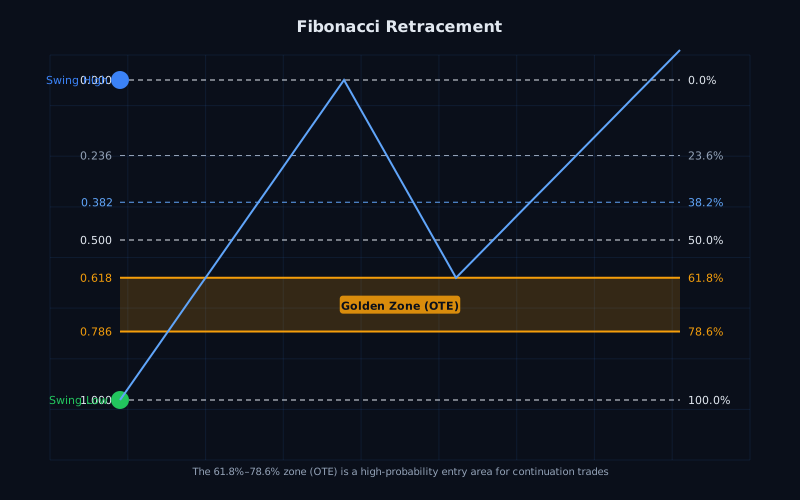
Fibonacci retracement drawn from swing low to swing high. The 61.8%–78.6% zone (OTE) is the highest probability entry zone according to ICT.
How to Draw Fibonacci on Charts
The critical rule: always draw Fibonacci from the most recent significant swing:
- Identify the last significant swing low and swing high (or high and low) on your current timeframe
- Activate the Fibonacci Retracement tool in TradingView (or your platform)
- For an uptrend retracement: click the swing LOW first, drag to the swing HIGH
- For a downtrend retracement: click the swing HIGH first, drag to the swing LOW
- The tool will automatically draw the key levels at 38.2%, 50%, 61.8%, and 78.6%
Common beginner mistake: drawing Fibonacci on random highs and lows rather than the most recent significant swing. The Fibonacci must be drawn on the impulse move you are expecting price to retrace against.
Fibonacci retracement levels are not magic — they work because millions of traders watch them. In SMC, they are used specifically to identify the 61.8%–78.6% zone (OTE) as the highest probability entry for continuation of the original move.
Quick Quiz
1. When drawing Fibonacci for an uptrend retracement, you should:
2. Which Fibonacci level represents the "equilibrium" or midpoint of a move?
The Golden Zone & OTE
8 min readThe Optimal Trade Entry (OTE) is ICT's specific application of Fibonacci to identify the highest probability entry point for a continuation trade. It combines the 61.8%–78.6% Fibonacci retracement zone with SMC confluence to produce a precise, repeatable entry model.
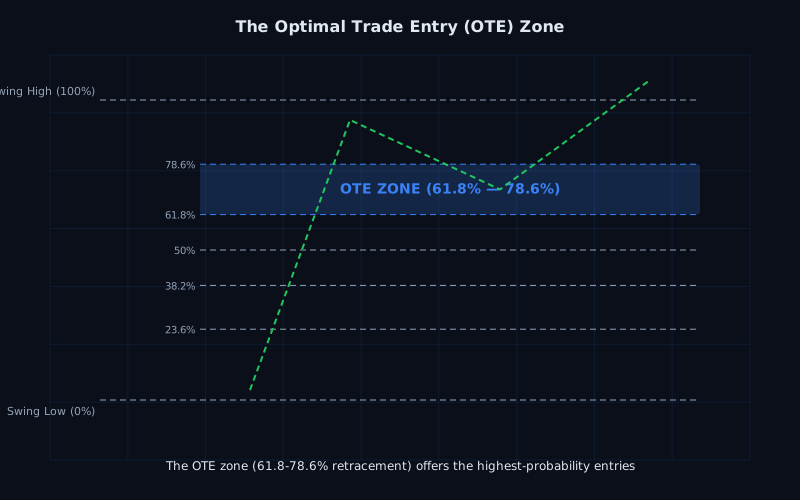
What is the OTE Zone?
The OTE zone is defined as the area between the 61.8% and 78.6% Fibonacci retracement levels. ICT's research and extensive backtesting suggest that during genuine trend continuation moves, price most commonly retraces into this "golden zone" before resuming in the original direction.
Why is this zone special?
- 61.8% is the golden ratio — the most mathematically significant retracement level
- 78.6% is deep enough to sweep stop losses below the 50% level, collecting retail stops
- The zone between them represents where institutional accumulation is most commonly observed during retracements
Combining OTE with OBs and FVGs
The OTE becomes exponentially more powerful when it aligns with an Order Block or Fair Value Gap:
- OTE + OB: Draw Fibonacci on the impulse. If the 61.8%–78.6% zone overlaps with the OB zone — this is your premium entry. The OTE confirms the timing; the OB confirms the location.
- OTE + FVG: If the CE (50%) of an FVG falls within the OTE zone — extremely high confluence. This is one of ICT's signature setups.
- Triple confluence: OTE zone + OB + FVG all overlapping = the highest probability SMC setup possible
The OTE zone (61.8%–78.6%) is where institutions typically accumulate during a trend retracement. When this zone overlaps with an Order Block or FVG, you have a three-way confluence that produces some of the cleanest, highest RR setups in SMC trading.
Quick Quiz
1. The OTE (Optimal Trade Entry) zone spans which Fibonacci levels?
2. What does it mean when OTE + OB + FVG all overlap?
Premium vs Discount
7 min readThe Premium/Discount framework is one of the most elegant concepts in SMC. It provides a simple but powerful filter for trade direction: only buy in the discount, only sell in the premium. Following this rule alone will eliminate many low-quality trades from your system.
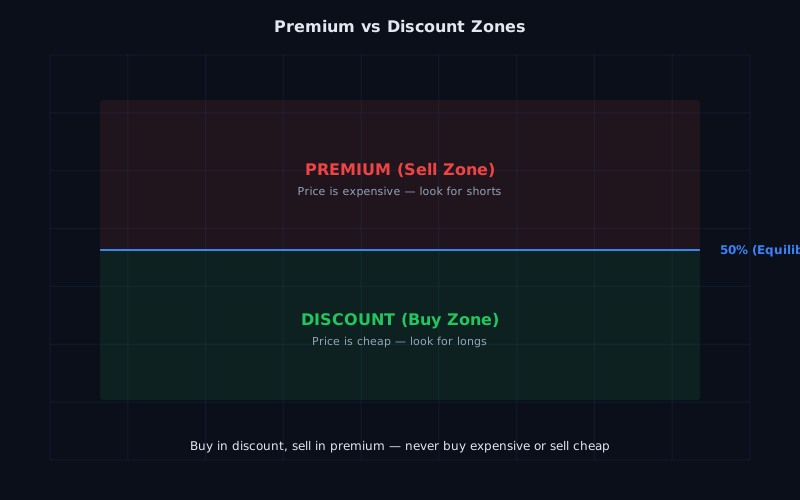
Defining Premium and Discount
Using the Fibonacci tool on any significant swing range:
- Above 50% (premium): Price is trading at a premium relative to the range. This is an overvalued area — good for selling. Buyers here are buying at "retail price."
- Below 50% (discount): Price is trading at a discount relative to the range. This is an undervalued area — good for buying. Sellers here are selling at "sale price."
- The 50% line (equilibrium): The exact midpoint of the range. Price at equilibrium has no natural directional bias from this model alone.
The Practical Application
When you have established an HTF bias (bullish or bearish), use the Premium/Discount framework as a filter:
- Bullish HTF bias: Only look for long entries when price is in the discount zone (below 50% of the HTF range). Do not buy in the premium — wait for price to drop to discount first.
- Bearish HTF bias: Only look for short entries when price is in the premium zone (above 50%). Do not sell in the discount — wait for a rally first.
This framework ensures you are always buying "cheap" and selling "expensive" — the fundamental principle of profitable trading applied through the SMC lens.
Combining with OTE
Notice that the OTE zone (61.8%–78.6%) sits comfortably in the discount zone for uptrend retracements. This is not coincidental. The OTE is specifically designed to be a deep discount entry — which is why it works. Similarly, the OTE zone for downtrend retracements places your short entry in the premium zone.
The rule is simple: buy in discounts, sell in premiums. The 50% equilibrium line divides the two. The OTE zone (61.8%–78.6%) is always in the deep discount (for longs) or deep premium (for shorts) — which is exactly why it is the optimal entry zone.
- Premium = above 50% Fibonacci level (selling zone)
- Discount = below 50% Fibonacci level (buying zone)
- Equilibrium = the 50% level (no bias)
- Rule: Only enter longs in discount, only enter shorts in premium
- The OTE zone (61.8%–78.6%) is always in the deepest discount/premium — highest probability
Quick Quiz
1. If you have a bullish HTF bias, where should you look for long entries?
2. Why does the OTE zone (61.8%–78.6%) work particularly well for long entries?
The 4 Kill Zones
9 min readICT's Kill Zones are specific trading windows — time-of-day periods when institutional activity is highest and the best SMC setups form. Trading these windows rather than watching charts for 24 hours makes you both more effective and more sustainable.
Kill Zone Overview
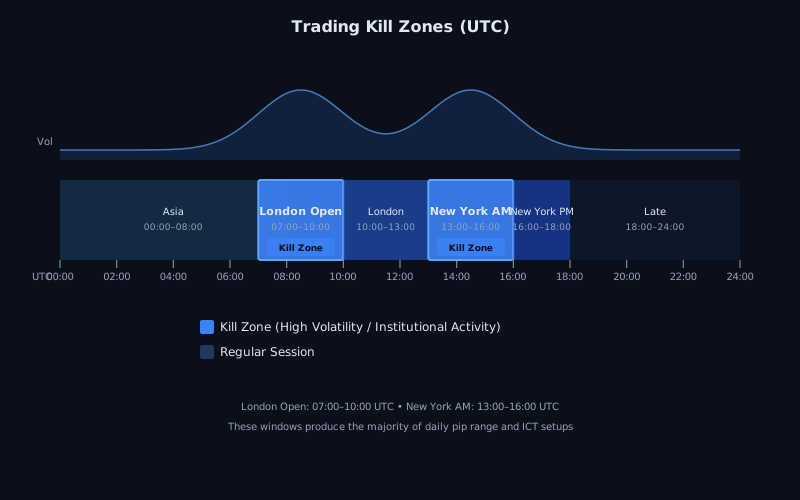
The four ICT Kill Zones: Asia (consolidation), London Open (manipulation), New York AM (trend/reversal), New York PM (low activity).
1. Asia Kill Zone (10:00 PM – 00:00 AM UTC)
The Asia session is characterized by consolidation and range-building. Tokyo, Singapore, and Sydney are the dominant markets. Volume is lower. Price tends to range within relatively tight bounds.
In ICT's framework, the Asia session serves a critical purpose: it sets the high and low that London and New York will target. The Asia High (AH) and Asia Low (AL) become key liquidity levels for the subsequent sessions. This is fundamental to strategies like the J3 Asia Sweep.
2. London Kill Zone (07:00 AM – 09:00 AM UTC)
London is the world's largest forex market. When it opens, volume surges dramatically. The London Kill Zone is characterized by manipulation:
- Price will frequently sweep the Asia session high or low at the London open
- This sweep is the "Judas Swing" — a false move designed to trap retail traders
- After the sweep, price reverses and establishes the true direction for the session
The London Kill Zone produces the highest quantity of quality SMC setups in the entire trading day for forex pairs.
3. New York AM Kill Zone (12:00 PM – 14:00 PM UTC)
As New York opens, the market transitions into the busiest period globally. Two of the world's largest markets are now simultaneously open (London + NY overlap). The NY AM Kill Zone is where the day's trend often:
- Continues in the direction established by London, or
- Reverses London's move (the "New York Reversal")
4. New York PM Kill Zone (15:00 PM – 16:00 PM UTC)
After 15:00 UTC, London has closed and the NY session is winding down. Volume decreases significantly. ICT recommends avoiding trading in the NY PM session for most setups — liquidity is thin and price moves can be erratic. This is the "choppy zone."
Focus your trading on the London and NY AM Kill Zones. Asia builds the liquidity. London sweeps it. New York either continues or reverses it. Trading outside these windows — especially NY PM and the dead Asia session — produces significantly lower quality setups.
Quick Quiz
1. What is the primary characteristic of the Asia Kill Zone?
2. The "Judas Swing" refers to:
Session-Based Trading
8 min readEach trading session has a distinct personality shaped by the institutions dominating that market. Learning to read each session's character — and exploiting the transitions between sessions — is the foundation of time-based SMC trading.
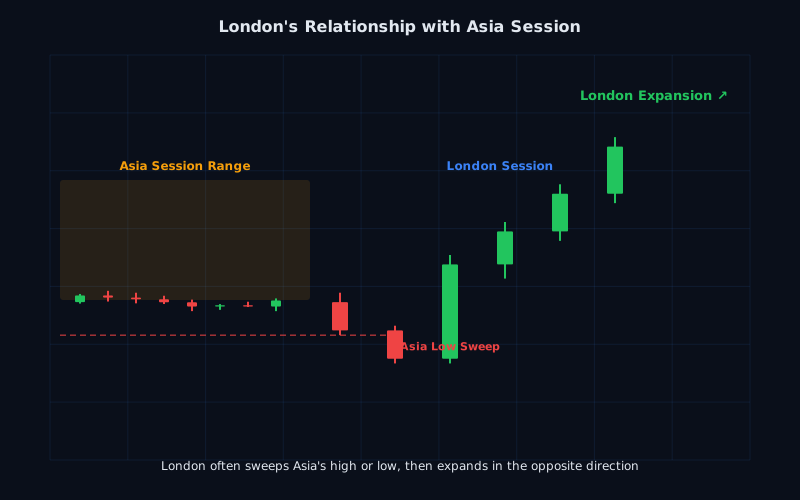
London's Relationship with Asia
The most reliable pattern in session-based trading: London often reverses the Asia range. If Asia ranged between 1.2500 and 1.2550, London will frequently sweep one of those extremes (usually the one that has more stop losses behind it) before reversing in the opposite direction.
This creates a playbook: identify which side has more liquidity (equal highs = BSL, equal lows = SSL), and bias your trade toward London sweeping that side and then reversing. This is precisely what the J3 Asia Sweep strategy exploits (covered in Module 21-26).
New York's Relationship with London
Two possible NY scenarios:
- NY continues London's direction: This happens when London established a strong trend. The NY AM session respects the same direction — look for entry setups (OBs/FVGs) that formed during London and enter at the NY AM pullback.
- NY reverses London: The "New York Reversal" happens when London's move overextended or when major US news (NFP, FOMC) changes the picture. After the NY open, watch for a liquidity sweep of London's extreme, followed by a reversal.
Best Setup Patterns Per Session
Asia: Range identification. Mark Asia High and Asia Low. Set alerts. No active trading unless you are in a swing position from the previous day.
London Open (7:00–9:00 AM UTC): The Judas Swing. Wait for the sweep of Asia H or L. Look for ChoCH + FVG/OB entry on the reversal.
NY AM (12:00–14:00 UTC): Continuation of London trend OR reversal. Check if London ran too far into premium/discount. Fade extremes with OB entries.
Sessions are not just time windows — they are behavioral patterns. Asia builds. London manipulates and sets direction. New York confirms or reverses. Matching your SMC setup to the session context dramatically improves trade quality.
Quick Quiz
1. What is the most reliable pattern between the London and Asia sessions?
2. During the Asia session, the recommended primary action is:
Macro Times
7 min readBeyond the broad Kill Zone windows, ICT has identified specific intraday "macro" time windows when price is most likely to make significant moves. These are based on ICT's research into how algorithmic price delivery operates during specific minutes of the trading day.
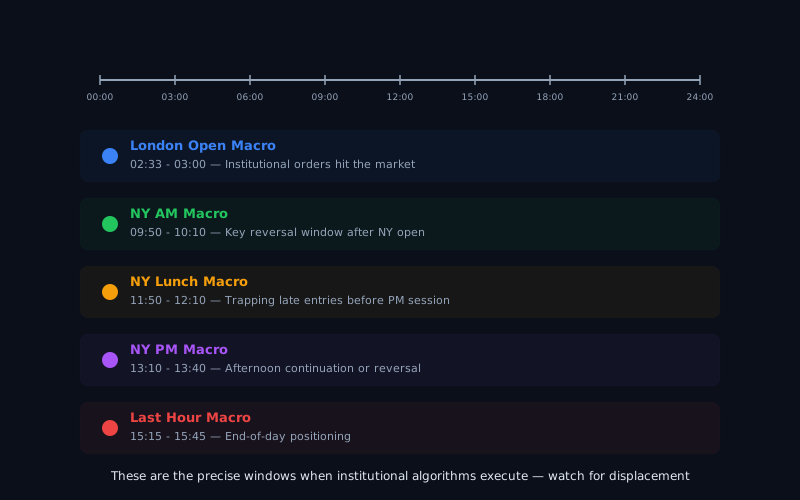
ICT Macro Windows (New York Time)
- 2:00–2:30 AM: Early Asian open — occasional macro for JPY pairs
- 8:20–8:40 AM: Pre-New York open — London/NY transition macro
- 9:50–10:10 AM: First NY macro — often establishes the AM direction
- 10:50–11:10 AM: Second NY macro — continuation or reversal of the AM move
- 11:50 AM–12:10 PM: Lunch macro — typically lower quality, more choppy
- 13:10–13:30 PM: PM session open macro
The Silver Bullet Windows
The Silver Bullet is ICT's specific time-based strategy (covered in detail in the Advanced course). The three primary Silver Bullet windows are:
- 3:00–4:00 AM New York Time: London's opening move
- 10:00–11:00 AM New York Time: NY AM macro
- 2:00–3:00 PM New York Time: PM Silver Bullet (lower quality)
The concept: during these specific windows, look for an FVG to form on the 1M or 5M chart in the direction of the HTF bias. Enter on the first 1M FVG within the window. This is a time-based, rules-driven approach to finding high-probability intraday setups.
Why Do Macro Times Matter?
Markets are increasingly driven by algorithmic programs. These programs execute at specific times — often at the :50 or :10 minutes of each hour — creating predictable inflection points. ICT's macro times are based on years of observing these algorithmic tendencies.
The 9:50–10:10 AM New York macro aligns with the post-market-open settlement period. Major institutions often re-balance their positions in the first 10–15 minutes after market open, creating the "9:30 reversal" phenomenon that many daytraders have observed for decades.
Quick Quiz
1. ICT's three primary Silver Bullet windows are:
2. Why do macro times produce reliable inflection points?
Position Sizing Formulas
10 min readThe single most important skill in trading is not finding setups — it is sizing positions correctly so that no single loss destroys your account. The math of position sizing is simple, but most traders either ignore it or apply it inconsistently. Consistency here is what separates professionals from amateurs.
The Core Formula
Position sizing always starts with one question: How much am I willing to lose on this trade in dollar terms?
The formula is:
Position Size (lots) = Risk Amount ($) ÷ (Stop Loss in pips × Pip Value per lot)
Example: You have a $10,000 account. You risk 1% per trade = $100. Your stop loss on EURUSD is 20 pips. Pip value per standard lot on EURUSD = $10. Therefore: 100 ÷ (20 × $10) = 100 ÷ 200 = 0.5 lots.
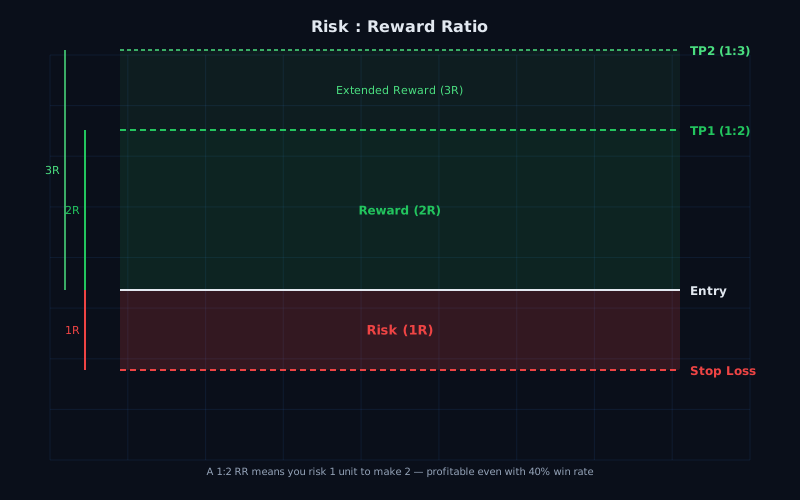
Risk-reward visualization: a 1:3 RR means you risk 1 unit to make 3. Even with a 40% win rate, a 1:3 RR strategy is profitable long-term.
Risk Per Trade Rules
Standard professional risk guidelines:
- Conservative: 0.5% per trade — maximum capital preservation, minimal drawdown
- Moderate: 1% per trade — the most common professional standard
- Aggressive: 2% per trade — maximum recommended for experienced traders only
- Never exceed 2% per trade regardless of how good the setup looks
Risk-to-Reward Ratios
The minimum acceptable RR for any SMC trade is 1:2. This means for every $1 risked, you target at least $2 in profit. At 1:2 RR, you only need a 34% win rate to be profitable. Most SMC setups, when traded correctly, offer 1:3 to 1:5 RR.
The math of 1:3 RR at various win rates:
- 50% win rate at 1:3 = 2× return per cycle of trades
- 40% win rate at 1:3 = 1.4× return per cycle
- 33% win rate at 1:3 = breakeven (zero expected value)
Compounding Gains Properly
The power of compounding: if you risk 1% per trade and maintain a 50% win rate at 1:2 RR, your expected gain is 0.5% per trade (50% × 2% − 50% × 1%). Starting with $10,000, after 100 trades that is approximately $16,470 — a 65% return with a simple, consistent approach.
Never adjust your position size upward because a setup "looks perfect." Perfect-looking setups fail regularly in SMC — that is the nature of markets. Sizing up on conviction is how traders blow accounts. Consistent 1% risk per trade, every trade, with no exceptions.
Quick Quiz
1. Using a $5,000 account, 1% risk, 15-pip stop on EURUSD ($10/pip/lot), what is your position size?
2. What is the MINIMUM acceptable risk-to-reward ratio for SMC trades?
Trade Management
9 min readGetting into a trade is only half the battle. How you manage a trade once it is live — where you move your stop, whether to take partial profits, and when to exit — often determines whether a good setup becomes a good trade or just another loss.
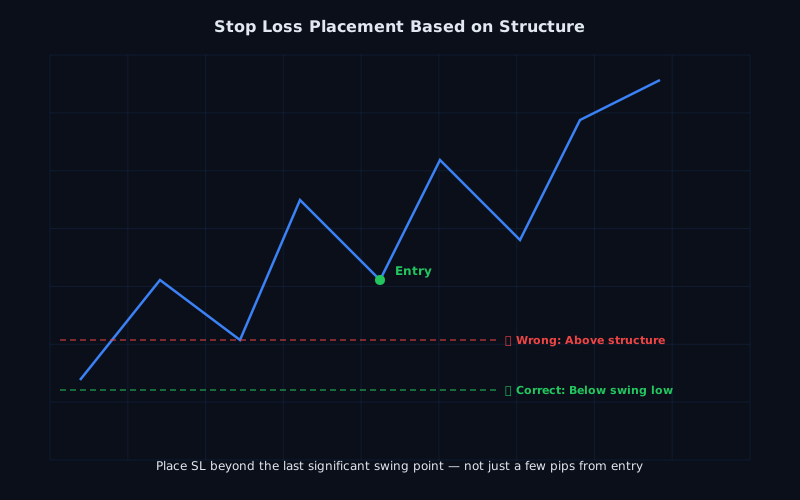
Stop Loss Placement Based on Structure
Stop losses should be placed at structural invalidation points — levels where, if hit, the original thesis is definitively wrong:
- OB entry: Stop below the bottom of the entire OB zone
- FVG entry: Stop below the bottom of the FVG
- After liquidity sweep: Stop beyond the sweep extreme
- Never use a fixed pip stop — always use structural placement
Partial Profits vs Letting Winners Run
Two legitimate approaches:
Partial profit approach: Take 50% off at TP1 (first liquidity target), move stop to break-even, let remaining 50% run to TP2. This approach reduces psychological pressure and guarantees a worst-case break-even result on the remaining position.
Full position run: Hold 100% of the position to the final target. Mathematically superior if your target is hit (maximum profit), but psychologically harder. Reserved for the highest conviction A-grade setups.
Moving to Break-Even
Move your stop to break-even (BE) when:
- Price has reached your TP1 level and you have taken partial profits
- Price has moved a sufficient amount in your favor to warrant protecting the trade
- A new structure (BOS) has formed in your favor on the LTF
Do NOT move to break-even too early — just because a trade is 5 pips in profit does not mean you should immediately move to BE. Give the trade room to breathe within the structure.
Trailing Stops
A trailing stop moves with price, locking in profits as the trade moves favorably. In SMC, trail behind the most recent structural swing low (for longs) or swing high (for shorts) rather than using a fixed-pip trail. This keeps the stop at a logical structural level and avoids being stopped out by normal market breathing.
The best trade management approach: enter with a full position, take 50% profit at TP1, move to break-even, and let the remaining 50% run to TP2 with a structural trailing stop. This approach guarantees you never turn a winner into a loser after TP1 is hit.
Quick Quiz
1. In SMC, where should stop losses be placed?
2. When should you move a stop loss to break-even?
Building Your Risk Plan
10 min readA trading system without a risk plan is not a system — it is gambling with extra steps. Your risk plan is the rulebook that governs how you behave during losing streaks, winning streaks, and everything in between. Write it once. Follow it always.
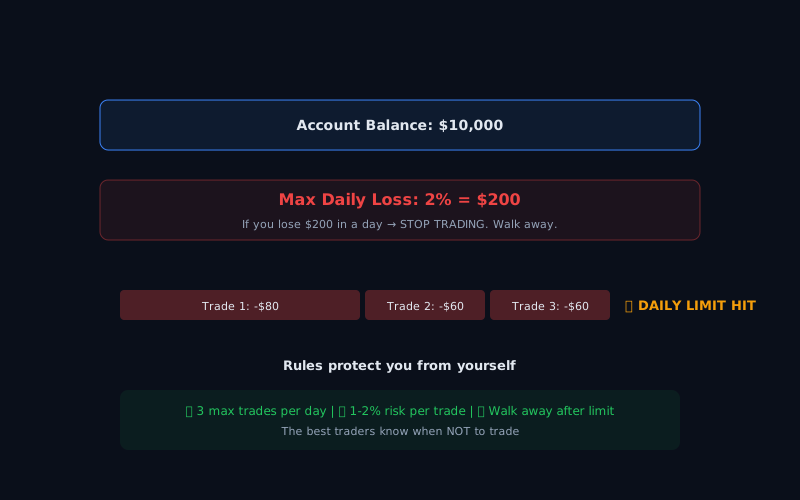
Maximum Daily Loss Limit
Define the maximum amount you will lose in a single day before stopping. The professional standard is 3% of account per day. If you hit your daily loss limit, you stop trading — no exceptions, no "just one more trade to recover."
The logic: if you lose 3% in a day, either the market conditions are unfavorable for your strategy or you are not trading well. Either way, more trades will likely make it worse. The daily limit forces you to walk away and reset.
Maximum Weekly Loss
Set a weekly loss limit at approximately 5–6% of account. If reached by Wednesday, take Thursday and Friday off. This prevents catastrophic drawdowns that take months to recover.
Number of Trades Per Day
More trades ≠ more profit. Quality over quantity is the law in SMC. Recommended limits:
- Beginner/Developing traders: Maximum 2 trades per day
- Intermediate traders: Maximum 3 trades per day
- Advanced traders: Maximum 5 trades per day (across multiple sessions/pairs)
Recovery Mode After Losses
After a significant losing streak (3+ consecutive losses), enter "recovery mode":
- Reduce position size to 0.5% risk per trade
- Only take A-grade setups (your highest conviction patterns)
- Take a 1-day break if you hit the daily loss limit
- Return to normal sizing only after 3+ consecutive winning trades
- Account size: $______
- Risk per trade: ___% (recommended: 1%)
- Maximum daily loss: 3% = $______
- Maximum weekly loss: 5% = $______
- Maximum trades per day: ___
- Minimum RR per trade: 1:2
- Recovery mode trigger: 3 consecutive losses
- Recovery mode: 0.5% risk until 3 consecutive wins
A risk plan only works if you follow it 100% of the time. Deviating "just this once" because a trade looked too good is how risk plans fail. Write your rules, print them, tape them to your monitor. Every rule break is a lesson costing you real money.
Quick Quiz
1. What is the recommended maximum risk per trade for most traders?
2. If you hit your maximum daily loss limit, what should you do?
3. What is the minimum recommended risk-to-reward ratio for a trade?
4. After 3 consecutive losses, what should you do in recovery mode?
Bullish vs Bearish OB Identification
12 min readYou already know the basic definition of an order block from Module 10. Now we go deeper — the kind of deep that separates traders who can identify OBs correctly every time from those who mark random candles and wonder why the level keeps failing.
The Bullish Order Block: Exact Identification
A bullish order block is the last bearish (down-close) candle immediately before a strong impulsive bullish move that breaks market structure. That sounds straightforward, but there are three conditions every single one must meet:
- It must be a candle that closed bearish (red/down) — not a doji, not a long-wick candle that was technically a down close but barely moved. You want a candle that clearly closed below its open.
- The move away from it must be impulsive — multiple large bullish candles, minimal wicks, minimal overlap between candle bodies. This is institutional displacement, not a slow grind up.
- A Break of Structure (BOS) or Market Structure Shift (MSS) must result — the subsequent move has to actually break something. If price just bounces and rolls over, the candle was not an order block — it was noise.
The actual zone you mark is the full range of that last bearish candle: from its high down to its low. But when price returns, the most reactive level within the OB is the mean threshold — the 50% midpoint of that candle's range. Think of it as the CE of an order block.
The Bearish Order Block: Exact Identification
Mirror logic applies. The bearish OB is the last bullish (up-close) candle before a strong impulsive bearish move that breaks structure. Criteria:
- Candle must clearly close bullish (green/up), above its open
- The move away must be aggressive and impulsive — institutional-grade selling pressure
- A BOS or MSS to the downside must follow
The zone is the full candle range. The 50% midpoint (mean threshold) is the highest-probability reaction level when price returns.
Higher Timeframe OBs Dominate
An OB on the daily chart will override an OB on the 15-minute chart every time. When a 1-hour OB lines up inside a daily OB, you have the strongest possible setup. Always identify your HTF OBs first — they define where price wants to go. LTF OBs give you the exact entry candle inside that HTF zone.
Do not mark every red candle before an up move as a bullish OB. The key qualifier is the structure break. No structure break = no OB. Also, do not confuse the OB with a supply or demand zone — an OB is a specific single candle (or the last in a consecutive group), not a broad consolidation range.
The three non-negotiables for any valid OB: contrarian candle (down before up, up before down) + impulsive displacement away + confirmed structure break. All three must be present.
- Bullish OB = last bearish candle before impulsive up move + BOS
- Bearish OB = last bullish candle before impulsive down move + BOS
- Mark the full candle range; mean threshold (50%) is the prime reaction level
- HTF OBs carry more weight than LTF OBs — always start top-down
Quick Quiz
1. What is the most important structural requirement for a valid order block?
2. What is the "mean threshold" of an order block?
3. A bullish order block is specifically defined as:
Mitigation Rules & Validity Checklist
10 min readAn order block is not a permanent structure on your chart. It has a lifespan, and understanding that lifespan is what stops you from entering on dead levels that everyone else is watching.
What Mitigation Means
When price returns to an order block after the initial displacement, it is said to "mitigate" the OB. This is the prime entry window — the first return is the most powerful because the institutional orders sitting inside that OB have not yet been filled. Once those orders are filled (mitigation complete), the OB loses its effectiveness. Trade the first return. Avoid the second.
The 4-Point OB Validity Checklist
Before entering any trade from an order block, run through this checklist in full:
- Clear impulsive move away from the zone — the displacement must look obviously institutional: large candles, minimal wicks, no chop.
- Market structure break resulted — either a BOS (continuation) or MSS (reversal). If the move never broke a prior swing, the OB is not valid.
- OB is unmitigated — price has NOT returned to the zone since the initial move. An OB that has already been tested is spent.
- Confluence with higher timeframe bias and liquidity — the OB must align with where the HTF wants price to go. Fighting the daily trend from a 5-minute OB is a low-probability game.
When Does an OB Become Invalid?
An order block is invalidated the moment price closes beyond the opposite side of the OB. For a bullish OB, that means a candle closing below the OB low. When that happens, the institutional demand that created the OB has been overwhelmed — there is no reason to expect a reaction there anymore. In fact, a violated bullish OB often becomes a bearish breaker block (more on that in Module 17).
Daily OB > 4H OB > 1H OB > 15M OB > 5M OB. A daily OB can absorb multiple reactions before being mitigated. A 5-minute OB may only hold for one touch before expiring. Always know which timeframe's OB you are trading and set your expectations accordingly.
One OB, one trade. The first return to an unmitigated OB is the entry. After mitigation, mark it as spent and stop watching it. Chasing second and third tests of the same OB is how traders turn winning setups into losing habits.
Quick Quiz
1. An order block is "mitigated" when:
2. When is a bullish OB considered invalidated?
3. Which return to an order block is most powerful for trade entry?
OB + FVG Confluence
9 min readOrder blocks and Fair Value Gaps are the two most important PD Arrays in the ICT framework. When they overlap, you have one of the highest-probability zones in all of SMC trading. Understanding why they overlap — and how to trade that overlap — is a skill that separates journeymen from consistent traders.
Why They Often Appear Together
Think about what creates an OB: a contrarian candle followed by an impulsive displacement move. Now think about what creates an FVG: a three-candle sequence where price moves so fast that a gap is left between candle 1's high and candle 3's low. These two phenomena often occur in the same sequence of candles because institutional displacement is the common ingredient. The OB is the last candle before the displacement; the FVG is within the displacement itself.
The Confluence Zone
When you draw the OB zone and the FVG zone, look for where they overlap. This overlapping area is your highest-probability entry region. Why? Because you now have two independent reasons for price to react at that exact level — unmitigated institutional orders (OB) AND an unfilled price imbalance (FVG). Institutions are defending that zone from both sides.
The ideal scenario: price retraces into the OB zone. Within that OB zone, there is an FVG. The Consequent Encroachment (CE) of that FVG — the 50% midpoint — becomes your precise entry point. Your stop sits below the low of the OB (for a bullish setup) and your target is the next liquidity draw.
How to Map the Confluence on a Chart
- Identify the displacement move and mark the OB (last contrarian candle before the impulse)
- Within that same displacement, find the FVG (3-candle imbalance)
- Check if the FVG overlaps with the OB zone — if yes, this is your confluence area
- Use Fibonacci on the FVG to find the CE (50% level)
- Wait for price to retrace into the confluence zone
- Enter at or near the CE, stop below the OB low
An OB alone is a valid entry. An FVG alone is a valid entry. But an OB with an FVG inside it is the ICT "A+ setup." If you only take one thing from this lesson: filter your OB entries to those where an FVG sits inside or overlapping the OB zone. Your win rate will reflect the difference.
Quick Quiz
1. Why do OBs and FVGs frequently appear together?
2. In an OB + FVG confluence setup, where is the ideal entry?
Stop Loss Placement & Trade Execution
11 min readKnowing where to enter from an order block is only half the equation. Where you place your stop loss determines whether you stay in the trade long enough to reach your target — or get shaken out by normal price fluctuation before the real move begins.
The Core Stop Loss Rule
For a bullish OB: stop loss goes below the low of the OB candle. This is the structural invalidation point. If price closes below that low, the OB is no longer valid — smart money has abandoned that level and you should too.
For a bearish OB: stop loss goes above the high of the OB candle. Same logic — a close above the OB high invalidates the bearish setup.
How to Execute the Trade
- Wait for price to reach the OB zone — do not pre-enter. Set a limit order at the OB's mean threshold (50% of the candle range), or wait for a lower timeframe MSS/confirmation candle within the OB.
- Confirm with LTF structure — drop to a 1-minute or 5-minute chart and look for a Market Structure Shift in your trade direction. This confirms the OB is holding, not just being touched in transit.
- Size your position — risk 0.5%–1% of account per trade. Calculate position size: Account × Risk% ÷ Stop Distance in pips (forex) or points (indices).
- Set targets before entry — identify the next draw on liquidity (equal highs/lows, session high, prior week high) and calculate your R:R. Minimum 1:2, aiming for 1:3 or better.
- Manage the trade — at 1R profit, move stop to break-even. At 2R, consider taking partial profits (30–50% of position). Let the remainder run to the full target.
Practical Example: Bullish OB on EUR/USD (1H)
Scenario: Daily chart is bullish. Price has retraced to a 1H bullish OB at 1.0850–1.0880, with the OB mean threshold at 1.0865. An FVG also sits within this zone. On the 5-minute chart, you see a MSS forming at 1.0862 during the London Kill Zone (3 AM EST).
- Entry: Limit buy at 1.0865 (mean threshold / CE of FVG)
- Stop Loss: 1.0843 (just below the OB low at 1.0848, with a 5-pip buffer)
- Stop distance: 22 pips
- Target 1: 1.0909 (1R = 22 pips above entry → 1.0887; 2R target = 1.0909)
- Target 2: 1.0950 (next external liquidity — prior session high)
- Risk per trade: 1% of $10,000 account = $100. Position size: $100 ÷ (22 × $10/pip for standard lot) = 0.45 lots
- Bullish OB stop: below OB low. Bearish OB stop: above OB high
- Never place stop inside the OB zone — that's where price is supposed to trade through before reversing
- LTF confirmation (MSS on 1M/5M) dramatically improves win rate vs. blind limit entries
- Minimum R:R target: 1:2. Target liquidity pools, not arbitrary pip numbers
Quick Quiz
1. Where should you place your stop loss on a bullish OB trade?
2. What is the minimum recommended R:R for an OB trade?
3-Candle Formation & BISI/SIBI Terminology
10 min readA Fair Value Gap is the most mechanically precise concept in all of ICT. There is no ambiguity about whether one exists — either the three-candle rule is met or it is not. That precision is what makes FVGs so tradeable once you understand them completely.
The Three-Candle Rule
An FVG requires exactly three consecutive candles. Here is how to identify each type:
Bullish FVG (BISI — Buy-Side Imbalance, Sell-Side Inefficiency)
- Three consecutive candles in an upward displacement
- The low of candle 3 is above the high of candle 1
- The gap between candle 1's high and candle 3's low is the FVG zone
- Price moved up so aggressively that there was no two-sided trading in that range
- Acts as a support/demand zone on retracement
Bearish FVG (SIBI — Sell-Side Imbalance, Buy-Side Inefficiency)
- Three consecutive candles in a downward displacement
- The high of candle 3 is below the low of candle 1
- The gap between candle 1's low and candle 3's high is the FVG zone
- Price moved down so fast that buy-side orders were never offered at those prices
- Acts as a resistance/supply zone on retracement
Why ICT Uses BISI and SIBI
The terms BISI and SIBI describe the market mechanics behind the FVG, not just the direction. A BISI (Buy-Side Imbalance, Sell-Side Inefficiency) means buy-side orders dominated so heavily that sell-side was unable to be filled — the market was inefficient from the sell side. Price will return to fill that inefficiency. A SIBI is the mirror: sell-side dominated, buy-side was never adequately offered, and price will return to correct that inefficiency.
Understanding the mechanics — not just the shape on the chart — is what allows you to trade FVGs with confidence rather than just pattern-matching.
Not every gap between candles is a Fair Value Gap. For a true FVG, the gap must exist between candle 1's extreme (high for bullish, low for bearish) and candle 3's opposing extreme (low for bullish, high for bearish). If any part of candle 1 and candle 3 overlap, there is no FVG — just a normal candle sequence.
Bullish FVG = gap between candle 1 high and candle 3 low, where candle 3 low > candle 1 high. Bearish FVG = gap between candle 1 low and candle 3 high, where candle 3 high < candle 1 low. If any overlap exists, it is not an FVG.
Quick Quiz
1. What is a Bullish FVG (BISI)?
2. What does BISI stand for in ICT terminology?
3. If candle 1 high = 1.0850 and candle 3 low = 1.0845, does a bullish FVG exist?
Consequent Encroachment (CE)
9 min readThe Consequent Encroachment is the most important level within a Fair Value Gap. It is the 50% midpoint of the gap and it acts as the most magnetic price level within the FVG — the gravitational centre that price is drawn to when retracing into the zone.
How to Calculate CE
The calculation is simple. For a bullish FVG:
- Top of FVG = low of candle 3
- Bottom of FVG = high of candle 1
- CE = (Top of FVG + Bottom of FVG) ÷ 2
For example: candle 1 high = 1.0820, candle 3 low = 1.0840. FVG spans 1.0820 to 1.0840. CE = (1.0820 + 1.0840) ÷ 2 = 1.0830.
On your charting platform, you can use the Fibonacci retracement tool: anchor 0 at the bottom of the FVG and 1 at the top. The 0.5 level is the CE.
Why the CE is the Primary Reaction Level
When price retraces into a bullish FVG, it is filling in the imbalance. Think of the FVG as a magnet — the edges of the zone are weaker, but the dead centre (CE) is where the most unfilled orders cluster. Statistically, the most frequent FVG reactions occur at or near the CE before price reverses. This is why ICT traders often set limit orders specifically at the CE rather than the edge of the FVG.
CE as Invalidation Signal
There is a critical rule about CE and FVG validity: if a candle closes through the CE (beyond the midpoint of the FVG), the probability of the FVG holding drops significantly. It does not mean the trade is immediately dead — but it is a yellow flag. If price then closes beyond the entire FVG (below the bottom of a bullish FVG, or above the top of a bearish FVG), the FVG is fully invalidated. At that point, a failed bullish FVG becomes a potential Inverse FVG (IFVG), which now acts as resistance instead of support.
If price closes past the CE into the back half of the FVG, be cautious. If price then closes fully beyond the FVG boundary, exit the trade — the FVG is invalidated. A close beyond the FVG is not a shallow retracement; it is a signal that the institutional orders you were counting on have been overwhelmed.
CE = 50% midpoint of the FVG = your primary entry point. Set limit orders at CE. Use a candle close beyond the full FVG as your invalidation signal. The CE is not just a number — it is the price level where the gap's institutional gravity is strongest.
Quick Quiz
1. What is the Consequent Encroachment (CE) of an FVG?
2. A bullish FVG has candle 1 high = 1.1000 and candle 3 low = 1.1020. What is the CE?
FVG as Support & Resistance
8 min readFair Value Gaps are not just one-time entry tools. Once they form, they remain on the chart as dynamic support and resistance zones until they are fully filled. Understanding how to use FVGs as ongoing structural references changes how you read every chart.
Unfilled FVGs as Magnets
Price has a structural tendency to return to unfilled FVGs. This is not a coincidence — it is the algorithmic mechanism that ensures price efficiency over time. When a bullish FVG forms and price continues upward without retracing into it, that FVG remains on the chart as a below-market support zone. As long as the broader trend remains bullish and the FVG is unmitigated, any pullback that reaches the FVG zone has a high probability of being bought.
Role Reversal After Full Fill
When price fully closes through an FVG — all the way past both boundaries — a role reversal may occur. A former bullish FVG that price closes entirely through now becomes a bearish Inverse FVG (IFVG), flipping from support to resistance. When price retraces back up into that former bullish FVG zone, it now acts as resistance rather than support. This is a key concept for understanding how failed FVGs transform.
Stacked FVGs
When multiple FVGs sit in the same general zone, they create a "FVG Stack" — a particularly strong confluence of imbalance. The stacked zone acts as powerful support or resistance. Enter at the CE of the uppermost (for bullish) or lowermost (for bearish) FVG in the stack, with the expectation that price will struggle to push through all layers at once.
Keep unmitigated FVGs on your chart at all times. They function as support (bullish FVG) or resistance (bearish FVG) until fully filled. When fully closed through, they may flip role — becoming IFVGs with the opposite bias. Mark them, track them, and update their status as price evolves.
Quick Quiz
1. When does a bullish FVG stop acting as support?
2. A "stacked FVG" zone refers to:
Trading the CE — Full Setup
12 min readHere is the complete, step-by-step procedure for trading an FVG using the Consequent Encroachment as your entry. This is an executable blueprint, not a theory discussion.
Bullish FVG Setup — Step by Step
- Establish HTF bias: Daily or 4H chart is bullish (higher highs, higher lows). Price is in discount zone (below 0.50 of the daily dealing range).
- Identify the FVG: On the 1H or 15M chart, find a bullish FVG that formed during a displacement move that created a BOS. Mark candle 1 high and candle 3 low.
- Calculate the CE: (Candle 1 high + Candle 3 low) ÷ 2. This is your limit entry price.
- Wait for retracement: Price will often continue in the displacement direction before pulling back. Do not pre-enter. Wait for price to return to the FVG zone.
- LTF confirmation (optional but recommended): Drop to 1M or 5M. Look for a MSS to the upside as price touches the FVG zone. This confirms the FVG is holding.
- Enter: Limit order at the CE. If using LTF confirmation, market entry on the MSS candle.
- Stop loss: Just below the bottom of the FVG (candle 1 high minus a small buffer, e.g., 5 pips on forex). If price closes below the bottom of the FVG, the setup is invalid.
- Targets: Target 1 = nearest internal liquidity (local swing high, prior session high). Target 2 = external liquidity (prior week high, major swing high). Minimum R:R = 1:2, ideal = 1:3.
Bearish FVG Setup — Step by Step
- HTF bias is bearish. Price is in premium zone (above 0.50 of the dealing range).
- Find bearish FVG on 1H/15M: candle 3 high below candle 1 low. Mark the zone.
- CE = (Candle 1 low + Candle 3 high) ÷ 2.
- Wait for retracement back up into the FVG zone.
- Enter short at CE (limit sell). LTF MSS to the downside = confirmation.
- Stop: above the top of the FVG (candle 1 low, with buffer).
- Targets: nearest sell-side liquidity, then external targets (major swing lows).
- Entry = CE (50% midpoint of FVG)
- Stop = beyond the full FVG boundary (not just the CE)
- FVG must be unmitigated — check that price has not already traded through the zone
- In bullish bias: trade bullish FVGs only (BISI). In bearish bias: trade bearish FVGs only (SIBI)
- LTF MSS within the FVG is your confirmation trigger; improves win rate vs. blind limit orders
Quick Quiz
1. In a bullish FVG setup, where does the stop loss go?
2. When should you enter a bullish FVG trade during a bearish HTF market?
How Failed OBs Become Breaker Blocks
10 min readA breaker block is what you get when an order block fails — but "failure" here does not mean the concept is broken. It means smart money has used one zone to collect liquidity before establishing a position from a deeper, more powerful zone. The breaker is that deeper zone.
The Formation Sequence
A breaker block forms through a specific four-step process:
- An order block forms — either bullish or bearish, meeting all standard validity criteria
- Price approaches the OB but breaks through it — instead of reversing at the OB, price sweeps through it, triggering the stop losses of traders who entered at the OB. This is a stop hunt.
- A Market Structure Shift (MSS) occurs — after breaking through the OB, price reverses aggressively in the opposite direction of the break, creating an MSS
- The broken OB transforms into a breaker — the zone that was previously an OB now acts with the opposite polarity
Bullish Breaker Block
A bullish breaker forms from a failed bearish OB. The sequence: a bearish OB exists (last bullish candle before a down move). Price eventually trades back above the high of that bearish OB (closing above it), triggering the stops of short sellers. A strong bullish MSS follows. The zone — specifically the consecutive up-closed candles before the swing high that swept liquidity — is now a bullish breaker block. The last up-closed candle in that sequence is the most reactive.
On a retracement, this bullish breaker acts as support. Buy on the return.
Bearish Breaker Block
Mirror logic: a bearish breaker forms from a failed bullish OB. Price closes below the low of a prior bullish OB. A bearish MSS follows. The consecutive down-closed candles before the swing low that swept liquidity are the bearish breaker. The last down-closed candle is the most reactive. On a retracement, this zone acts as resistance. Sell on the return.
Breaker vs. Mitigation Block
| Feature | Breaker Block | Mitigation Block |
|---|---|---|
| Origin | Failed OB that led to trend continuation first | OB that failed to continue trend at all |
| Prior move | OB did create a new high/low initially, then failed | OB never made a new high/low before reversing |
| Trigger | Stop hunt + MSS after the original OB is violated | Failed swing + MSS in the opposite direction |
| Role | New support (bull breaker) or resistance (bear breaker) | Demand area (bull) or supply area (bear) after MSS |
Breakers are failed OBs that have been validated by a stop hunt and MSS. They are often more powerful than regular OBs because they have shaken out retail traders and reversed with institutional force. Do not delete a failed OB from your chart — relabel it as a potential breaker and watch for a retracement back to the zone.
Quick Quiz
1. What is the key event that transforms an order block into a breaker block?
2. A bullish breaker block originates from a:
Trading Breaker Blocks
10 min readBreaker blocks are among the highest-conviction setups in the SMC toolkit. The stop hunt + MSS combination means you are entering after smart money has already collected liquidity and reversed. You are trading with the tide, not against it.
Trading a Bullish Breaker — Full Procedure
- Identify the original bearish OB that was violated. Mark it on your chart.
- Confirm the violation — a candle must close above the high of the bearish OB. A wick through does not count. The close is what matters.
- Confirm the MSS — an impulsive bullish displacement follows, creating a structural shift (breaks prior swing high). An FVG should ideally form during this displacement.
- Mark the breaker zone — the consecutive up-closed candles before the swing high that was swept. Focus on the last up-closed candle in that sequence as the most reactive level.
- Wait for retracement — price will pull back from the MSS level into the breaker zone.
- Enter long at the 50% midpoint of the breaker zone (or at the bottom of the zone if you want a tighter entry). Limit order recommended.
- Stop loss: below the low of the breaker block zone
- Targets: next draw on buy-side liquidity (BSL). Best timeframes: 15M–1H for entry, 4H–Daily for structure.
Trading a Bearish Breaker — Full Procedure
- Identify the original bullish OB that was violated (closed below).
- Confirm violation with a close below the bullish OB low.
- Confirm bearish MSS with displacement — breaks prior swing low, ideally with FVG.
- Mark the breaker: consecutive down-closed candles before the swing low that was swept. Last down-closed candle = most reactive.
- Wait for retracement up into the breaker zone.
- Enter short at the 50% midpoint of the bearish breaker.
- Stop: above the high of the breaker zone.
- Target: next draw on sell-side liquidity (SSL).
15-minute to 1-hour for entries; 4-hour to daily for structure context. Breaker blocks on the 15M and 1H consistently produce the best R:R setups. On the daily chart, they are powerful but rare — worth waiting for when they align with a major trend change.
The breaker block trade entry comes after the confirmation — not during the stop hunt. Wait for the close through the OB, wait for the MSS, then wait for the retracement. Three waits. That patience is what makes the entry valid and the stop tight.
Quick Quiz
1. When should you enter a bullish breaker block trade?
2. In a bearish breaker block, the stop loss goes:
Mitigation Block Formation
9 min readA mitigation block is subtler than a breaker block — and because of that subtlety, it is overlooked by most traders. Once you can spot it, you gain access to reversal setups that form at the end of major trends.
What Defines a Mitigation Block
A mitigation block is an order block that temporarily reverses price but fails to continue the trend by creating a new higher high or lower low. The failed OB then transforms into a zone where traders who entered the failed rally will "mitigate their losses" when price returns. Smart money steps in on the opposite side at this exact point.
Bullish Mitigation Block — Formation
- Price is in a bearish trend (lower lows, lower highs)
- A bearish OB forms — price bounces up from it but fails to create a new lower low
- Instead, price creates a higher low — the first sign of trend weakening
- Price then reverses and breaks above the lower high, creating an MSS to the upside
- The entire bearish rally leg (from the lower high down to the point of the structure shift) becomes the mitigation block
- The last up-close candle at the lower high is the most precise, reactive candle within this zone
- After the MSS, when price retraces back to this zone, it acts as a demand area — buy there
Bearish Mitigation Block — Formation
Mirror logic: at the end of a bullish trend, a bullish OB forms but fails to create a new higher high. Price creates a lower high instead. A bearish MSS follows as price breaks below the higher low. The entire bullish rally leg is the mitigation block. The last down-close candle at the higher low is the most reactive. After the MSS, the zone acts as supply — sell there on retracement.
Trading Logic
Traders who entered positions within the failed rally range (the mitigation zone) will be in loss when the trend reverses. When price retraces back to that zone, those traders desperately look to exit at break-even or reduced loss — this creates natural selling (for a bearish mitigation block) or buying (bullish). Smart money exploits this predictable behavior by placing orders in the opposite direction at that exact level. You trade alongside smart money, entering counter to those loss-mitigation flows.
- Mitigation block = failed OB that never created a new swing extreme in the original direction
- Bullish mit. block: last up-close candle at a lower high in a bearish trend, before an MSS up
- Bearish mit. block: last down-close candle at a higher low in a bullish trend, before an MSS down
- Traders trapped in the failed rally mitigate losses here — smart money enters opposite
- Key distinction from breaker: breaker = OB made a new swing first, then failed. Mit. block = OB never made a new swing at all
Quick Quiz
1. What is the key difference between a breaker block and a mitigation block?
2. Why does price react at a mitigation block zone?
Buy-Side vs Sell-Side Liquidity
10 min readLiquidity is the oxygen of institutional trading. Without it, smart money cannot fill their large orders. Understanding exactly where liquidity lives on a chart — and why it is there — transforms your ability to anticipate price movement before it happens.
Buy-Side Liquidity (BSL)
Buy-side liquidity sits above price — specifically above visible highs. It consists of two types of orders:
- Short stop-losses: Retail traders who are short will have their stop losses placed above the high of their entry or above a resistance level. These stops are buy orders waiting to trigger.
- Breakout buy stops: Retail breakout traders who intend to buy when price "confirms" the move above a high by placing buy-stop orders above resistance levels.
When price sweeps BSL — briefly trading above a visible high — it triggers those stop-loss orders and breakout entries. This creates a surge of buy orders that smart money can sell into to exit long positions or build short positions. A BSL raid in premium often precedes a significant drop.
Sell-Side Liquidity (SSL)
Sell-side liquidity sits below price — below obvious lows. It consists of:
- Long stop-losses: Retail longs have stops below support, below the previous swing low, or below a round number. These are sell orders waiting to trigger.
- Breakout sell stops: Breakout traders who want to short below a support level place sell-stop orders there.
When price sweeps SSL — briefly trading below a visible low — those sell orders flood the market, giving institutions the buying opportunity they needed. A SSL raid in discount often precedes a sharp rally.
The Asymmetric Truth
Most retail traders see a sweep as "the market broke my level and ran my stop." Smart money sees a sweep as "I just filled my position at an ideal price." Same event, radically different interpretation. The moment you learn to view sweeps as institutional fills rather than random stop-outs, you will start entering trades after sweeps instead of getting stopped out by them.
BSL above highs = fuel for institutional distribution (sell into it). SSL below lows = fuel for institutional accumulation (buy from it). Wherever retail stops cluster, institutional orders follow — on the opposite side of the trade.
Quick Quiz
1. Buy-Side Liquidity (BSL) is located:
2. A sweep of Buy-Side Liquidity in a premium zone typically signals:
Internal vs External Liquidity
9 min readNot all liquidity carries the same weight. ICT distinguishes between internal and external liquidity — a hierarchy that tells you whether a sweep is a routine stepping stone or a major turning point.
| Type | Location | Significance | Expected Reaction |
|---|---|---|---|
| Internal Liquidity | Within the current trading range — minor swing highs/lows, short-term equal highs/lows | Stepping stones; routine price development | Moderate; price continues after brief pause |
| External Liquidity | Beyond the range/trend boundaries — major swing highs/lows, prior week highs/lows, range extremes | Higher-order targets; major reversal points | Strong; often produces meaningful reversals or major continuations |
Internal Liquidity in Practice
During the course of a normal trading day or week, price constantly sweeps internal liquidity. A minor swing high from the previous hour gets taken out before the continuation up. A short-term equal low gets briefly breached before the bounce. These sweeps are normal price development — they do not signal major reversals. They are the market "breathing" as it progresses toward the larger target.
Internal liquidity sweeps work well as entries for short-term scalp trades, but do not read too much into them on the macro level.
External Liquidity in Practice
External liquidity sits at the major boundaries — prior week highs/lows, significant multi-day swing points, the highs/lows of a clearly established trading range. When external liquidity is swept, the market reaction tends to be meaningful. This is where institutional positions are built or exited, where major reversals originate, and where the most reliable ICT setups form.
When you see external liquidity swept on the daily or 4H chart, followed by an MSS and displacement, you are witnessing a potential trend change. These are the setups worth waiting all week for.
Internal liquidity = stepping stones within a trend. External liquidity = major turning point targets. For scalps, internal sweeps are fine entries. For swing trades, wait for external liquidity sweeps. Always identify your nearest internal target and your next external target before entering any trade.
Quick Quiz
1. External liquidity is located:
2. When external liquidity is swept, what typically follows?
Equal Highs & Equal Lows as Liquidity Pools
8 min readEqual highs and equal lows are the most visible liquidity pools on any chart. Retail traders see them as strong support or resistance. Smart money sees them as a clustered inventory of stop orders — a target.
Why Equal Highs and Lows Form
When price tests a level twice and fails to close above it (for highs) or below it (for lows), a double-top or double-bottom pattern forms. This is exactly what retail traders are taught to trade as "strong resistance" or "strong support." As a result, a massive concentration of:
- Above equal highs: Short stop-losses (retail shorts who sold at the double-top) + breakout buy stops (retail breakout buyers waiting for a "confirmed" break above)
- Below equal lows: Long stop-losses (retail longs who bought at the double-bottom) + breakout sell stops (retail breakout sellers waiting for a "confirmed" break below)
Three equal highs or lows are even more powerful than two — each additional test increases the retail order concentration. This is why "triple tops" and "triple bottoms" almost always get swept before the real move begins.
How to Mark and Trade Equal Highs/Lows
- Identify them early — when you see price testing the same level twice without breaking it cleanly, mark it immediately. Do not wait for a third test.
- Do not trade from them like support/resistance — the retail approach. Do not sell just because price is at a prior high.
- Anticipate the sweep — ask: "When will smart money go for this liquidity, and what direction will they drive price after collecting it?"
- Wait for the sweep and reversal — after price spikes above equal highs (or below equal lows) and reverses back inside the range, you have a high-probability setup. Enter on the LTF MSS that follows the sweep.
- Stop: Beyond the sweep extreme. Target: Opposing liquidity pool.
Never treat equal highs or lows as support or resistance to trade from directly. Treat them as magnets that price will be drawn to and sweep before reversing. Your job is to anticipate the sweep, wait for it, confirm the reversal, and enter after — not at the level itself.
Quick Quiz
1. Above equal highs, what types of orders cluster?
2. When should you enter a trade in relation to equal highs/lows?
Liquidity Sweeps & Stop Hunts
11 min readA liquidity sweep is a deliberate price movement engineered to trigger clustered stop orders before reversing. Once you can identify them in real-time, you have one of the most powerful entry triggers available in ICT trading.
Anatomy of a Liquidity Sweep
A sweep follows a predictable sequence:
- Setup: Visible equal highs, equal lows, prior session high/low, or major swing point — a known pool of liquidity
- Approach: Price moves toward the level with some momentum
- Spike: Price briefly exceeds the level, often with a single large wick candle — just enough to trigger the stops
- Reversal: Price snaps back sharply inside the prior range within 1–3 candles. The wick is long relative to the candle body.
- Displacement: A strong impulsive move in the reversal direction follows, often creating FVGs
- MSS: A Market Structure Shift confirms the reversal
How to Trade a Liquidity Sweep — Step by Step
- Mark your liquidity pools: Equal highs/lows, prior session highs/lows, and obvious swing points on your watchlist assets before the session opens.
- Wait for the sweep: Price spikes through the level with a wick. Confirm the wick candle closes back inside — the candle body should be in the prior range, with only the wick exceeding the level.
- Switch to LTF (1M or 5M): Look for a Market Structure Shift forming in the reversal direction. An FVG appearing during the MSS displacement is ideal confirmation.
- Enter: On the LTF MSS candle (market entry) or on a retracement into the FVG formed by the displacement (limit entry at CE).
- Stop loss: Beyond the sweep extreme — below the wick low for a bullish sweep setup, above the wick high for a bearish sweep setup. Give it a 3–5 pip buffer on forex.
- Target: The opposing liquidity pool. If SSL was swept and you're long, target the nearest BSL (equal highs, session high, prior week high).
Key Sweep Scenarios
- SSL sweep in discount → long: Price spikes below a low in a discount zone, sweeps SSL, reverses. High-probability long setup. Expect a move to the nearest BSL.
- BSL sweep in premium → short: Price spikes above a high in a premium zone, sweeps BSL, reverses. High-probability short setup. Target the nearest SSL.
- Sweep + OB + FVG confluence: The ultimate entry — sweep at a level that also has an unmitigated OB or FVG directly below/above it. When all three align, you have maximum confluence.
- Sweep anatomy: approach → spike beyond level → sharp reversal → displacement → MSS
- Entry: after MSS confirmation on LTF (not during the sweep spike)
- Stop: beyond the sweep extreme with a small buffer
- Target: opposing liquidity pool (if SSL swept, target BSL; and vice versa)
- Best timing: during Kill Zones (London 2–5 AM EST, NY 7–10 AM EST)
Quick Quiz
1. A confirmed liquidity sweep is identified by:
2. When SSL is swept in a discount zone, the trade setup is:
3. Where does the stop loss go in a bullish sweep setup?
BOS vs CHoCH vs MSS Compared
12 min readMarket structure is the backbone of ICT analysis. But the three main signals — BOS, CHoCH, and MSS — are regularly confused by traders at every level. Misreading them leads to trading against the trend or entering reversals too early. This lesson gives you the definitive comparison.
| Concept | Signal Type | Timeframe Context | Location | What It Tells You |
|---|---|---|---|---|
| BOS Break of Structure |
Continuation | Current trend timeframe | At prior swing high (uptrend) or swing low (downtrend) | Trend is still in play — momentum confirmed |
| CHoCH Change of Character |
Major Reversal | Higher timeframe (long-term) | At a key swing point indicating a major trend transition | The established trend is ending; a full reversal is underway |
| MSS Market Structure Shift |
Short-term Reversal | Lower timeframe (short-term) | At swing points after a liquidity sweep | Early warning of reversal — short-term change in price delivery |
Break of Structure (BOS) — In Detail
In an uptrend (HH + HL): a BOS occurs when price takes out the previous Higher High. This is bullish confirmation — the trend continues. Do not look for shorts at a BOS; look for retracement buys after it. In a downtrend (LL + LH): a BOS occurs when price takes out the previous Lower Low. Trend continues bearishly.
A BOS tells you: "The move that just happened was genuine trend continuation. Align with it."
Change of Character (CHoCH) — In Detail
CHoCH is a higher-timeframe signal that marks the end of a major trend. In an uptrend: CHoCH is triggered when price creates a pronounced break below a significant prior Higher Low — the kind of break that makes you question whether the entire uptrend is over. In a downtrend: CHoCH is a break above a prior Lower High at a major structural level.
CHoCH typically occurs at significant HTF points of interest — near major OBs, at premium/discount extremes, or at weekly/monthly swing levels. It does not happen randomly mid-trend. A CHoCH tells you: "The old trend is likely dead. Begin looking for setups in the new direction."
Market Structure Shift (MSS) — In Detail
The MSS is the ICT entry trigger. It is a short-term structure break that occurs after a liquidity sweep — confirmed by a displacement candle (or candles) that creates a Fair Value Gap. The critical element that separates MSS from a random structure break is the displacement: aggressive, impulsive candles with an FVG. A "floating" FVG (one that forms after the structure break) is the gold standard confirmation.
An MSS tells you: "The short-term bias has shifted. The liquidity was grabbed. Now enter in the reversal direction."
BOS = trend continuation (stay aligned with trend). CHoCH = major trend reversal (reset your bias). MSS = short-term entry trigger (this is where you click the button). Most trading mistakes happen when people confuse MSS for CHoCH or BOS for a reversal signal. Use the table above until the distinction is automatic.
Quick Quiz
1. A BOS (Break of Structure) signals:
2. What is the key confirmation element that distinguishes a valid MSS from a random structure break?
3. CHoCH (Change of Character) typically occurs:
Identifying Each Signal on a Live Chart
10 min readReading about BOS, CHoCH, and MSS is one thing. Finding them in real-time on a clean chart is another. Here is the step-by-step process for identifying each signal correctly.
How to Identify a BOS
- Determine the current trend by marking swing highs and swing lows (use at least 5–10 candles on each side to qualify a swing)
- In an uptrend: the most recent confirmed Higher High is your BOS reference. When price closes above that level, a bullish BOS is confirmed
- In a downtrend: the most recent confirmed Lower Low is your BOS reference. When price closes below it, a bearish BOS is confirmed
- Mark the BOS level with a horizontal line — it now acts as structural reference for the trend direction
How to Identify a CHoCH
- Identify the primary trend on a higher timeframe (daily or 4H)
- In an uptrend: mark the most recent significant Higher Low (not every HL — find the one that represents the last "foundation" of the uptrend)
- Watch for a candle close below that significant HL — especially if it is a large, impulsive candle with clear momentum. That is a CHoCH.
- Confirm with the overall narrative: are there multiple signs of trend exhaustion? Premium zone price action? Distribution patterns?
- After CHoCH, flip your bias to bearish and begin looking for short setups
How to Identify an MSS
- On a lower timeframe (5M or 15M), identify a recent liquidity sweep (wick beyond a known level that quickly reverses)
- After the sweep, watch for price to break through the nearest minor swing in the reversal direction
- The break must come with displacement — look for large candles and at minimum one clear FVG during the displacement
- The FVG formed during the displacement is your entry zone — this is the "floating FVG" that ICT refers to as the MSS confirmation
- Mark the MSS with an arrow on your chart and use the FVG CE as your limit entry
When learning to identify these signals, chart them retroactively on historical data first. Pull up 1 month of 15-minute charts on EUR/USD and mark every BOS, CHoCH, and MSS you can find. Do this for 30 days before going live. The pattern recognition becomes automatic, and your in-session identification speed will be dramatically faster.
Quick Quiz
1. What qualifies a candle as a swing high or swing low for BOS identification?
2. After identifying a CHoCH on the daily chart, you should:
Higher Timeframe vs Lower Timeframe Structure
9 min readStructure exists on every timeframe simultaneously. The skill is understanding how HTF and LTF structures relate to each other — and which one governs your decision-making at any given moment.
The Hierarchy
HTF structure always dominates. Here is the practical framework:
- Weekly/Daily: Defines the primary trend. A bullish weekly CHoCH changes everything. Ignore LTF noise that contradicts a strong daily trend.
- 4H/1H: Defines the intermediate trend. This is where you identify the dominant order blocks and FVGs you will be trading from.
- 15M/5M: Entry structure. This is where you look for the MSS that triggers your entry into the HTF zone.
- 1M/3M: Precision execution. Used for final timing only — limit orders at CE, or market entry on the MSS candle.
Top-Down Analysis — The Non-Negotiable Process
- Start with Daily: Is the daily trend bullish or bearish? Has there been a recent CHoCH? Where are the unmitigated daily OBs and FVGs?
- Move to 4H: Confirm the 4H trend aligns with daily. Mark the key 4H PD Arrays (OBs, FVGs, liquidity pools).
- Move to 1H: Identify the specific zone where the trade will originate. Is there an unmitigated 1H OB or FVG inside a 4H zone?
- Move to 15M: Wait for price to reach the 1H zone. Watch for a liquidity sweep and the beginning of an MSS.
- Move to 5M/1M: Identify the FVG that formed during the MSS displacement. Place your limit order at the CE.
The LTF Trap
One of the most common mistakes: seeing an MSS on the 5-minute chart and entering before checking if it aligns with the higher timeframe bias. A 5-minute MSS that is fighting a 4-hour bearish trend is not a valid entry — it is noise in a larger move. Always check that your LTF entry signal aligns with the HTF directional bias before pulling the trigger.
Top-down is non-negotiable. Daily → 4H → 1H → 15M → Entry. Each timeframe confirms the next. An LTF entry that fights a higher timeframe trend is speculation, not analysis. Build the case from the top; execute at the bottom.
Quick Quiz
1. In ICT top-down analysis, the daily chart is used for:
2. A 5-minute MSS that contradicts the 4-hour bearish trend is:
Trading Rules for Each Signal
10 min readNow we convert theory into executable trading rules. Each market structure signal has a specific set of actions associated with it. Follow these consistently and you will stop second-guessing your entries.
Rules for BOS
- Do: Use BOS as confirmation that the trend is intact. After a bullish BOS, look for retracement buying setups (OBs, FVGs) in the discount zone.
- Do: After a bearish BOS, look for retracement short setups in the premium zone.
- Do not: Enter counter-trend trades at a BOS level — that is a continuation signal, not a reversal.
- Target after bullish BOS: The next external BSL (prior swing high on HTF).
- Target after bearish BOS: The next external SSL (prior swing low on HTF).
Rules for CHoCH
- Do: When a CHoCH forms on the daily or 4H, immediately flip your overall bias. Stop looking for trades in the old direction.
- Do: Wait for the first LTF MSS in the new direction after the CHoCH for your entry — do not enter at the CHoCH candle itself.
- Do not: Trade every CHoCH on a 5-minute chart as a full trend reversal — minor LTF CHoCHs happen within larger trends and are often just corrections.
- After bullish CHoCH: Begin mapping bullish OBs and FVGs. First LTF MSS to the upside in discount is your entry.
- After bearish CHoCH: Begin mapping bearish OBs and FVGs. First LTF MSS to the downside in premium is your entry.
Rules for MSS
- Do: Require displacement + FVG for a valid MSS. A slow grind through a structure level does not qualify.
- Do: Enter on the retracement into the MSS's FVG (CE) or on the MSS candle itself for a more aggressive entry.
- Do: Confirm MSS aligns with HTF bias before entering.
- Stop loss: Below the swing low that was created during the MSS (for a bullish MSS), or above the swing high (for a bearish MSS).
- Target: The next draw on liquidity in the MSS direction — internal first, then external.
- BOS = stay in trend direction. Trade retracements in the trend direction after each BOS.
- CHoCH = full bias flip. Wait for LTF MSS in new direction before first entry.
- MSS = the entry trigger. Requires displacement + FVG. Align with HTF.
- Never trade at the BOS/CHoCH/MSS level — trade the retracement after confirmation
Quick Quiz
1. After a bearish CHoCH on the daily chart, you should:
2. What makes an MSS valid versus a random structure break?
Calculating Equilibrium
9 min readPremium and discount zones give you a simple but powerful filter: are you buying when price is cheap or expensive? The framework uses the Fibonacci 50% level — called equilibrium — as the dividing line between the two zones.
The Dealing Range
Every premium/discount calculation starts with a dealing range — defined by a swing low and a swing high. The dealing range can be the current day's range, the range between two BOS levels, or any identifiable swing structure. Choose the range that is most relevant to your trading timeframe.
Calculating Equilibrium and the Zones
For a bullish dealing range (draw Fibonacci from swing low to swing high):
- The swing low = 0 (the bottom of the range)
- The swing high = 1.0 (the top of the range)
- Equilibrium (EQ) = 0.50 level — the exact midpoint
- Discount Zone = below 0.50 — price is cheap relative to the range. This is where you look for longs.
- Premium Zone = above 0.50 — price is expensive relative to the range. This is where you look for shorts.
The Optimal Trade Entry (OTE) zone for longs sits between 0.618 and 0.786 — deep in the discount zone. This is where the most asymmetric long opportunities exist. The most precise OTE level is 0.705.
For a Bearish Dealing Range
Draw Fibonacci from swing high (0) to swing low (1.0):
- Above 0.50 = Premium Zone — look for shorts (price is expensive in a bear market context)
- At 0.50 = Equilibrium
- Below 0.50 = Discount Zone — not ideal for new shorts (price is already cheap in a bearish context)
The OTE for shorts sits between 0.618 and 0.786 (in the premium zone), with 0.705 as the most precise level.
Redefining the Dealing Range After Each BOS
This is a critical mechanical rule: after every BOS, you draw a new dealing range from the fresh swing. Do not keep using the same old range indefinitely. New BOS = new range = new premium/discount calculation. The best OBs and FVGs to trade are those that sit in the discount zone (for bullish bias) or premium zone (for bearish bias) of the most recent dealing range.
Equilibrium = 0.50 Fibonacci of your dealing range. Discount = below EQ (buy here). Premium = above EQ (sell here). OTE sweet spot = 0.618 to 0.786 (with 0.705 as the most precise level). Redraw after every BOS. This single filter prevents most "buying at the top" and "selling at the bottom" mistakes.
Quick Quiz
1. In a bullish dealing range, where is the discount zone?
2. The most precise ICT OTE (Optimal Trade Entry) level within the OTE zone is:
Buy in Discount, Sell in Premium
10 min readThe core rule is deceptively simple: buy when price is cheap (discount), sell when price is expensive (premium). Apply this to your order blocks, FVGs, and liquidity setups and you will eliminate a large category of low-probability trades immediately.
Why This Filter Works
Think of any market as a trading range between recent highs and lows. Institutions buy at the bottom of a range (where prices are discounted) and sell at the top (where prices are at a premium). Retail traders do the opposite — they buy after price has already moved up into premium (FOMO) and sell after price has already dropped into discount (panic). The premium/discount filter aligns your entries with institutional behavior rather than retail emotion.
Applying the Filter to OBs and FVGs
Not all OBs are created equal. A bullish OB sitting in the discount zone of the dealing range is a high-probability entry. A bullish OB sitting in the premium zone is a low-probability entry — you would be buying expensive, which is the retail mistake. Similarly, a bearish OB or FVG in the premium zone is your prime short entry. A bearish OB in the discount zone is low-probability.
The filter in practice:
- Bullish setup: HTF bias bullish + dealing range = price in discount (below 0.50) + bullish OB or FVG in the discount zone = green light to buy
- Bearish setup: HTF bias bearish + dealing range = price in premium (above 0.50) + bearish OB or FVG in the premium zone = green light to sell
- Avoid: Buying from an OB in premium. Selling from an OB in discount. These are the trades that look right technically but fail statistically.
Equilibrium as a No-Trade Zone
Price at the 0.50 equilibrium level tends to produce choppy, uncertain price action. Smart money has no directional conviction there — it is the balance point between buyers and sellers. When price is near the 0.50 level of a dealing range, reduce your bias, avoid initiating new positions, and wait for price to develop into either premium or discount before looking for entries.
The most common application error: traders apply the premium/discount filter to the wrong dealing range. If you are trading on a 15-minute chart, your dealing range should come from the 1H or 4H — not from the 15-minute itself. Always draw your dealing range from one to two timeframes above your entry timeframe.
Quick Quiz
1. The core rule for premium and discount zone trading is:
2. A bullish OB in the premium zone of the dealing range is considered:
Applying Premium & Discount to Every Setup
9 min readPremium and discount is not a separate strategy — it is a filter you apply on top of every other setup. Every OB, every FVG, every breaker block, every liquidity sweep gets evaluated through this lens before you commit capital.
The Daily Workflow Integration
Before the trading session, here is how premium/discount integrates into your prep:
- Draw the daily dealing range: Mark the most recent daily swing low and swing high. Calculate the 0.50 equilibrium.
- Determine current zone: Is today's open above or below equilibrium? This immediately tells you the premium/discount context for the day.
- Filter your PD Arrays: If you are in discount, only mark and watch bullish OBs and bullish FVGs for potential longs. Ignore bearish setups unless the HTF context shifts.
- Execute in the correct zone: When price reaches your OB or FVG in the correct zone, run through the full entry checklist.
OTE Zone — The Premium/Discount Deepest Level
The OTE zone (0.618 to 0.786 retracement within the discount or premium zone) gives you the highest R:R entries. At 0.618, you are buying well into discount. At 0.705, you are at the sweet spot. At 0.786, you are near the boundary of the zone — stop placement is tight and targets are the same. The deepest entries in the OTE zone require the least capital at risk for the same target.
- Draw the dealing range before every session. Mark 0.50 (EQ), 0.618, 0.705, 0.786 levels.
- In bullish bias + discount zone: only look for buy setups
- In bearish bias + premium zone: only look for sell setups
- At equilibrium: reduce activity, wait for directional development
- OTE zone (0.618–0.786) = highest R:R entries within the discount or premium zone
- Redraw the dealing range after every confirmed BOS
Quick Quiz
1. The OTE (Optimal Trade Entry) zone within a bullish discount zone spans which Fibonacci levels?
2. When price is at equilibrium (0.50 of the dealing range), the recommended action is:
Accumulation Phase
9 min readPower of Three (PO3) — also called AMD — describes how institutions deliver price in three distinct phases on every timeframe: Accumulation, Manipulation, and Distribution. Master this model and you will understand what a candle's shape is telling you before the day even closes.
The Three Phases — Overview
On the intraday timeframe (using New York time):
- Accumulation: Approximately 7:00 PM – 1:00 AM EST (Asian session)
- Manipulation: Approximately 1:00 AM – 7:00 AM EST (London session)
- Distribution: Approximately 7:00 AM – 1:00 PM EST (New York session)
Accumulation — What It Looks Like
Accumulation is the quiet phase. Price consolidates in a tight range near the daily opening price. Smart money is silently building positions — buying quietly into small dips (if it will be a bullish day) or selling quietly into small rallies (if it will be a bearish day). The price action is slow, overlapping, and undirected. Volume is low.
On the chart, accumulation looks like a horizontal consolidation or sideways chop with no clear bias. Do not try to trade it. Your role in the accumulation phase is to observe and wait — not to act.
What the Accumulation Range Tells You
The accumulation range defines the boundaries of the day's "launch pad." The highs and lows of the accumulation range are critical levels:
- Above the accumulation high = buy-side liquidity (stop losses of early shorts, breakout buy stops)
- Below the accumulation low = sell-side liquidity (stop losses of early longs, breakout sell stops)
These are the levels that the manipulation phase will target. Mark them clearly as soon as you identify the accumulation range has formed.
Identifying Accumulation in Real-Time
Look at the Asian session (7 PM – 1 AM EST): is price moving sideways in a range of 10–30 pips (forex) or 5–15 points (indices)? That is your accumulation. It often forms as a slow oscillation between a high and a low that has been tested 2–3 times each side. Mark those extremes — they are where the manipulation will strike.
Do not trade during accumulation. Observe it. Mark the range high and low. Those two levels are the targets for the manipulation phase that follows. The entire PO3 trade setup begins with correctly identifying the accumulation range.
Quick Quiz
1. The accumulation phase in intraday PO3 typically occurs during:
2. What should you do during the accumulation phase?
Manipulation — The Judas Move
11 min readThe manipulation phase is where most retail traders get destroyed — and where prepared SMC traders find some of their highest-probability setups. This is the "Judas move" — a deliberate false breakout engineered to harvest liquidity before the real directional move.
Timing: When Manipulation Occurs
Manipulation primarily occurs during the London Kill Zone (2:00 AM – 5:00 AM EST). This is when London opens and the first significant liquidity events of the day take place. The classic PO3 manipulation pattern:
- Asian session established an accumulation range (marked)
- Between 2:00 AM and 5:00 AM EST: price makes a false move against the day's true direction
- On a bullish day: manipulation is a false move below the accumulation low — sweeping sell-side liquidity, stopping out overnight longs, inducing breakout short sellers
- On a bearish day: manipulation is a false move above the accumulation high — sweeping buy-side liquidity, stopping out overnight shorts, inducing breakout buyers
Why This Is Called the "Judas Move"
ICT named this the Judas Swing after the biblical betrayal. The market "lies" to retail traders — price moves in a direction that appears to confirm their breakout entry, then immediately betrays them by reversing. They are positioned long on a false breakdown, or short on a false breakout, and then pinned as price moves against them for the rest of the day.
How to Identify Manipulation in Real-Time
- You have marked the Asian accumulation range high and low
- At London open (2–5 AM EST), watch for price to spike beyond one side of the range
- The spike should be sharp and quick — a wick candle or 1–3 fast candles that exceed the level and then reverse
- Price closes back inside the accumulation range (or above/below the spike candle with a strong reversal candle)
- A Market Structure Shift (MSS) forms in the direction opposite to the manipulation spike
- This MSS — with its displacement and FVG — is your entry signal for the distribution phase
Trading the Post-Manipulation Setup
- After bearish manipulation (false rally above accumulation high): Enter long on the MSS FVG. Stop below the manipulation low (the spike wick). Target: the day's expected high (next BSL).
- After bullish manipulation (false dip below accumulation low): Enter short on the bearish MSS FVG. Stop above the manipulation high. Target: the day's expected low (next SSL).
- Stop distance: 10–20 pips on FX (below/above the manipulation wick extreme)
- Expected R:R: 2:1 to 4:1 — the distribution move typically covers 2–4x the stop distance
The Judas move is not random. On a bullish day, it goes below. On a bearish day, it goes above. The direction of the manipulation is opposite to the day's real intention. Train yourself to see the spike, wait for the MSS, and enter against the manipulation direction. That is how you trade with smart money, not against it.
Quick Quiz
1. On a bullish PO3 day, the manipulation (Judas move) goes:
2. The manipulation phase primarily occurs during:
Distribution — The Real Move
10 min readDistribution is where the money is made. This is the true directional move — the part of the day where institutional positions built during accumulation are "distributed" into the market as price runs to its intended target.
When Distribution Occurs
Distribution primarily runs during the New York Kill Zone (7:00 AM – 10:00 AM EST), often extending into the early New York session up to 1:00 PM EST. This is the highest-liquidity period of the trading day — London and New York sessions overlap, institutional activity peaks, and price makes its largest moves of the day.
What Distribution Looks Like
After the manipulation sweep and MSS, distribution is characterized by:
- Directional momentum: Strong, consistent moves in one direction with higher-than-average candle sizes
- Minimal retracements: Small pullbacks that respect intraday OBs and FVGs before continuing
- Target: liquidity pools — equal highs/lows, prior session highs/lows, or weekly extremes
- Final push: Often an acceleration near the end of the distribution phase as price reaches the external liquidity target
The PO3 Daily Candle Structure
PO3 maps perfectly onto the anatomy of a daily candle:
- The body of the candle is the distribution — the real, intended directional move
- The wick in the opposite direction of the body is the manipulation — the false move that grabbed liquidity
- The open price area is the accumulation — where the candle consolidated before moving
A bullish daily candle that has a long lower wick, a small upper wick, and a large green body is a textbook bullish PO3: accumulated near the open, manipulated below (lower wick = Judas move), then distributed upward (the green body). Every daily candle tells this story when you know what to look for.
Trading Distribution
Your primary entry opportunity is immediately after the manipulation sweep — on the MSS FVG. But you can also enter during distribution itself on retracements to intraday OBs and FVGs that form as distribution progresses. The key rules:
- Only enter in the distribution direction — do not counter-trade the main daily move
- Target the external liquidity pool that the distribution is driving toward
- Exit before the distribution phase ends (typically by 1:00 PM EST) — do not hold through the market's choppy afternoon
- At 1R profit, move stop to break-even. At 2R, consider taking 50% of position off.
Distribution = the day's real move. Enter after the manipulation MSS or on retracements during the NY session. Exit by 1 PM EST before the session winds down. The daily candle's body is distribution; its contra-trend wick is manipulation. Learn to read every candle as a miniature PO3 story.
Quick Quiz
1. On a daily candle, the distribution phase corresponds to:
2. The distribution phase primarily runs during:
PO3 on Multiple Timeframes
10 min readPO3 is not just an intraday framework. It is a fractal concept that operates simultaneously across all timeframes — weekly, daily, and intraday. Understanding the nested structure tells you where you are in the broader institutional narrative at any moment.
Weekly PO3
- Accumulation: Sunday and Monday — market opens, tight range forms
- Manipulation: Tuesday and sometimes Wednesday — a false move against the week's real direction. Tuesday is historically the most common day for the week's manipulation (Judas) move.
- Distribution: Wednesday through Friday — the real weekly directional move
Before trading on any day, ask: is this a manipulation day or a distribution day within the weekly PO3? If Tuesday has already made a strong reversal from a Judas move, Wednesday may be the beginning of distribution — a higher-conviction entry window.
Daily PO3
Already covered in Lessons 21.1–21.3. The daily AMD maps to: Asian session (accumulation) → London Kill Zone (manipulation) → New York session (distribution).
Intraday (Candle-Level) PO3
Even individual 4H or 1H candles exhibit PO3 structure. The first portion of the candle consolidates (accumulation). A wick forms against the candle's eventual direction (manipulation). The body drives to the close (distribution). When you see a long-wick candle that closed in the opposite direction of the wick, you are looking at a miniature PO3 on that single candle's timeframe.
How to Use Multi-Timeframe PO3 Together
When weekly, daily, and intraday PO3 all point in the same direction, you have a high-conviction session:
- Weekly: manipulation was Tuesday (false down move). Now Wednesday — distribution to the upside expected.
- Daily: accumulation formed in the Asian session. London made a Judas sweep below the low.
- Intraday: MSS formed on 15M chart after the London sweep. FVG in place for entry.
- All three confirm: you enter long with maximum confidence.
- Weekly PO3: Mon–Tue accumulation + Tuesday manipulation + Wed–Fri distribution
- Daily PO3: Asian accumulation + London manipulation + NY distribution
- Candle-level PO3: consolidation → wick (manipulation) → body (distribution)
- When all three timeframe PO3s align, you have the highest-conviction entry possible
- Tuesday is historically the most common "manipulation day" of the week
Quick Quiz
1. In the weekly PO3 framework, which day is most commonly the manipulation (Judas move) day?
2. When weekly, daily, and intraday PO3 all align in the same direction:
London Kill Zone (2–5 AM EST)
11 min readKill zones are the four specific daily time windows when institutional order flow peaks, creating the best ICT-aligned trading opportunities. Each one has its own character, typical setups, and best markets. The London Kill Zone is the first major opportunity of every trading day.
London Kill Zone — Exact Times
- EST (Eastern Standard Time / New York time): 2:00 AM – 5:00 AM
- GMT: 7:00 AM – 10:00 AM
- Note: Always track by New York local time — kill zone windows remain consistent with NY time across Daylight Saving Time changes
Character of the London Kill Zone
This is the highest-volume window for EUR and GBP pairs. London is the world's largest forex trading center, and when it opens, institutional orders flood the market. The defining characteristics:
- Typically creates the low of the day in bullish markets — London sweeps SSL (sell-side liquidity below lows) before the real rally begins during the New York session
- Typically creates the high of the day in bearish markets — London sweeps BSL (buy-side liquidity above highs) before the real sell-off in New York
- Potential for 25–50 pip directional moves on major FX pairs on active days
What Happens in the London Kill Zone
During Asian session (the hours before London opens), price consolidates in a tight range. That range creates two pools of liquidity: stops sitting above the Asian session high and stops sitting below the Asian session low. London's job, almost every day, is to sweep one of those pools.
On a bullish day, London dips below the Asian low (the Judas Swing), grabs all the stop losses from traders who went long overnight, gives smart money cheap long entries, then reverses upward. On a bearish day, London spikes above the Asian high, traps breakout buyers, then reverses into a downtrend that carries through New York.
Expect 25–50 pip moves on major FX pairs during the London window on active days. Quiet days produce smaller ranges, but the structural logic remains the same.
Best Pairs for London Kill Zone
- EUR/USD — Highest volume; tightest spreads; cleanest OB and FVG reactions
- GBP/USD — More volatile than EUR/USD; wider swings; excellent for the Judas setup
- GBP/JPY — Explosive during London; high pip potential but wide stops required
- EUR/GBP — Quieter; better for range-based plays within the London window
Typical London Setup: Step by Step
- Before the window opens (around 1:00–1:45 AM EST), mark the Asian session high and low. These are your liquidity pools.
- At 2:00 AM EST, start watching. Note which direction has more liquidity (equal highs vs equal lows, which is more obvious to retail traders).
- Watch for a sweep of the liquidity pool during 2:00–5:00 AM. The sweep should be aggressive — one or two large candles piercing the level.
- After the sweep, wait for a lower timeframe (5M or 15M) Market Structure Shift in the opposite direction.
- Identify the Fair Value Gap that formed during the displacement after the MSS. Enter at the CE (50% midpoint) of that FVG.
- Stop: beyond the extreme of the liquidity sweep (below the wick low for longs, above the wick high for shorts). This should be 10–20 pips beyond the sweep for major pairs.
- Target: the opposing session high/low or the next major draw on liquidity. Minimum 1:2 R:R.
The London Kill Zone does not create the daily trend — it sets it up. London finds liquidity; New York delivers the move. If London sweeps the sell-side, New York is likely going higher. If London sweeps the buy-side, New York is likely to sell off. Read London's sweep to predict New York's direction.
- London Kill Zone: 2:00 AM – 5:00 AM EST (7:00–10:00 AM GMT)
- Typically creates the low of the day (bullish) or high of the day (bearish)
- Best pairs: EUR/USD, GBP/USD, GBP/JPY
- Setup: Asian session liquidity sweep → MSS → FVG entry at CE
- London sweep direction = inverse of expected New York move
Quick Quiz
1. When does the London Kill Zone occur in EST?
2. On a bullish day, what does the London Kill Zone typically create?
3. Which pair is considered the highest-quality for London Kill Zone trades?
New York Kill Zone (7–10 AM EST)
12 min readThe New York Kill Zone is the most important trading window for dollar-denominated markets. It overlaps with the tail end of the London session, creating the highest combined liquidity of the trading day. More daily ranges are created — and completed — in this window than in any other.
New York Kill Zone — Exact Times
- EST: 7:00 AM – 10:00 AM
- GMT: 12:00 PM – 3:00 PM
- Equity market opens: 9:30 AM EST (falls within this window)
- Silver Bullet window (within NY AM): 10:00 AM – 11:00 AM EST
Why New York AM Is So Powerful
From 7:00–8:30 AM EST, you have both London and New York market participants active simultaneously. This overlap generates massive volume — the interbank market is at its most liquid, spreads narrow to their tightest, and the institutional algorithms that drive ICT-based moves are most active.
At 8:30 AM EST, major U.S. economic data releases land (NFP, CPI, PPI, retail sales, FOMC decisions). These create the highest-volatility moments of any trading week. Even when there is no scheduled data, 8:30 AM consistently produces a volatility spike that ICT traders use as a reference point.
At 9:30 AM EST, U.S. equity markets open. This creates an additional surge of order flow, particularly affecting NQ (Nasdaq futures), ES (S&P 500 futures), and equity-correlated forex pairs (USD, CAD, JPY-crosses).
Typical NY AM Setup Structure
By the time New York opens, London has already made its move. Your job is to read what London did and position accordingly:
- Identify London's sweep: Did London sweep the Asian session high (BSL) or low (SSL)? The sweep direction tells you the likely NY direction (if London swept SSL = NY bullish; if London swept BSL = NY bearish).
- Mark the daily bias: Is price in a higher timeframe premium or discount? Is the higher timeframe trend bullish or bearish? Confirm your NY directional lean.
- Watch 7:00–8:30 AM EST: Look for an early New York liquidity sweep — sometimes NY sweeps a minor session high or low to gather more liquidity before the main move.
- At 8:30 AM (data) or 9:30 AM (equity open): Watch for a volatility spike, then an MSS on the 5M or 15M chart.
- Enter on FVG or OB retracement: After the MSS, the displacement creates a tradeable FVG. Enter at the CE of the FVG or at the 50% midpoint of the OB that formed.
- Stop: Beyond the most recent swing extreme (below the sweep low for longs, above the sweep high for shorts).
- Target: The opposing daily liquidity (previous day's high/low or major session liquidity). Minimum 1:2.5 R:R — this session supports it.
Best Markets for NY AM
- Forex: EUR/USD, GBP/USD, USD/JPY, DXY — the overlap with London makes these the most liquid
- Indices: NQ (Nasdaq), ES (S&P 500) — especially powerful after 9:30 AM equity open
- Metals: XAUUSD (gold) — extremely reactive to 8:30 AM data and NY open
The Silver Bullet Within NY AM
ICT's Silver Bullet strategy specifically targets the 10:00 AM – 11:00 AM EST window within the NY AM session. By 10:00 AM, the opening volatility has settled and a cleaner, more methodical move tends to develop. The Silver Bullet setup (FVG formed after a liquidity sweep within the 10–11 AM window) is one of the highest-probability patterns in ICT's curriculum.
There is also an afternoon Silver Bullet window: 2:00 PM – 3:00 PM EST, which falls in the NY PM session. Expect lower volatility but similar structural logic.
On high-impact news days (NFP, CPI, FOMC), do not trade the initial 8:30 AM spike. Wait for the data candle to close, then wait for a secondary move (usually 8:35–8:50 AM) that creates a cleaner FVG. The first candle on data days is almost always a stop hunt — trade the reaction, not the spike itself.
The New York AM Kill Zone is where the daily range is made. If you only trade one window, make it this one. The combination of London overlap, economic data, and the equity market open creates the cleanest, most decisive institutional price delivery of the day.
- NY AM Kill Zone: 7:00 AM – 10:00 AM EST (12:00–3:00 PM GMT)
- 8:30 AM = economic data; 9:30 AM = equity market open — both are volatility triggers
- Silver Bullet within NY AM: 10:00 AM – 11:00 AM EST
- Best markets: EUR/USD, GBP/USD, NQ, ES, XAUUSD
- On data days: skip the spike, trade the secondary reaction FVG
Quick Quiz
1. What time does the New York AM Kill Zone occur in EST?
2. On a high-impact news day, when should you enter a trade?
3. The Silver Bullet window within NY AM is:
Asian & London Close Kill Zones
10 min readTwo more kill zones complete the daily session picture: the Asian Kill Zone, which sets up the entire day's narrative, and the London Close Kill Zone, which creates one final institutional opportunity as European banks wind down their books.
Asian Kill Zone
- EST: 7:00 PM – 9:00 PM (previous day evening)
- GMT: 12:00 AM – 2:00 AM
- Best markets: AUD/USD, NZD/USD, USD/JPY, AUD/JPY
The Asian Kill Zone is fundamentally different from the London and New York windows. Rather than explosive directional moves, it produces low-volatility, corrective or consolidating price action. This is by design — the Asian session creates the liquidity range that London will sweep the following morning.
What Asian Does for Your Trading
Think of the Asian session as the setup phase for your London trade. While you sleep (if you're in Western time zones), Asian is quietly building the narrative:
- It forms a clear high and a clear low — these become tomorrow's liquidity pools
- It often forms the accumulation phase of PO3 — the tight range that precedes London's manipulation sweep
- Equal highs or equal lows that form during Asian are prime London sweep targets
- The New York Midnight Opening Price (00:00 EST) is a reference point ICT uses to identify whether London's move is bullish or bearish manipulation
For AUD, NZD, and JPY pairs, Asian can produce actual tradeable moves — particularly at the start of the session (7:00–9:00 PM EST) when Asian banks are opening. For EUR, GBP, and USD pairs, treat Asian primarily as the framework-building session rather than a trading opportunity.
London Close Kill Zone
- EST: 10:00 AM – 12:00 PM
- GMT: 3:00 PM – 5:00 PM
- Character: Reversal or continuation scalps
As European banks close their positions for the day (London official close is 4:00 PM GMT), they often unwind trades established during the morning session. This creates a predictable price reaction in the 10:00 AM – 12:00 PM EST window.
Two scenarios commonly play out during London Close:
- Continuation: If New York AM established a clear trend, London Close often produces a pullback into an FVG or OB, then continues in the NY direction. This is an A-grade entry opportunity — the trend is already defined, you're buying/selling a retracement.
- Reversal: If NY AM ran to a major liquidity level and created a displacement, London Close may reverse price back toward the NY AM origination point. This is a lower-probability trade and should only be taken with strong confluence.
The Four Kill Zones: Complete Reference Table
| Kill Zone | EST Time | GMT Time | Best Markets | Typical Setup | Expected Move |
|---|---|---|---|---|---|
| Asian | 7:00–9:00 PM | 12:00–2:00 AM | AUD, NZD, JPY | Accumulation range; PO3 setup | 10–20 pips (FX) |
| London | 2:00–5:00 AM | 7:00–10:00 AM | EUR, GBP, GBP/JPY | Asian session liquidity sweep → MSS → FVG | 25–50 pips (FX) |
| New York AM | 7:00–10:00 AM | 12:00–3:00 PM | All major pairs, NQ, ES, Gold | London sweep follow-through; data reaction; equity open | 20–30 pips (FX); 30–80 pts (NQ) |
| London Close | 10:00 AM–12:00 PM | 3:00–5:00 PM | EUR/USD, GBP/USD | Continuation pullback or reversal scalp | 10–20 pips (FX) |
ICT emphasizes always tracking kill zones by New York local time (EST/EDT), not UTC or GMT. During U.S. Daylight Saving Time, the EST times shift by one hour for non-US markets, but your NY-based kill zone times remain the same. Set your charting software to New York timezone and never adjust.
- Asian KZ (7–9 PM EST): accumulation; builds liquidity pools for London
- Asian equal highs/lows = London sweep targets
- London Close KZ (10 AM–12 PM EST): continuation or reversal scalps
- Always use New York local time — do not adjust for DST
- Priority order: NY AM > London > London Close > Asian
Quick Quiz
1. What is the PRIMARY role of the Asian Kill Zone?
2. What time is the London Close Kill Zone in EST?
3. Which pairs are best suited to the Asian Kill Zone?
Kill Zone Trading Blueprint
13 min readKnowing the kill zone times is the easy part. The hard part is building a consistent routine around them so that every session you sit down to trade, you have a clear decision process rather than staring at charts hoping something shows up. This lesson is that process.
Pre-Session Preparation (15–30 Minutes Before Any Kill Zone)
Do this before every session, every single time:
- Higher Timeframe Bias: Open the daily chart. Is price above or below the prior day's midpoint? Is it in a premium or discount zone relative to the current dealing range (swing low to swing high)? Write down your bias: bullish, bearish, or neutral.
- Mark the Liquidity: On the 15-minute chart, mark: (a) the most recent session high and low, (b) any equal highs or equal lows, (c) the previous day's high and low. These are your targets — price will hunt them.
- Mark Unmitigated OBs and FVGs: Note any unmitigated order blocks and fair value gaps in the direction of your bias that price could retrace into. These are your potential entry zones.
- Check the economic calendar: High-impact news during your session changes everything. Widen your stops on data days or sit out the initial spike.
Session Execution Rules
During the kill zone itself, follow this checklist before every trade:
- A — Alignment: Does this trade align with my higher timeframe bias? A bearish trade in a strong uptrend is automatically C-grade or lower.
- B — Liquidity: Has price swept a visible liquidity pool? This is the trigger. No sweep = no trade.
- C — Structure: After the sweep, has a Market Structure Shift (MSS) confirmed on the 5M or 15M chart? No MSS = no trade.
- D — Displacement: Did the MSS come with impulsive displacement? A slow grind is not institutional — it doesn't leave a valid FVG or OB for entry.
- E — Entry Zone: Is there a clear FVG or OB that I can retrace into for entry? Is the CE clearly identifiable? Can I get a 1:2 R:R minimum?
If all five boxes are checked, it's an A-grade trade. If B or C is missing, sit out — there are four kill zones every trading day. The next one is never more than a few hours away.
Risk Rules Per Session
Effective kill zone trading requires pre-defined risk rules so you're not making emotional decisions in the moment:
- Maximum 1–2% risk per kill zone session — split across a maximum of two trades if taking partials
- One and done rule: If your first trade hits full stop loss, do not take a second trade in the same kill zone. Wait for the next session. Revenge trading in a kill zone is how accounts blow up.
- Move stop to break-even at 1R: Once your trade reaches 1R in profit (your stop distance in your favor), move the stop to your entry price. You now have a risk-free trade.
- Take partials at 2R, run to 3R or beyond: Close 50% of the position at 2R and trail the remaining position using a lower timeframe swing low (for longs) or swing high (for shorts).
Weekly Kill Zone Planning Framework
Step back once per week (Sunday or Monday pre-market) and plan your kill zone strategy for the week:
- Weekly bias: Review the weekly chart. Is there a clear higher timeframe trend? Is price near a weekly OB or FVG? Is there a major external liquidity target (weekly high/low) nearby?
- Key economic events: Mark all high-impact news days. NFP, CPI, FOMC are the big three for forex and indices. Plan around them — either widen risk or trade only after the data settles.
- Which kill zones to prioritize: If you're trading EUR/USD, your primary sessions are London (2–5 AM EST) and NY AM (7–10 AM EST). If you're trading NQ/ES, NY AM is your primary session. Focus — do not try to trade every session.
- Maximum trades per week: Set a limit. Prop firm traders often cap at 3–5 trades per week to maintain quality. More trades rarely mean more profit — they usually mean more losses.
ICT traders who consistently profit do not trade 24/7. They identify one or two kill zones that fit their schedule, master those windows, and sit out everything else. You do not need to be in every session. You need to be excellent in two sessions per day — that is enough to be a full-time profitable trader.
Kill zones are not magic windows where any trade works. They are windows of highest institutional activity, which means the setups that form inside them carry more conviction. The ABCDE checklist ensures you only trade when institutional involvement is confirmed by structure — not just because the clock says "it's London session."
- Pre-session routine: HTF bias → mark liquidity → mark OBs/FVGs → check calendar
- ABCDE checklist: Alignment, Liquidity sweep, CHoCH/MSS, Displacement, Entry zone
- Risk rules: max 1–2% per session; one-and-done after full stop; BE at 1R; partial at 2R
- Weekly planning: bias + news calendar + session focus + trade limit
- Master 2 sessions, not all 4 — quality beats quantity
Quick Quiz
1. Which of these is NOT part of the ABCDE kill zone entry checklist?
2. When should you move your stop to break-even?
3. After a full stop loss on your first kill zone trade, what should you do?
4. What is the recommended approach to choosing which kill zones to trade?